Lightning surge hits, burns the comms modules of 3 collection terminals — add a 5G cellular router and it's stopped?
2 AM. Phone rings.
Colleague from the monitoring center, voice urgent: "Site 3 data is completely down. Did your collection terminals get struck by lightning again?"
You curse under your breath and drive to site. You arrive — all three collection terminals' comms modules are burned black. Replacement cost plus downtime loss: close to 20,000 RMB gone in one night.
Next day, the boss calls you into his office. Only one question:
"How many times is this this year?"
You can't answer. Because you don't remember either.
You added surge protectors. Swapped shielded cables. Even bought power modules with surge protection for the terminals.
But every lightning season comes around — they still burn.
You start wondering: Is it bad luck? Is this site a "lightning zone"? Are collection terminals just born to fear lightning?
None of the above.
The real problem was never the terminal.
It was your network architecture.
Most people think lightning only burns when it "directly strikes the device."
It doesn't.
Lightning's real killing method is called"induced surge."
Lightning strikes the ground or a building hundreds of meters away. The powerful electromagnetic field induces a pulse voltage of thousands of volts on your communication cables.
This pulse doesn't creep up slowly. It's a microsecond-level spike — a million times faster than a blink.
Your surge protector can stop direct strikes. But induced surges "sneak in" along the signal lines. The surge protector blocks the power side — it can't block the signal side.
So what you see: power is fine, surge protector is fine, but the comms module is burned anyway.
Because the surge didn't come from the power line. It came from the Ethernet cable, the serial cable, the 4G antenna feed line.
That's why you replaced the terminal three times and it still burned.
Because you were protecting the wrong link the whole time.
Conclusion first:Conditionally, yes.
But the key isn't "add one." It'swhatyou add.
A regular router? Useless. It can't handle surges itself — adding it just means one more target.
What actually solves the problem is anindustrial-grade router with signal isolation and surge protection.
Here's how it works:
Collection Terminal → 5G Cellular Router → 4G/5G Network → Cloud
Between the terminal and the public network, there's a "firewall."
This "firewall" does three things:
| Protection Layer | Function | Countermeasure |
|---|---|---|
| Signal Isolation | Terminal doesn't connect directly to public network — surge can't travel along public network lines | Physical isolation, cutting the path at the root |
| Port Protection | Router's Ethernet/serial ports have built-in TVS surge suppression diodes | Absorb microsecond-level spikes, clamp to safe voltage |
| Ground Discharge | 5G cellular router metal housing + professional grounding design | Residual energy discharged through ground wire, never passes through internal circuits |
Terminal burns? Replace the terminal. Router stays untouched.
That's the real logic of "add one and it's stopped"— not armoring the terminal, but making sure the terminal never has to go to battle.
Because I've seen too many "5G cellular routers."
Claim to be industrial-grade. Actually just a commercial router in a metal shell. No real signal isolation. No TVS protection. No wide-temperature design. Cooling via a tiny fan. Noise like a tractor.
During lightning season, this "fake 5G cellular router" dies first. How can it protect the terminal?
So today I don't want to talk spec sheets with you. I want to talk about one thing —
What a 5G cellular router that can actually survive surges and extreme environments should look like in the field.
This is what I most want you to know.
Many 5G cellular routers claim "fanless design." But you touch the case — hot enough to fry an egg.
That's not fanless. That's "the fan is dead."
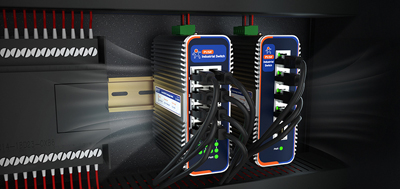
The G816 is truly fanless. Pure aluminum heatsink + large-area thermal conduction structure.
We ran a 72-hour full-load bake test — heatsink surface temperature: you can touch it directly with your hand. Warm. Not hot. Under 50°C.
No noise. Zero decibels.
In a mine distribution room, in an unmanned site at 2 AM — you'll forget it's even running.
Why does this matter for lightning protection?
Because a fan introduces two fatal problems: dust buildup in the fan bearings causing cooling failure, and the fan itself being an EMI source. In a lightning storm, the EMI environment is already terrible. Adding another interference source is pouring gasoline on a fire.
The G816 has no fan. No such problem.
Coastal monitoring boxes are palm-sized. Mine DTU cabinets need DIN rail. Desert PV brackets need a mini version.
The G816 comes in multiple form factors. No matter how weird your installation environment is, it fits.
You don't adapt the site to the device.The device adapts to your site.
Collection terminals use RS485. Cameras use RJ45. Alarms use DI/DO. O&M uses Wi-Fi.
Before, you needed: router + protocol converter + serial server + alarm module. Four devices, four failure points.
Now the G816 handles it all in one.
One less device = one less chance of getting burned by a surge.
The G816 natively supports Modbus, DNP3, IEC 61850, and other industrial protocols, with built-in multi-layer signal isolation and TVS surge protection.
Every external port — Ethernet, serial, DI/DO — has independent surge suppression circuits.
What does that mean?
It means when a lightning surge comes in along the signal line,it gets eaten before it ever reaches the router's internal circuits.
The terminal connects behind the router, separated by a wall of copper and iron.
Surge wants to burn the terminal?It has to get through the router first.
And the G816 itself — metal housing, professional grounding design, -40°C ~ +75°C wide-temperature operation — it passes that test.
| Comparison | Traditional (Terminal Direct + External Surge Protector) | G816 Solution |
|---|---|---|
| Device count | Terminal + 4G module + surge protector + protocol converter | One G816, done |
| Failure points | 4 | 1 |
| Annual lightning damage replacements | 2–4 terminal comms modules (~8,000–15,000 RMB) | 0 |
| O&M site visits | Required after every storm (6–10/year avg.) | Remote management, zero-touch |
| 3-year total cost | Device + O&M + damage ≈40,000+ RMB | Less than half |
You think adding a router is extra cost?
It's actually saving you three years of firefighting money.
Imagine a different scenario.
Still 2 AM. Still a lightning storm. Still Site 3 data down.
But this time, you're not woken up.
Because your phone pushes a notification:"Site 3 4G signal interrupted. Automatically switched to backup link. Data recovering."
You roll over and go back to sleep.
Next morning at site: collection terminals fine, comms modules fine, G816 quietly glowing green.
No burned circuit boards. No 20,000 RMB loss. No boss's interrogation.
Because when the surge came,the G816 ate it.
The terminal never even knew it happened.
I know your mindset when you're selecting equipment.
You don't fear spending money. You fear spending money and still having failures.
You don't fear buying expensive. You fear buying expensive and it not being as durable as the cheap one.
You don't fear complex tech. You fear having a problem and no one to call.
The G816 doesn't just solve the surge problem.
It solves the problem of being woken up at 2 AM by a phone call.
It solves the problem of dreading every lightning season.
It solves the problem of your O&M engineers driving to site a dozen times a year.
It solves the problem of always explaining to your boss "why it burned again."
A right router won't make your project perfect.
But it will let you sleep soundly on the worst night.
USR-G816.
5G Cellular Router.
Handles surges. Handles extreme environments. Handles your project site.
If your site is also in a lightning zone —
Stop adding surge protectors to the terminal.
Add a G816 instead.
After all, lightning storms come every year.
But your collection terminals don't have to be replaced every year.