Construction site network conditions tend to look alike:
① fixed broadband cannot reach the site — installation takes weeks while the schedule counts days;
② the site moves with the project and gets torn down months later;
③ plenty of equipment needs connectivity — camera backhaul, project-office work, tower-crane monitoring, PLCs and IoT devices. The network has to be self-built, and an industrial router plays the lead: insert a SIM and it works, 4G/5G serves as the uplink, the exit gets set up first, then the network extends outward.
A complete temporary network follows a fixed chain:
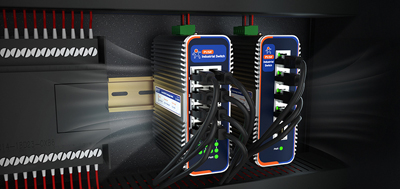
4G/5G Router (uplink exit) → Industrial Switch (wired expansion) → AP (wireless coverage) → CCTV / Laptop / PLC / IoT (end devices)
The router determines how fast this network runs, the switch determines whether there are enough wired ports, and the AP determines where WiFi reaches. Selection follows the chain from the exit toward the endpoints — fill in whatever is missing.
Cameras consume the bulk of the bandwidth. A single 1080P camera is typically estimated at 4 Mbps — 16 concurrent channels add up to 64 Mbps of upstream traffic. Cat 4 4G offers a theoretical 50 Mbps uplink, and real deployments rarely reach half of that, which falls short of this volume. Add project-office video conferencing and daily traffic on top, and a 5G model is the safer choice for sites backhauling multiple cameras; small stations running only a few cameras, or mostly PLC data, get by fine on 4G.
Large sites can look at the USR-G816: a 1.9 Gbps theoretical 5G downlink, SA/NSA dual-mode; three gigabit LAN ports plus one gigabit WAN/LAN, with the switch cascading from here; dual-band WiFi covering the project office; dual-SIM redundancy that switches to the backup card automatically when the primary loses service — with the two cards on different carriers. Sites sit in remote spots, and which carrier's signal works better cannot be known before arrival; dual SIM keeps that choice in hand.
Endpoint count decides port allocation:
Sites with complex port requirements can cover the first two levels with one USR-G809s: two gigabit fiber ports plus eight gigabit Ethernet ports, switching capability built in; the cellular module selectable among 5G, 5G RedCap, or 4G depending on budget; WiFi 6 covering the office area; dual serial ports and GNSS positioning as extras. On a medium site it merges Router and Switch into a single unit — one less purchase, one less installation, one less maintenance item.
Project-office work, phone inspections, and tablet monitoring all depend on WiFi. The router's built-in dual-band WiFi covers an office area adequately; open zones like living quarters and material yards need an AP added. For small-data, tight-budget sites, the USR-G806w's enhanced WiFi — two FEM chips and dual 5 dBi antennas — reaches several hundred meters in open environments, letting one device handle the uplink and the coverage at once; the 104×102×28 mm body mounts on a DIN rail or a wall.
Site conditions are harsh, and failed parameters all show up later as network outages. Five items to verify before installation:
On a site without broadband, build the network from the uplink toward the endpoints: count the cameras first to settle 5G versus 4G; count the endpoints next to settle one-device-two-levels versus router-plus-switch; then run the checklist on wide temperature, wide voltage, dual SIM, and remote management. The chain order is fixed, the parameters take one pass, and the industrial router selection narrows on its own.