The Daily Routine in Front of the Rack
A rack holds a few switches and disk arrays, each with an RS232 console port on the front panel. The most common approach: plug a USB to serial adapter into a laptop, log into one device, take a look, unplug, and move to the next. Run this routine long enough and the problems pile up in three places:
① Someone has to stand at the rack. Equipment sits in different rooms and on different floors — every alarm means walking to the site, at 2 a.m. if necessary.
② One device at a time. Keeping two device logs open side by side for comparison is not possible.
③ Drivers are never simple. USB to serial adapters depend on drivers on the computer side. On Apple Silicon Macs, driver support for many adapters lags behind, and intermittent communication after a "successful" connection is not rare.
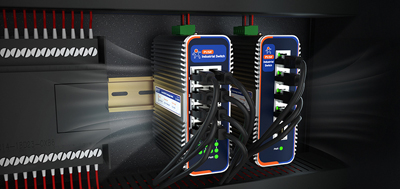
All three problems trace back to one cause: the serial ports are not on the network. Put them on the network, and the management model changes — that is exactly what a multi-port Serial to Ethernet Converter does.
Take a four-port unit (the PUSR USR-N540, for example). The whole deployment breaks into four steps.
Step 1: Wiring.The N540 provides 4 independent serial ports, one for each device's console port — switches and disk arrays take one channel each, leaving the rest for expansion. The serial side supports RS232/RS485/RS422; switch console ports are almost always RS232, so they connect directly.
Step 2: Networking.The converter has a single Ethernet port — connect it to the rack switch and assign an IP address. The 4 serial ports each map to a different TCP port, which works out to 4 independent "serial lines over the network."
Step 3: Choose the operation mode.Two are used most often:
UDP mode and HTTPD mode are also available; the latter can push serial data to a server directly via GET or POST.
Step 4: Use it.Two ways. One, install virtual COM software on the management PC, map the network port to a local COM port, and existing serial tools such as SecureCRT or minicom open and run with no configuration changes. Two, skip the virtual COM port and connect straight to "IP:port" with any TCP-capable terminal. The second option matters most for Mac users — no dependence on USB to serial adapter drivers anymore; any machine that can run a terminal will do.
For a small device count and a tight budget, a two-port unit (the USR-N520, for example) is enough; add ports as the fleet grows — the series runs from 2, 4, up to 8 ports. One rule decides it: the number of serial ports should be at least the number of devices under continuous management, plus one or two spares.
A console port attached to the network is an open control console for the device, and encryption is not a step to skip. The N540 and N520 support SSL/TLS encryption (in TCP Client, HTTP Client, and MQTT modes) with two-way certificate authentication, so remote sessions run through an encrypted channel.
On power and stability, both units accept a wide DC 5–36V input with reverse polarity protection, and a built-in watchdog resets the device automatically after a fault. The main chip runs an ST Cortex-M7 core at 400MHz — enough headroom for multiple serial ports transmitting simultaneously.
When devices are spread across multiple sites, they can also join the PUSR cloud platform for paired connections and remote maintenance, without setting up a VPN for each one.
Back to switches and disk arrays — the idea is the same: console ports into the converter, converter into the network. From any computer with network access, four terminal windows can be open at once, each logged into a different device. No more cable swapping, no more walking to the machine room.
For a single device, quick temporary debugging, with someone already standing at the rack — one cable is the most direct tool. Past three to five devices, or whenever remote access and continuous monitoring enter the picture, the gap opens up. At that point the question is no longer whether cable swapping is a hassle — it is whether remote access, simultaneous sessions, and a continuous record are possible at all.