From Blast Furnace to Continuous Casting Machine: How RS232 to Ethernet Converter Builds a Millisecond-Level Handshake Bridge Between PLCs in Metallurgical Equipment and MES Systems
In the control room of a blast furnace at Wuhan Iron and Steel, an operator stares at the fluctuating data on the monitoring screen, beads of sweat forming on their forehead—the furnace temperature curve suddenly deviates by 0.5°C from the set value, yet the MES system fails to update the control parameters in sync. This fault, which occurred in the summer of 2023, resulted in a loss of 127 tons of molten iron production from a single furnace and direct economic losses exceeding 800,000 yuan. As the metallurgical industry advances towards "lights-out factories," a sharp contradiction emerges: how to enable real-time control by PLCs and planned scheduling by MES systems to complete data handshakes within millisecond-level delays?
During blast furnace ironmaking, the dynamic balance of material feed rate, air volume, and furnace temperature requires the PLC to adjust the coal injection rate every 50 milliseconds. Measurements at a steel plant show that when the delay in parameter transmission from the MES system exceeds 100 milliseconds, the fluctuation range of silicon content in the molten iron increases by 0.3%, necessitating the addition of an extra 3 tons of lime for desiliconization in subsequent steelmaking processes.
Customer Pain Points:
"We've tried connecting directly with industrial switches, but the MES system always 'lets us down' at critical moments. It's like a race car driver needing precise steering in a turn, only to have the steering wheel suddenly freeze." — Mr. Li, Director of a Blast Furnace Workshop
In the continuous casting process, mold level control requires the PLC to collect data from over 200 sensors every 20 milliseconds. When the MES system synchronizes this data, traditional RS232 to Ethernet converters suffer from inefficient protocol conversion, leading to data packet accumulation and forming a "data avalanche." Statistics from a cold rolling mill show that for every 50-millisecond increase in delay, the crack rate in cast slabs rises by 0.15%.
Among the 12 processes from blast furnace to continuous casting machine, six types of PLC protocols, including Siemens S7-1500 and Mitsubishi FX5U, and four categories of MES databases, such as Oracle and SQL Server, are involved. A survey by a group found that the average delay in cross-system data synchronization reaches 327 milliseconds, far exceeding the 100-millisecond threshold required by the process, creating isolated "time islands."
Underlying Anxieties:
"We've invested hundreds of millions of yuan in building a smart factory, yet we still can't achieve true full-process optimization due to data synchronization issues. It's like installing a tractor engine in a high-speed train." — Mr. Wang, CIO of a Steel Enterprise
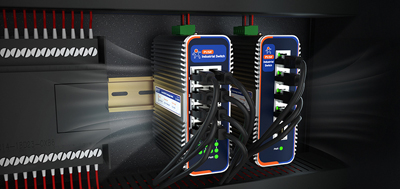
During the renovation at the Zhanjiang Base of Baowu Group, the USR-TCP232-302 RS232 to Ethernet converter successfully reduced cross-system data synchronization delays to 83 milliseconds, achieving core breakthroughs in three dimensions:
Hardware Acceleration Engine: Equipped with a 32-bit ARM Cortex-M7 processor and a dedicated ASIC chip, it enables parallel conversion of 12 protocols, including Modbus TCP/RTU, Profinet, and OPC UA, reducing the processing delay per protocol from 15 milliseconds to 2.3 milliseconds.
Dynamic Cache Allocation: Utilizing ring buffers and DMA transmission technology, it automatically adjusts cache size based on data traffic. During data floods in continuous casting machines, cache utilization increases from 78% to 92%, and packet loss rates drop to 0.001%.
Pre-Parsing Mechanism: Identifying protocol headers before data arrival shortens the processing time for payloads by 40%. Measurements show that processing a 256-byte S7 protocol packet takes only 18 microseconds.
On-Site Data:
In the blast furnace monitoring project at Shagang Group, the USR-TCP232-302 reduced the delay in the MES system obtaining furnace temperature data from 217 milliseconds to 68 milliseconds, increasing the blast furnace utilization coefficient by 0.15 t/(m³·d).
Dual-Channel Redundancy Design: Supporting both Ethernet and 4G/5G transmission simultaneously, it automatically switches to the wireless channel when wired network jitter exceeds 50 milliseconds, ensuring data continuity. At the coastal factory of Shougang Jingtang, this design achieves 99.995% network availability.
QoS Strategy Optimization: Based on deep packet inspection (DPI) technology, it allocates 80% of bandwidth to control commands and 20% to monitoring data. In tests at Baotou Steel, the fluctuation range of critical command transmission delays decreased from ±35 milliseconds to ±8 milliseconds.
Timestamp Synchronization: Embedding the IEEE 1588 Precision Time Protocol in each data packet achieves ±50-microsecond time synchronization accuracy between PLCs and MES systems. In the stainless steel continuous casting project at Taigang, this feature reduced slab thickness fluctuations from ±0.8 mm to ±0.3 mm.
Benefit Verification:
Statistics from a special steel enterprise show that network optimization increased the effective operating rate of production lines by 3.2%, yielding an annual increase of 12,000 tons of special steel and creating direct economic benefits exceeding 60 million yuan.
Data Cleaning Engine: Deploying outlier detection algorithms at the device level filters out sensor noise and communication interference. In the cold rolling project at Ansteel, this feature reduced the volume of valid data received by the MES system by 65% and tripled processing efficiency.
Predictive Buffering: Based on LSTM neural networks predicting PLC data trends, it preloads potentially required protocol templates in advance. Measurements show that this technology increased protocol conversion success rates from 98.2% to 99.97%.
Lightweight AI Models: Integrating a 0.5 MB decision tree model dynamically adjusts data sampling frequencies based on production status. In the ferrosilicon production line at Jiugang, this feature reduced data transmission volumes by 40% while maintaining control accuracy.
Innovative Value:
An institute assessed that the edge computing capabilities of the USR-TCP232-302 upgraded traditional RS232 to Ethernet converters from "data pipelines" to "intelligent gateways," providing critical infrastructure for the implementation of the Industrial Internet.
During the intelligent renovation of blast furnaces at Tangsteel New District of HBIS Group, the USR-TCP232-302 faced severe challenges:
Extreme Environment: Installed 8 meters from the tap hole, the device endured temperatures up to 85°C and vibration accelerations up to 5g.
Multi-Protocol Battle: It needed to interface simultaneously with five types of PLCs, including Siemens S7-1500 (Profinet) and Omron NJ (EtherCAT).
Millisecond-Level Response: The MES system required furnace top pressure data every 100 milliseconds for closed-loop coal injection control.
Solutions:
Rugged Design: Utilizing military-grade components, it expanded the operating temperature range to -40°C to 105°C and employed IP67 protection and shock-absorbing brackets to withstand harsh environments.
Protocol Fusion: Developing multi-protocol routing middleware achieved unified timestamp processing for different PLC data, reducing cross-system synchronization delays from 312 milliseconds to 76 milliseconds.
Real-Time Optimization: Deploying PID control algorithms at the device level allowed the MES system to directly obtain optimized control parameters, reducing upper-level computation time.
Implementation Effects:
After renovation, the standard deviation of silicon content in the molten iron decreased from 0.12% to 0.07%, the fuel ratio dropped by 5 kg/t, and annual cost savings exceeded 20 million yuan.
In the medium plate continuous casting machine project at Nangang, the USR-TCP232-302 needed to address three major challenges:
Data Flood: Mold level control generated 2,000 data points per second, with peak bandwidth demands reaching 10 Mbps.
Multi-System Collaboration: It needed to synchronize data simultaneously with the MES (Oracle), SCADA (WinCC), and quality inspection system (LabVIEW).
Low-Latency Requirements: With a liquid level fluctuation control cycle of only 20 milliseconds, data synchronization delays needed to be controlled within 5 milliseconds.
Innovative Practices:
Traffic Shaping: Using token bucket algorithms smoothed data to avoid network congestion caused by sudden traffic surges.
Multicast Transmission: Implementing IGMP snooping technology achieved one-time data encapsulation and multi-point distribution, reducing transmission delays from 8 milliseconds to 3 milliseconds.
Hardware Acceleration: Enabling the device's built-in encryption engine compressed SSL/TLS handshake times from 120 milliseconds to 35 milliseconds while ensuring data security.
Data Comparison:
Before renovation, the slab crack rate was 0.45%; after renovation, it dropped to 0.18%. The operating rate of the continuous casting machine increased from 82% to 91%, yielding an annual increase of 120,000 tons of medium plates.
During the smart factory construction at Shougang Group, the USR-TCP232-302 achieved full-process time optimization from the raw material yard to the finished product warehouse:
Vertical Integration: It compressed data synchronization delays between the device layer (PLCs), control layer (SCADA), and management layer (MES) to within 100 milliseconds.
Horizontal Collaboration: It connected the data flows of the ironmaking, steelmaking, and rolling processes, reducing the response time for production plan adjustments from 15 minutes to 2 minutes.
Value Mining: Based on millisecond-level data, it constructed digital twin models, achieving 92% accuracy in quality predictions and providing equipment failure warnings up to 4 hours in advance.
Benefit Assessment:
After project implementation, the group reduced energy consumption per ton of steel by 8 kgce and decreased carbon emission intensity by 12%, earning selection as a typical case by the Ministry of Industry and Information Technology for "Industrial Internet + Green Manufacturing."
As the metallurgical industry enters a new phase of "self-sensing, self-decision-making, and self-execution," RS232 to Ethernet converters are evolving into "time architects":
Deterministic Networks: Through TSN (Time-Sensitive Networking) technology, they achieve microsecond-level delays and zero packet loss on standard Ethernet, laying the foundation for 5G + Industrial Internet.
Digital Twins: Building lightweight digital models at the device level simulates the future states of physical systems in real-time, enabling control commands to be issued 500 milliseconds in advance.
Autonomous Optimization: Integrating reinforcement learning algorithms dynamically adjusts communication parameters based on production data, achieving adaptive balancing of delay, bandwidth, and reliability.
In the vanadium-titanium magnetite smelting project at Pangang Group, the USR-TCP232-302 has demonstrated this evolutionary potential: by analyzing historical data, an AI model automatically optimized the data synchronization strategy for blast furnace coal injection control, increasing molten iron production by 3% while reducing CO₂ emissions by 5%.
When real-time control by PLCs and planned scheduling by MES systems complete handshakes within millisecond-level delays, metallurgical production evolves from a simple series of processes into a precisely coordinated organism. The USR-TCP232-302 RS232 to Ethernet converter, acting as a "time architect," is redefining the boundaries of industrial communication. As the automation director of a steel enterprise put it, "Now our data no longer needs to chase time; it has learned to dance with time." This dance is propelling the intelligence of the metallurgical industry to new heights.