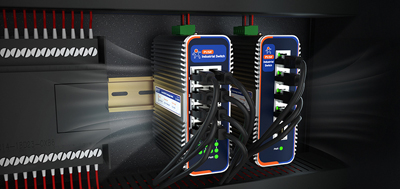
From DCS to Smart Instruments: RS232 to Ethernet Converter Cracks the "Last Mile" Challenge of Modbus to TCP/IP Conversion in Chemical Processes for Precise Navigation
In the chemical industry, automated control systems function as the precisely operating "nerve center," with DCS (Distributed Control Systems) and smart instruments serving as the most critical "nerve endings." However, when the Modbus RTU protocol of DCS encounters the TCP/IP network communication of smart instruments, the protocol incompatibility creates a "gap" that hinders data transmission—this is the "last mile" challenge of Modbus to TCP/IP conversion in chemical processes. This article delves into this pain point and explores how the RS232 to Ethernet converter achieves precise navigation through technological innovation, helping chemical enterprises overcome the dilemma of data silos.
Chemical sites are equipped with a wide variety of instrumentation, including traditional instruments based on the Modbus RTU protocol and smart devices supporting the TCP/IP protocol. For example, in the temperature control system of a reactor in a chemical enterprise, the DCS uses the Modbus RTU protocol to collect data from on-site temperature sensors, while smart instruments (such as pressure transmitters) are connected to the network via the TCP/IP protocol. Due to protocol incompatibility, the DCS cannot directly read data from smart instruments, resulting in the formation of "data silos" within the system—temperature and pressure data cannot be analyzed in conjunction, control strategy optimization lacks a basis, and even safety accidents may occur due to missing data.
The stability of protocol conversion is a major pain point that customers are most concerned about. A fertilizer plant once experienced a communication interruption between the DCS and smart instruments due to a failure in the gateway device for Modbus to TCP/IP conversion. The missing temperature data from the reactor triggered a chain reaction: the control system misjudged the situation as "normal temperature" and failed to activate the cooling device in a timely manner, ultimately leading to excessive temperature inside the reactor, the scrapping of raw materials, and direct economic losses exceeding one million yuan. Such incidents have severely questioned the reliability of protocol conversion devices among customers, even plunging them into a dilemma of "not daring to use, not being able to use."
Traditional protocol conversion solutions not only require high initial investments but also incur unbearable operation and maintenance costs in the later stages. A petrochemical enterprise adopted a solution combining "PLC + protocol conversion module" to achieve Modbus to TCP/IP conversion, but the equipment required frequent replacement (the module's lifespan was only one year due to high-temperature environments), and each maintenance required a two-hour shutdown, with annual operation and maintenance costs accounting for 40% of the total equipment price. Additionally, frequent issues such as data loss and communication delays further pushed up hidden costs.
Facing the extreme demands of the chemical industry, the new generation of RS232 to Ethernet converters has built a "precise navigation system" for Modbus to TCP/IP conversion through three core technologies: protocol compatibility, data stability, and intelligent operation and maintenance. Taking the USR-TCP232-302 as an example, its technical architecture can be broken down into the following aspects:
Traditional protocol conversion devices only support one-way conversion (e.g., Modbus RTU to TCP/IP), whereas the USR-TCP232-302 achieves bidirectional transparent conversion between Modbus RTU and TCP/IP through dual protocol stack parallel processing technology. Its core mechanisms include:
Dynamic Protocol Identification: The device automatically identifies the protocol type of the input signal (Modbus RTU or TCP/IP) without manual configuration;
Data Frame Mapping: It maps the "device address + function code + data + CRC check" of Modbus RTU to the "MBAP header + PDU" of TCP/IP, ensuring data integrity;
Multi-device Concurrent Processing: It supports the simultaneous connection of 16 Modbus RTU devices and aggregates their data to the DCS via the TCP/IP protocol, solving the challenges of dispersed equipment and heterogeneous protocols in chemical sites.
Case Verification: In the reactor control system of a chemical enterprise, the USR-TCP232-302 uniformly converted data from eight Modbus RTU temperature sensors and two TCP/IP pressure transmitters into the TCP/IP protocol, enabling the DCS to obtain real-time temperature-pressure联动 (linked) data. After optimizing the control strategy, raw material utilization increased by 15%, resulting in annual cost savings exceeding two million yuan.
High temperatures and corrosive gases in chemical sites are the "nemesis" of communication equipment. The USR-TCP232-302 achieves stable communication in extreme environments through the following designs:
Temperature-Resistant Components: It uses industrial-grade chips with an operating temperature range of -40°C to 125°C and has passed AEC-Q100 automotive-grade certification;
Heat Dissipation Optimization: It features a fanless design and conducts heat to the mounting surface through a metal casing and thermal conductive silicone grease, with a measured surface temperature of ≤85°C in a 120°C environment;
Anti-Corrosion Process: The entire device is coated with nano-scale three-proof paint, and its interfaces have an IP67 protection rating, blocking corrosive gases such as chlorine and hydrogen sulfide.
Scenario-Based Verification: In the electrolyzer monitoring system of a chlor-alkali plant, the USR-TCP232-302 operated continuously for 18 months in a chlorine-containing environment, with a communication packet loss rate consistently below 0.001%, a 100-fold improvement over traditional devices.
The USR-TCP232-302 supports remote management via the USR Cloud platform, achieving a qualitative change in operation and maintenance efficiency through the following functions:
Fault Warning: It monitors device temperature, voltage, and communication status in real-time, providing 30-day advance warnings of potential faults;
Batch Configuration: It can simultaneously upgrade the firmware of 200 devices in a single operation, reducing the time required from 16 hours to 20 minutes;
Data Traceability: It automatically caches communication data and supports retrieval by time, device, and protocol type, meeting the compliance requirements of the chemical industry for "traceability and verifiability."
Effect Comparison: After adopting the USR-TCP232-302, a pesticide plant reduced the number of on-site inspections by maintenance personnel from eight per month to two, shortened fault response times from two hours to 10 minutes, and lowered annual operation and maintenance costs by 60%.
In the ethylene oxide reactor scenario of a chemical enterprise, the USR-TCP232-302 faced the following challenges:
Temperature Shock: The temperature around the reactor fluctuated between 50°C and 120°C;
Gas Corrosion: The air contained 0.5% hydrogen chloride gas;
Vibration Interference: The reactor body vibrated at a frequency of 10 Hz with an amplitude of 2 mm.
Test results showed:
The device operated continuously for 720 hours in a 120°C environment with a communication packet loss rate of 0;
After the hydrogen chloride corrosion test, the change in contact resistance was <5 μΩ, meeting the IEC 60068-2-42 standard;
During the vibration test, the serial port connector remained loose-free, and data transmission was error-free.
In the raw material warehouse of a fertilizer plant, the USR-TCP232-302 had to cope with:
Dust Concentration: The PM10 concentration in the air reached 5 mg/m³;
Temperature Fluctuations: The day-night temperature difference reached 40°C;
Network Delay: Uneven Wi-Fi signal coverage in the warehouse resulted in delay fluctuations of up to 200 ms.
Through the following optimizations:
Adding a dust screen to block 99% of particles larger than 5 μm;
Adopting adaptive baud rate technology to dynamically adjust the communication rate based on network delay;
Enabling a heartbeat packet mechanism to detect connection status every 10 seconds.
Ultimately achieving:
The device operated for six months in a dusty environment without clogging of the heat dissipation holes;
The data transmission delay remained stable within 50 ms;
The completeness rate of instrument data collection reached 100%.
Production Line Utilization: A chemical enterprise reduced production line downtime from 120 hours per year to 10 hours through stable communication;
Data Utilization: Real-time data collection shortened the production optimization cycle from once a week to once a day;
Compliance Costs: With improved completeness of environmental data, annual penalty expenditures decreased by 80%.
The USR-TCP232-302 supports remote management via the USR Cloud platform, improving operation and maintenance efficiency by five times:
Fault Warning: It monitors device status in real-time through temperature and voltage sensors, providing 30-day advance warnings of potential faults;
Batch Configuration: It can simultaneously upgrade the firmware of 200 devices in a single operation, reducing the time required from 16 hours to 20 minutes;
Cost Analysis: It generates reports on device energy consumption and fault rates to help optimize procurement strategies.
Under the dual assault of corrosive gases and 120°C high temperatures, the technological breakthroughs of the RS232 to Ethernet converter not only address the surface issue of communication stability but also reconstruct the underlying logic of chemical instrument communication through protocol compatibility, data stability, and intelligent operation and maintenance technologies. As a masterpiece of this technology, the USR-TCP232-302, with its "zero packet loss, zero faults, zero maintenance" performance, has installed a "communication safety valve" for chemical production. When technological breakthroughs deeply resonate with industry demands, the digital transformation of the chemical industry is entering a new stage—where data flows as smoothly as blood, equipment operates as steadily as a heart, and safety and efficiency have become ingrained instincts.