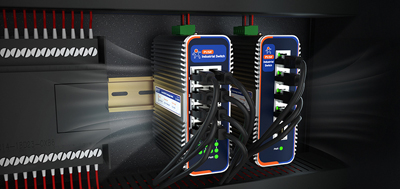
A common question that arises in industrial settings: in a Windows environment, can a remote serial device show up as a local COM port? The use case is common in process control, instrumentation, POS terminals, and PLC debugging — a classic "serial-over-IP" scenario.
For manufacturers who already have RS232 equipment on the floor, the more immediate question is whether an RS485 converter is still required to go Ethernet. This piece puts the rs232 to Ethernet converter side by side with the RS485 version, breaking down the differences, typical use cases, and selection method.
Three things: signal level, distance, and multi-device capability.
So at the "go Ethernet" step, both interfaces do the same job — transparently carry a byte stream onto TCP/IP. What actually drives the choice is how the existing field wiring is laid out.
The most reliable way is to check the connectors and the device manual. Common cases:
If the field has a single RS232 device (such as an older PLC, POS printer, or serial temperature/humidity sensor) and no plan to expand in the short term — a plain RS232-to-Ethernet converter is enough. USR-TCP232-302 is one option: one RS232 port, supports TCP Server/Client and UDP, and when paired with a virtual COM utility, it makes the host appear to "gain" an extra COM port without changing the upstream software. Heartbeat packets, registration packets, and customized RFC2217 are all built in for monitoring and remote parameter changes. Typical deployments include traffic signal collection and unattended weighbridges.
If multiple instruments are daisy-chained along a bus, or PLCs, variable-frequency drives, and sensors are in the mix, go straight to RS485-to-Ethernet. USR-TCP232-304 is a fit: one RS485 port with built-in multi-host polling and multi-device management — supporting multi-user access on the same bus without an additional polling master. Typical deployments are the same traffic and weighing scenarios where an RS485 bus is already in place.
That is another dividing line. Plain RS232/RS485 carries a raw byte stream; running Modbus is a different layer — Modbus RTU on the serial side, Modbus TCP on the Ethernet side, with a "Modbus gateway" translating between them.
If the field device already speaks Modbus RTU (which most PLCs, meters, and drives do), the converter should include a built-in Modbus gateway — otherwise the host either rewrites the protocol or writes its own serial polling, both of which add work.
When data needs to go straight to a cloud platform (AWS IoT, ThingsBoard, a private cloud), the converter should also support MQTT with SSL/TLS, saving a dedicated gateway box.
A typical landing point for this kind of requirement is the dual-port industrial model USR-TCP232-410s:
It covers the combined case where RS232 and RS485 both exist on the floor and data needs to reach the cloud directly, saving a dedicated gateway and the associated setup time compared with a single-port approach.
Returning to the opening question — making a remote serial device "look like" a local COM port — the answer is to pair a hardware converter with a virtual serial port utility.
Pure software approaches (com0com plus port redirection, for instance) also work, but only fit LAN environments with relaxed latency tolerance and no real RS232/RS485 signal levels. The byte stream is tunneled through TCP/UDP without ever going through a physical transceiver, which keeps the cost low but removes surge protection and ground isolation. Once real instruments are involved — or any cable runs through a plant floor with motor drives, inverters, or long distances — a hardware-based converter stays the more stable choice.
Compressing the above into three checks:
After running through the three, RS232 or RS485 is no longer the core question — the core is whether the interface matches the field, whether the protocol matches the host, and whether a separate gateway can be avoided. A one-line summary: in most industrial fields, a dual-port + Modbus gateway + MQTT setup (such as 410s) is more general and extensible than a single-port approach; for a single RS232 device used only for temporary debugging, a single-port RS232 converter (302) gives better cost efficiency. The rs232 to Ethernet converter choice, ultimately, comes back to the field itself — wiring distance, bus load, what protocols the host already speaks, and whether data is staying on the LAN or going to the cloud.