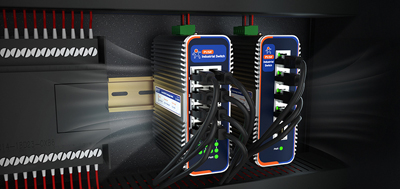
In the operation and maintenance systems of distributed photovoltaic and centralized solar power stations, remote monitoring is the core link for ensuring power generation efficiency and reducing manual inspection costs. As the key hub connecting on-site inverters, combiner boxes, environmental sensors, and cloud-based monitoring platforms, the service life of the 4G industrial router directly determines the long-term stability of the entire monitoring system.
Many practitioners new to selection tend to fall into the trap of "only looking at 4G/5G speed parameters," neglecting the special operating conditions of solar power stations. This leads to frequent equipment failures, significantly shortened service life, and ultimately higher life-cycle operation and maintenance costs.
This article will start from the actual pain points of power station sites, combined with extensive front-line implementation experience, to systematically outline the selection logic for long-life 4G industrial routers and provide professional, actionable references for beginners.
The deployment scenarios of solar power stations inherently carry three major characteristics: "unattended operation, extreme environments, and limited power supply." The underlying logic of all long-life selection decisions comes from long-term summarization of these on-the-ground pain points.
First is the extreme test of deployment environments: centralized photovoltaic power stations are mostly built in open areas such as deserts, mountainous regions, and water surfaces. In summer, equipment surfaces are subjected to prolonged direct sunlight, with internal ambient temperatures easily exceeding 70°C. In winter, some high-altitude areas see temperatures drop below -30°C. At the same time, sites are accompanied by harsh conditions such as sandstorms, high humidity, and strong lightning. Ordinary consumer-grade routers in such environments typically experience component aging and interface corrosion within 1-2 years, far from surviving the station's 25-year design operation cycle.
Second is the O&M constraint of unattended scenarios: a large number of photovoltaic station sites are dispersed, with many areas inaccessible to vehicles. A single on-site maintenance trip can easily cost thousands of yuan in transportation and labor. Some remote stations even require cross-province personnel dispatch. Once a router fails, it not only causes interruption in power generation data transmission but may also miss critical windows for detecting efficiency-affecting issues such as inverter anomalies and module shading. The hidden cost of frequent equipment replacement is far higher than the router's purchase price itself.
Third is the inherent limitation of solar power supply: many photovoltaic monitoring points have no external grid power and rely entirely on solar panels plus batteries for power supply. If the router has excessively high power consumption, it significantly increases the load on the power supply system—not only raising the hardware cost of photovoltaic monitoring units but also causing power shortages and system crashes during extended cloudy or rainy periods, indirectly shortening the equipment's actual online service life.
Finally, there is the stability requirement for long-term operation: power station monitoring systems require uninterrupted online operation 365 days a year. If the router lacks hardware-level fault self-recovery capabilities, it is prone to cache overflow and system freezes after prolonged operation, requiring manual on-site reboots—completely incompatible with unattended O&M requirements.
Moving beyond the "specs-only" mindset and starting from the full life-cycle usage scenarios of solar power stations, selection of long-life 4G industrial routers must cover four core professional dimensions—none of which can be overlooked.
The foundation of long service life is the hardware's environmental tolerance capability. Quality models must feature all-metal cold-rolled steel or aluminum alloy enclosures with fanless cooling structures to prevent sand and dust accumulation from blocking heat dissipation channels. All core components should be industrial-grade automotive-grade materials, with an operating temperature range covering -40°C to 85°C. The unit must achieve at least IP30 protection rating, with interfaces designed for corrosion resistance, surge suppression, and lightning protection—physically resisting the erosion of high temperatures, low temperatures, sandstorms, and lightning to prevent premature component aging.
For solar-powered scenarios, the router's typical operating power consumption must be controlled within 3W, while supporting a wide voltage input range of 7V~32V to adapt to the voltage fluctuation characteristics of photovoltaic batteries, preventing sudden voltage changes from impacting the power module and causing hardware damage. Low-power design not only reduces the load on the power supply system but also minimizes the equipment's own heat generation, further slowing the aging rate of internal components and indirectly extending the equipment's service life.
Long service life does not mean "never fails," but rather the ability to autonomously recover from temporary anomalies without manual intervention. The router must incorporate both software and hardware watchdog technologies, enabling automatic reboot recovery when system freezes or process anomalies occur. At the same time, it should be equipped with multi-level link detection mechanisms, using PPP heartbeat, ICMP probing, and other methods to monitor network status in real time, with automatic reconnection upon disconnection. Support for dual SIM cards or multi-link backup (wired + cellular) is essential, allowing automatic switching when a single carrier network fails, preventing prolonged offline periods that accelerate equipment aging and lead to neglect.
Many routers have short service lives not because of hardware damage, but because the embedded system exhausts resources after long-term operation and vulnerabilities cannot be patched. Quality long-life models employ lightweight embedded systems with minimal background redundant processes, preventing cache accumulation even during extended operation. Additionally, manufacturers should provide at least 5 years of firmware iteration maintenance, continuously patching system vulnerabilities and ensuring that the device remains compatible with new monitoring platform protocols years later, avoiding premature retirement due to software obsolescence.
Determining whether a router can truly achieve long service life in power station scenarios cannot rely solely on manufacturer marketing materials. Cross-verification through industry-recognized validation dimensions is essential—this is the core support for selection credibility.
First, confirm the device's industrial-grade certification credentials, such as EMC anti-interference certification, lightning protection test reports, and high/low temperature aging test reports. These third-party testing data are objective proof of hardware reliability, far superior to manufacturer claims.
Second, examine the device's track record in bulk deployments. Prioritize models that have been operating for over 3 years in domestic centralized photovoltaic power stations of 10MW or larger, as well as hundreds of thousands of distributed photovoltaic monitoring points. Products validated through large-scale real-world operating conditions often achieve Mean Time Between Failures (MTBF) exceeding 100,000 hours—far higher than products from small manufacturers.
Finally, confirm the manufacturer's full life-cycle service capability—whether they can provide long-term spare parts support and technical integration services. This prevents scenarios where, when the device eventually fails, the original model has been discontinued and cannot be replaced, forcing complete retrofitting of the monitoring point.
Based on the above selection standards and long-term validation experience from numerous domestic photovoltaic power stations, a 4G industrial router meeting all dimensional requirements can achieve an actual service life of 5-8 years under normal O&M conditions—with some well-maintained scenarios even exceeding 10 years—far surpassing the 2-3 year lifespan of ordinary consumer-grade routers. The average life-cycle cost is actually lower.
For beginners new to selection, there is no need to blindly pursue excessive 5G high-bandwidth specifications. By prioritizing the core indicators of hardware environmental tolerance, low power consumption, and fault self-recovery, and then matching interface quantity and protocol integration requirements based on the specific power station, one can select a truly suitable long-life 4G industrial router for solar power station scenarios, laying a solid foundation for the long-term stable operation of the entire remote monitoring system.