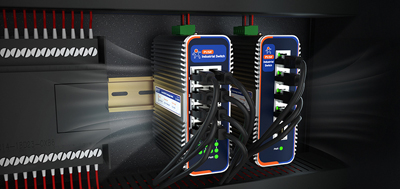
For a serial to Ethernet converter, one of the most confusing moments after deployment is when the network-side connection is established but the device side simply delivers no data. A successful connection only means the TCP handshake completed; it says nothing about whether the two ends are actually configured to match. Treating "connected" as "correctly configured" is the most common misjudgment in this kind of problem.
Here is one such case: a testing instrument with Windows-only drivers, whose companion software only recognizes local COM ports. On site, the instrument was connected to a serial to Ethernet converter, and virtual serial port software was used to recreate a COM port on the PC for the software. The TCP connection showed as established, yet the software kept receiving nothing. The whole link consists of two segments — the serial segment and the network segment — and a successful connection only proves the network segment. Troubleshooting typically follows the 10 checks below, starting from serial parameters, the most frequent culprit. The list runs from the simplest causes to the more hidden ones, and most cases are resolved within the first five items.
1. Match the serial parameters first— Baud rate, data bits, stop bits and parity on the converter must exactly match the device. Parity is not limited to none/even/odd: Space and Mark also exist, and more than a few field cases fail here. Changed parameters usually only take effect after a restart or power cycle — worth remembering when "changes do nothing".
2. Check the wiring— RS232 TX/RX must be crossed (pins 2 and 3 swapped) with a common ground; on RS485, keep A and B straight, because reversed polarity typically shows up as "connection fine, no data". If a dual-port model with both RS232 and RS485 is available (such as the USR-TCP232-410s, whose two ports work simultaneously), use the second port as a reference to quickly tell a wiring issue from a device issue.
3. Confirm the TCP roles pair up— A TCP Server needs a TCP Client on the other end: when the converter runs as Server, the host software or virtual serial port connects to it as Client; if both sides are Servers, no connection is ever made, and if both are Clients, nobody initiates. Selecting the wrong work mode is a leading cause of "cannot connect" or "connected but silent". The USR-TCP232-410s supports modes including TCP Server, TCP Client, UDP Client, UDP Server and Httpd Client — check this item first.
4. Keep the port numbers aligned— The remote port entered on the host must equal the local listening port of the converter. When a non-default port is used, the PC firewall must allow that port as well. In UDP mode, double-check that the remote IP and port are correctly paired.
5. Do not let data-transforming modes get in the way— Modes such as Modbus gateway, edge acquisition, MQTT and NVT process only messages of their own protocol; for example, custom data sent directly in Modbus gateway mode often gets no response. For pure data pass-through, choose a plain TCP/UDP transparent mode. When in doubt, connect a network debugging tool directly to the converter and send a block of hex data: if it echoes back unchanged, the mode is not the problem.
6. Check the virtual serial port side— When software only recognizes COM ports, virtual serial port software (PUSR's USR-VCOM does exactly this) maps the network connection back to a local COM port. Common mismatches: the created COM number is already occupied, the software opens a different COM number, or the driver does not match the OS bitness. In a point-to-point setup between two converters, remember to configure one end as Client and the other as Server.
7. A reachable network path is not an open port— Verify that the converter and the PC are on the same subnet, the gateway is correct, the switch port VLAN is right, and the PC firewall permits the port. Ping only proves IP-layer reachability; an actual TCP connection test with a debugging tool is what proves the port is open. For sites accessed across networks, the same rule applies to the VPN tunnel or the port-forwarding rules on the router at either end.
8. Split the problem in two— Break the link into the serial segment and the network segment: use a serial debugging tool to talk directly to the serial side of the converter, and a network debugging tool to open a TCP connection on the network side. Once it is clear which segment works and which does not, the search area shrinks by half.
9. Unstable power is a silent killer— Insufficient power causes the device to reboot repeatedly, which shows up as intermittent connections and occasional data loss. In industrial settings, a model with wide-voltage DC input and dual hardware/software watchdog (the USR-TCP232-410s supports both) removes a large share of such "mysterious" faults.
10. Restore factory defaults when settings are messed up— When parameters are scrambled and the management interface is no longer reachable, a model with a Reload button (supported by the USR-TCP232-410s) can be restored with a long press, then reconfigured from a minimal baseline. If everything still fails, cross-test with a known-good converter to tell a device fault from a configuration issue.
For sites that connect only one kind of serial device, single-port options such as the RS232-only USR-TCP232-302 or the RS485-only USR-TCP232-304 also fit tighter budgets.
When evaluating a vendor, look at whether its documentation explains that "connection established does not equal data flowing": whether default parameter tables, factory-restore procedures, virtual serial port manuals and work-mode guides are complete, and whether free debugging tools are provided. Almost every deployment runs into a "connected but not communicating" situation at some point, and the quality of documentation and support shows itself right there. Field experience points the same way: a large share of "broken" serial servers turn out to be configuration issues rather than hardware faults, which is why clear manuals and responsive support matter as much as the specifications on the datasheet. A successful connection is only the beginning; smooth data flow is the real test of a serial to Ethernet converter.