In modern manufacturing environments with multiple workstations and cross-workshop production scenarios, distributed weighing systems have become the core data backbone for material flow, recipe batching, and finished product verification. Many enterprises encounter a common pain point when deploying such systems: timestamps of weighing terminal data across different production lines are misaligned, batch measurement records are chronologically disordered, and even after a batch of material is weighed in Workshop A, the system in Workshop B still shows no update—ultimately leading to batching errors and inventory reconciliation discrepancies.
These issues are not due to insufficient precision of the weighing sensors themselves, but rather the lack of a unified time reference among multiple terminals. Traditional solutions relying on local crystal oscillators for timekeeping can see a single device drift by over 1 second after just one week of operation, and the time difference across multiple terminals in different workshops can even reach several seconds, directly disrupting the data coordination logic of distributed weighing systems.
From a technical perspective, synchronization faults in distributed weighing systems are mainly concentrated in three core areas.
Many workshops use movable weighing platforms with swivel casters. After being relocated across production lines, the tilting of the unit can trigger misalignment of the built-in gravity metrology reference and mechanical origin sensors. This not only causes measurement deviations but also causes the local RTC clock frequency to drift randomly with mechanical vibration. The greater the displacement, the more severe the subsequent time misalignment.
In traditional solutions, each weighing instrument relies on its own crystal oscillator for timekeeping. Different devices have inherent differences in crystal accuracy. Combined with temperature and humidity fluctuations in the workshop environment and long-term equipment aging, a single device can accumulate a time error of over 1 second per day. Over a month, the cumulative deviation can exceed dozens of seconds, directly preventing weighing data uploaded from different workstations from being sequenced according to the actual production timeline.
Many enterprises attempt to use NTP over the local area network for time synchronization. However, workshop networks experience heavy packet contention from numerous industrial devices, causing significant network latency jitter. The resulting synchronization accuracy can only reach the hundred-millisecond level, which is far from meeting the millisecond-level timing alignment requirements of distributed weighing systems, nor can it support subsequent Sequence of Events (SOE) recording requirements.
To thoroughly resolve the issue of unsynchronized measurement data across workshops, combining GPS clock synchronization technology with a serial to Ethernet converter is currently the most cost-effective and easiest-to-implement solution in industrial scenarios.
The core logic of GPS clock synchronization relies on high-precision atomic clocks aboard satellites. By receiving timestamp signals from multiple satellites, it calculates UTC standard time at the nanosecond level, and then distributes a unified time reference to every terminal device through a time service network, fundamentally eliminating time drift across multiple terminals.
To further enhance reliability, current mainstream solutions adopt hybrid GPS+BeiDou multi-system time service. Even if one satellite system's signal is temporarily obstructed by the workshop structure, it can quickly switch to the other system to maintain a stable time reference.
In the actual implementation chain, the serial to Ethernet converter plays a critical role as the "time reference relay hub." Most traditional weighing instruments are equipped only with RS232/485 serial ports and do not natively support network time protocols, making direct connection to an NTP network impossible for synchronization. The serial to Ethernet converter simultaneously performs two core functions: on one hand, it converts serial data from distributed weighing terminals into network packets for upload; on the other hand, it distributes the standard time signal output from the GPS clock source to each weighing instrument with precision via the serial port, completing full-chain time alignment.
Deploy a GPS clock device supporting multimode time service in the workshop weak-current room. It outputs a 1PPS pulse-per-second signal and NMEA messages containing complete time information, tracing the entire plant's time reference to a unified UTC standard, with timing accuracy stably controlled within 30 ns.
Connect the GPS clock's time service serial port to the serial to Ethernet converter. Leveraging the converter's transparent transmission capability, standard time messages are synchronously forwarded to all distributed weighing terminals across workshops. Meanwhile, transmission latency is reduced by optimizing the serial baud rate. Experimental data shows that when the baud rate is set to 115200, the average serial transmission delay is only 0.29 ms, which fully meets the timing accuracy requirements of weighing instruments.
Upon receiving the standard time message, each weighing terminal automatically calibrates its local RTC clock. By further comparing the phase of the 1PPS pulse, the time deviation among all terminals is controlled to within hundreds of microseconds, thoroughly resolving the timing misalignment issue in cross-workshop weighing data.
Additionally, this solution can be integrated with the maintenance process of movable weighing platforms. After equipment relocation and leveling are completed, the serial to Ethernet converter can quickly perform a secondary time synchronization of the terminal, avoiding timing disorder in measurement data caused by displacement.
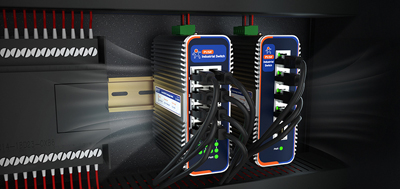
Among the many industrial-grade serial to Ethernet converter products, the USR-TCP232-410s is a highly suitable choice for such distributed weighing synchronization scenarios. Its hardware design fully accommodates the complex environment of industrial workshops, supporting wide temperature and wide voltage operation, and can work stably in production sites with high dust and strong electromagnetic interference.
In time service forwarding scenarios, its serial transparent transmission latency is extremely low, supporting up to 115200 baud rate, which fully matches the transmission requirements of GPS time service messages without introducing timing errors caused by forwarding delays.
At the same time, it supports flexible switching between TCP Server and TCP Client modes. In a distributed weighing system, it can act as a Server to simultaneously connect up to 8 weighing terminals for broadcasting time messages, or as a Client to actively connect to the plant's GPS time server, establishing connections on random ports to avoid server filtering of reconnection requests and ensuring uninterrupted 7×24 hour time service links.
Many manufacturing enterprises that have already deployed this solution report that after the GPS synchronization system with this serial to Ethernet converter was put into operation, the time deviation among all distributed weighing terminals across workshops is stably controlled within 1 ms, thoroughly resolving the long-standing issue of batch data timing misalignment. The overall error rate of batching metrology has decreased by 40%, significantly improving the efficiency of cross-workshop material flow reconciliation.