Smart factory networking proposals are notorious for one thing: hundreds of pages long, dozens of devices listed, but once deployed on-site — half are unused, half aren't enough.
The reason is simple: most proposals are reverse-engineered from an "ideal architecture," not forward-engineered from "on-site reality."
Anyone who's actually run projects knows that smart factory networking boils down to two things: can the data be collected, and once collected, can it be used? Collection depends on theIndustrial Router. Usability depends on the Industrial Computer (IPC). Every other device exists solely to solve specific obstacles encountered along the way — add it if needed, skip it if not.
Don't treat an Industrial Computer like a regular PC. On the smart factory floor, it does three things:
① Protocol unification.
Modbus, Profinet, OPC UA, GigE Vision — it's a mess on the production line. Run edge software or deploy protocol conversion services directly on the Industrial Computer: ingest all protocols southbound, output unified MQTT northbound. One Industrial Computer is a software gateway — no need to buy a separate edge gateway.
② Data usability.
Collected data gets cleaned, aggregated, and judged locally on the Industrial Computer. Visual inspection runs inference on the Industrial Computer's GPU. OEE is calculated in real time on the IPC. Alarms are triggered directly from the IPC. Data that doesn't reach the Industrial Computer is just noise.
③ Environmental resilience.
Fanless, -40°C~85°C, IP65, IEC60068 certified — these aren't specs to brag about. They're the baseline for three years of stable operation on a production line.
A factory isn't an office where you can just reboot after a network drop. One minute of downtime on a production line can cost tens of thousands.
The Industrial Router solvesreliable transmission + wide-area interconnection:
The Industrial Computer handles "collect and use." The router handles "transmit and connect." Lock these two down, and the skeleton is up.
Pain Point 1: Protocol chaos → The Industrial computer itself is the answer
Many proposals push an edge gateway right away — costing ten to twenty thousand yuan. But if there are fewer than 5 protocol types on-site, running edge software on the Industrial Computer does the same job: Modbus, OPC UA, MQTT, all handled. Save the cost of an entire device.
Only when protocol types exceed 10 and data volume is massive do you need a dedicated edge gateway for traffic splitting.
Pain Point 2: Real-time performance not met → Industrial computer + Industrial Ethernet Switch (ring network)
Visual inspection and robot coordination require jitter under 1ms. The Industrial Computer alone can't deliver this — you need real-time industrial Ethernet.
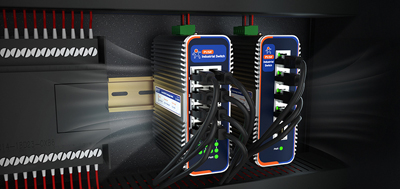
The solution is simple: connect an industrial Ethernet switch below the Industrial Computer, build an ERPS ring network, run Profinet IRT or EtherCAT. Switchover under 50ms, jitter under 1ms — at a fraction of the cost of a full real-time controller.
If the line has no motion control requirements, this layer can be skipped. A standard gigabit industrial Ethernet switch is sufficient.
Pain Point 3: Environment too harsh → The Industrial computer and router are already industrial-grade
This is actually the least of your worries. Industrial Computer and Industrial Routers ship built to industrial standards: -40°C~85°C, wide-voltage input, EMC Level 4, fanless. Get these two cores right, and 80% of environmental challenges are already solved.
One thing to watch: power supply. Voltage instability is normal on factory floors. Both the Industrial Computer and router must be paired with an industrial-grade UPS. This is not optional — it's mandatory.
Pain Point 4: Old and new can't connect → Serial-to-Ethernet Converter / Industrial DTU, add as needed
70% of factories have legacy equipment without Ethernet support. This is the most classic "add-only-if-needed" scenario:
| Legacy Device Type | What to Add | Cost |
|---|---|---|
| Old PLC (serial) | Serial-to-Ethernet Converter × N | A few hundred yuan per unit |
| Distributed sensors (no network) | Industrial DTU × N | A few hundred yuan per unit |
| Old meters (Modbus) | Industial computer connects directly — no extra device needed | ¥0 |
Rule: if the Industrial Computer can connect directly, never add an intermediate device. If conversion is mandatory, one serial-to-Ethernet converter does the job — don't add a gateway.
| Scenario | Core Configuration | What to Add | Budget |
|---|---|---|---|
| Legacy line retrofit | Industrial computer ×1 + Industrial Router ×1 | Serial-to-Ethernet Converter × several | ¥10K~30K |
| Single workshop smart upgrade | Industrial computer × 2~4 + Industrial Router ×1 | Industrial Ethernet Switch (ring) + Serial-to-Ethernet Converter as needed | ¥80K~200K |
| Multi-site group | Industrial computer cluster + Industrial Router (SD-WAN) | Industrial Ethernet Switch + 5G CPE + Edge gateway as needed | ¥300K+ |
Smart factory networking isn't a device competition — it'sproblem-driven.
Protocol chaos? Industrial Computer collects it. Real-time gaps? Add a ring switch. Harsh environment? Industrial Computer and router handle it. Too much legacy gear? Serial-to-Ethernet converter fills the gap.
Nail down the Industrial Computer and Industrial Router as the two cores first. Everything else is a patch — apply it where it's needed. That's how you get big results with a lean budget.