Smart Hotel Room Control: Industrial Panel PC Voice Interaction and One-Touch Scene Mode Switching Reshape the New Benchmark for Accommodation Experience
In traditional hotels, room control often relies on cumbersome physical switches and remote controls. Guests struggle to operate devices in unfamiliar environments, and delayed service responses further degrade the experience. Hotel managers face deep-rooted pain points such as high equipment maintenance costs, inefficient energy consumption management, and low service efficiency. As IoT technology penetrates hotel scenarios, an intelligence revolution centered on "guest experience" is underway—the voice interaction and one-touch scene mode switching of industrial panel PC are quietly redefining the warmth and efficiency of accommodation services.
Upon checking into a traditional hotel room, guests often fall into "device operation anxiety": scattered light switches, delayed air conditioning adjustments, manual curtain control, and even the need to call the front desk for basic needs. A high-end hotel once reported that guests spent an average of 12 minutes familiarizing themselves with room devices, with 35% of nighttime complaints stemming from difficulty finding switches. This "transition period" not only drains guests' energy but also makes hotel services seem "cold and distant."
Traditional room services rely on manual inspections and phone responses, but high labor costs and slow response times are a contradiction. For example, after a guest presses the "please clean" button, housekeeping staff must confirm requests floor by floor, with an average response time exceeding 20 minutes. Nighttime air conditioning failures may delay repairs due to insufficient staff, directly affecting guests' sleep quality. This "reactive service" model makes it difficult for hotels to meet modern consumers' expectations for "immediacy."
Traditional room control lacks data support, leading to inefficient energy management. A chain hotel survey revealed that guests forgetting to turn off air conditioning or lights resulted in an average of 5 kWh of additional energy consumption per room daily. Frequent use of mechanical switches increased equipment failure rates by 40%, raising annual maintenance costs by tens of thousands of yuan. These "hidden costs" continuously erode hotel profits, becoming pain points managers cannot ignore.
The core breakthrough of industrial panel PC lies in transforming "physical operations" into "natural conversations." Take USR-SH800 as an example: its built-in iFLYTEK voice engine supports 21 dialect recognitions. Guests can simply say commands like "dim the lights" or "open the curtains," and the system responds in milliseconds via NPU (Neural Processing Unit). More critically, voice interaction breaks down "device silos": guests can control TVs, air conditioners, curtains, and even place food orders or schedule wake-up calls through the hotel service system, turning the room into an "all-scenario smart terminal."
Scenario-Based Cases:
Night Mode: Guest says, "I'm going to sleep," and the system automatically turns off lights, closes curtains, adjusts air conditioning to 26°C, and activates "Do Not Disturb."
Reading Mode: Voice command "turn on reading light," and the system only activates the bedside lamp at a soft brightness to avoid disturbing others.
Emergency Assistance: Guest shouts "help," and the system immediately triggers an SOS alert, notifies security personnel, and pushes the room location.
This "conversational service" simplifies operations and makes guests feel "understood"—technology is no longer a cold tool but a partner that understands needs.
Another innovation of industrial panel PCs is achieving device coordination through "scene modes." USR-SH800 supports custom scene configurations, allowing hotels to preset modes based on time or guest type:
Welcome Mode: Upon card entry, the system automatically turns on corridor lights, plays welcome music, and sets air conditioning to a comfortable temperature.
Meeting Mode: In business rooms, a voice command "start meeting" closes curtains, dims lights, and activates the projector.
Energy-Saving Mode: The system detects guest departure and automatically turns off non-essential devices, retaining only basic power for refrigerators.
Data Support:
After deploying USR-SH800, a five-star hotel reduced guest device operation time from 12 minutes to 2 minutes, with scene mode usage reaching 85%. Smart energy-saving strategies cut average daily room energy consumption by 30%, saving over 100,000 yuan in annual electricity costs.
Industrial panel PCs not only serve guests but also empower hotel management through data collection and analysis. USR-SH800's built-in edge computing module monitors equipment status, energy consumption, and guest behavior in real time:
Equipment Health Alerts: Detect air conditioning motor abnormalities via current and temperature sensor data to prevent sudden failures.
Guest Preference Analysis: Track frequently used scene modes (e.g., "reading mode" usage frequency) to optimize room services.
Precision Energy Management: Generate energy consumption reports by area and time to help hotels formulate differentiated energy-saving strategies.
Management Benefits:
A chain hotel optimized housekeeping inspection routes by 20% and reduced equipment failure response times to under 5 minutes through USR-SH800 data analysis, boosting guest satisfaction by 15 percentage points.
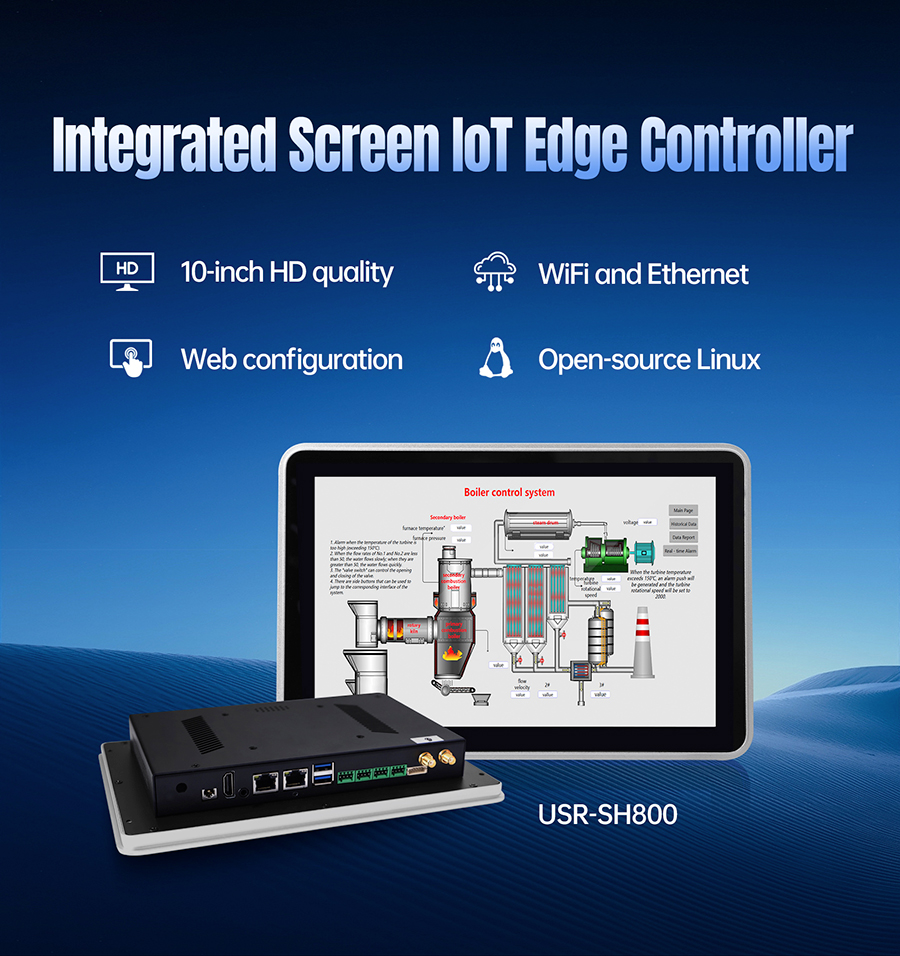
Among industrial panel PC, USR-SH800 stands out with three advantages: performance, scenario compatibility, and ecosystem openness:
Performance Leadership: Equipped with an RK3568 quad-core processor and 1.0 TOPS NPU, it supports multitasking and AI voice interaction, maintaining smooth responses even under high concurrency.
Scenario Compatibility: Offers 2 RS485 ports, 2 Ethernet ports, and HDMI output for seamless integration with existing hotel PLCs, door locks, and audio-visual systems, reducing renovation costs.
Ecosystem Openness: Supports integration with mainstream platforms like Alibaba Cloud and Huawei Cloud and includes Node-RED low-code development tools for custom scene logic and service workflows.
Practical Application Case:
A Sanya resort hotel achieved "contactless service" with USR-SH800's voice interaction and scene modes: guests operated no physical devices from check-in to checkout, with room occupancy rising 20% during the pandemic. Collected guest behavior data also increased repurchase rates for themed rooms like "family rooms" and "senior rooms" by 35%.
The proliferation of industrial panel PCs is driving the hotel industry from "device intelligence" to "spatial intelligence." In the future, with the integration of 5G and digital twins, room control will further transcend physical boundaries:
Cross-Space Collaboration: Guests booking restaurant seats via voice in their rooms automatically trigger table air conditioning adjustments.
Predictive Services: AI algorithms anticipate regular guests' preferences for drinks or room humidity adjustments based on historical data.
Carbon Neutrality Practices: Energy consumption data and carbon footprint models help hotels achieve green operations, attracting ESG investments.
When technology truly "hides behind the scenes" and services return to being "people-centric," the value of smart hotels will extend beyond efficiency gains to become a "third space" connecting emotions and experiences.
From "device operation" to "conversational spaces," and from "single control" to "scenario intelligence," the evolution of industrial panel PCs essentially reflects the hotel industry's deep understanding of "guest needs." The value of USR-SH800 lies not just in its hardcore technical specifications but in how it makes technology serve people—through natural voice interactions, proactive scene adaptations, and transparent data management, it upgrades rooms from "accommodation spaces" to "warm, intelligent entities." When guests open their room doors, they are greeted not by cold switches but by a "smart space that understands needs, thinks, and evolves"—perhaps this is the most captivating vision of future hotels.