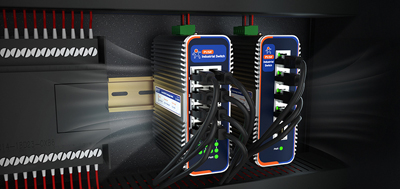
The essence of smart logistics networking is not "networking." It's "making sure not a single frame of data is lost in the harshest environments."
Dust-filled warehouses with wild temperature and humidity swings. Vibration-rattled trucks with extreme temperature differentials. Outdoor terminals left unattended in wind and rain. Distribution centers that never sleep — 7×24, no exceptions. Any one of these four scenarios is an ultimate stress test for communication equipment.
Why do traditional solutions always fail? Because they take the office network playbook and drop it straight into the industrial field.
This solution starts from the Industrial PC and builds the networking architecture layer by layer. No buzzwords. Just what actually works on the ground.
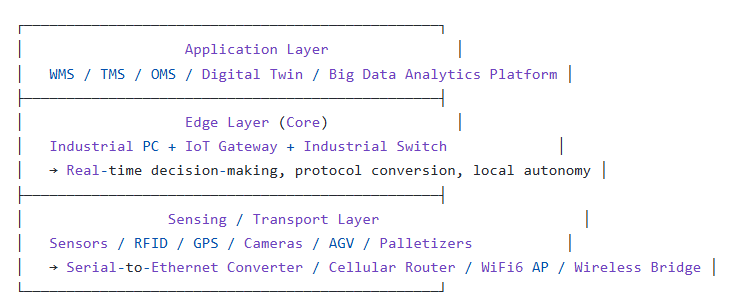
Core Principle: If the edge can handle it, it never goes to the cloud. If the cloud should own it, the edge never carries it.
Pain Points:
AGVs, palletizers, RGVs, shuttle cars — all running in the same warehouse, alongside RFID tags stacked on every shelf and temperature/humidity sensors everywhere. Device brands are all over the place, and communication protocols range from RS485 to Modbus TCP and everything in between. To make it worse — dense metal shelving blocks everything, and WiFi signal is a disaster.
Networking Solution:
| Function Module | Core Device | Selection Key Points |
|---|---|---|
| AGV Main Controller | Embedded Industrial PC (fanless, wide temp -20~60℃) | Connects to motor drives, LiDAR, safety bumper sensors via RS485/232 serial + I/O; runs ROS/autonomous navigation algorithms |
| AGV Wireless Roaming | WiFi6 Dual-band Industrial AP + WiFi6 Client Module | Seamless roaming across multiple APs, handoff < 50ms, ensuring uninterrupted real-time data exchange between PLC and WMS/WCS |
| AS/RS Palletizer / Stacker Crane | Industrial-grade Directional Wireless Bridge (2.4G+5G dual-band redundancy) | One unit at each end of the aisle, building point-to-point redundant links — replaces hard-to-wire cable solutions, ensures real-time PLC communication for up to 18 stacker cranes |
| RGV / Shuttle Car Comm | WiFi6 Industrial AP + Dual-band Industrial Wireless Client | Dead-zone-free coverage across operation area, supports PROFINET, EtherNet/IP, Modbus TCP and other industrial protocols |
| Elevator Linkage Control | Edge Computing Gateway (with I/O expansion + dual-band WiFi) | Real-time sensing of AGV arrival signals and elevator status, auto-controls door open/close and lifting, latency < 100ms |
| Smart Shelf / Inventory Tracking | Low-power Bluetooth Beacons + UWB Base Stations | Bluetooth beacons (coin-cell battery, 5-year life) for shelf-level positioning; UWB for centimeter-level tracking of high-value assets |
| Charging Station Energy Monitoring | WiFi Serial-to-Ethernet Converter + YouRen Cloud Platform | Collects meter/sensor data, remotely monitors charging status, optimizes equipment utilization |
| Warehouse Network Backbone | PoE Industrial Switch (Gigabit/10Gig uplink) | APs powered + networked via PoE; aggregation switch connects to AC controller; AC centrally manages all warehouse APs |
Key takeaway: Warehouse networking succeeds or fails not on the number of APs, but on whether the industrial switch's PoE budget is sufficient and whether the wireless bridge can hold up against interference.
Pain Points:
Logistics costs eat up 30% of operating expenses, and the biggest black hole is — you don't know where the truck is, where the cargo is, or what the driver is doing. GPS gives you location, but what about temperature? Hard braking? Fatigue driving? When that data can't come back, everything is just groping in the dark.
Networking Solution:
| Function Module | Core Device | Selection Key Points |
|---|---|---|
| Vehicle Main Controller | Vehicle-mounted Industrial PC (wide temp -40~70℃, vibration-resistant, M12 connectors) | Interfaces with GPS/BeiDou positioning, OBD vehicle data, 4G/5G comm module, cameras, sensors |
| Wireless Backhaul | Industrial-grade 4G/5G Router (Cellular Modem/CPE 2-in-1) | Real-time upload of GPS trajectories, video streams, sensor data to cloud platform; supports multi-link backup (4G+5G dual-SIM) |
| Video + Event Triggering | Vehicle NVR + 4G Video Transmission Module | Auto-triggers camera snapshot + recording upload on hard braking / route deviation; fully traceable afterward |
| Driver Behavior Monitoring | Edge AI Box (connected to vehicle IPC) | Local DMS face recognition and fatigue detection; only uploads alert events to save bandwidth |
| Cold Chain / High-value Cargo Monitoring | Temp/Humidity Sensor + LoRa/NB-IoT Module | Low-power WAN direct-to-cloud upload; instant alarm on temperature anomaly, independent of vehicle network |
| Fleet Management Platform | Cloud TMS + Big Data Analytics | Trajectory playback, route optimization, fuel consumption analysis, driver scoring — data-driven dispatch decisions |
Key takeaway: The core of vehicle-side networking is not "send more data." It's "get the critical data back even from the worst signal spots." 4G/5G dual-link + edge local decision-making — both are non-negotiable.
Pain Points:
Self-service parcel lockers and smart mailboxes deployed in residential communities, office buildings, and parks. No wired network, no one on-site for maintenance, but they must stay online 7×24. Traditional wired solutions are expensive to deploy and inflexible — once a device fails, user complaints explode.
Networking Solution:
| Function Module | Core Device | Selection Key Points |
|---|---|---|
| Cabinet Main Controller | Embedded Industrial PC (IP65 rated, wide temp) | Processes business data (SMS / scan code / keypad / LED ads) + management data (device status / video monitoring) |
| Wireless Connectivity | Industrial-grade 4G/3G Router | Replaces wired transmission; 3G/4G full-network support; wide-voltage input (5-35V); antenna extension cable for anti-shielding |
| Remote Management | Monitoring Platform (standalone server / cloud) | Real-time terminal online status monitoring, remote command push, request handling, OTA upgrades |
| Secure Access | VPN + Data Encryption | Prevents malicious attacks; secures user pickup codes and payment data |
Key takeaway: For outdoor terminal networking, selection boils down to three specs — IP65 protection as the minimum, wide-voltage input to survive grid fluctuations, and 4G full-network for guaranteed signal coverage. Everything else is noise.
Pain Points:
The distribution center is the "central nervous system" of logistics. Cross-floor cargo movement, multi-system integration (WMS + WCS + TMS + OMS), massive concurrent order processing. Statistics show that logistics platforms involve vehicle status, location, environment sensing, and human-vehicle behavior data all hitting at once — traditional architectures simply cannot withstand the high-concurrency onslaught.
Networking Solution:
| Function Module | Core Device | Selection Key Points |
|---|---|---|
| Central Brain | Rack-mount Industrial PC / Edge Server | Runs WMS/WCS core logic; interfaces with AGV scheduling, sorter line control, electronic label systems |
| Network Backbone | Three-tier architecture: Core Switch (10Gig) + Aggregation Switch (Gigabit PoE) + Access Switch | VLAN isolates business network from device network; QoS guarantees AGV communication priority |
| Cross-floor AGV Scheduling | Edge Computing Gateway + 5G Private Network / WiFi6 | AGV calls elevator; edge gateway determines optimal elevator in real-time and issues commands, linkage latency < 200ms |
| Smart Sorter Line | Industrial PC + Serial-to-Ethernet Converter (RS485 to Ethernet) | Interfaces with sensors, photoelectric switches, barcode scanners; controls sorting actions in real time |
| Video Surveillance | Industrial NVR + PoE Switch Power Supply | Dual-purpose: security + operations; AI analyzes anomalies (cargo drop, unauthorized entry) |
| High-concurrency Ingress | Edge Computing Gateway (local data cleansing + filtering) | Massive terminal data is cleaned and aggregated at the edge; only valid data goes to the cloud, drastically reducing cloud load |
Key takeaway: Distribution center networking isn't about stacking devices — it's about "traffic splitting." The edge handles 80% of real-time decisions; the cloud only receives 20% of high-value data. Otherwise, even the most expensive server will get crushed by concurrency.
| Device Type | Recommended Form Factor | Core Parameter Requirements | Typical Application Location |
|---|---|---|---|
| Industrial PC (IPC) | Embedded fanless / Rack-mount | Wide temp -40~70℃, vibration-resistant, M12/RJ45, multi-serial | AGV controller, cabinet controller, center server |
| Edge Computing Gateway | Industrial-grade ARM/x86 Gateway | Edge AI inference, multi-protocol conversion (Modbus/OPC UA/MQTT), I/O expansion | Elevator linkage, cold chain monitoring, data preprocessing |
| Cellular Router | 4G/5G full-network, dual-SIM | IP30 protection, wide voltage 9~36V, VPN, watchdog | Transport vehicles, outdoor terminals, temporary sites |
| Serial-to-Ethernet Converter | RS485/232 to Ethernet | Bi-directional transparent transmission, serial port isolation protection | Sensor access, legacy PLC networking |
| Industrial Switch | PoE Gigabit/10Gig, managed | VLAN, QoS, ring protection (ERPS), wide temp -40~75℃ | Warehouse / Distribution center network backbone |
| WiFi6 Industrial AP | Dual-band (2.4G+5G), IP65 | 1267Mbps, seamless roaming < 50ms, PoE powered | Warehouse wireless coverage, RGV communication |
| Industrial Wireless Bridge | Directional, 2.4G+5G dual-band redundancy | Long-range (500m+), anti-interference, dual-channel real-time redundancy | Palletizers / Stacker cranes / Shuttle cars |
| UWB / Bluetooth Beacons | BLE 5.0 / UWB | Bluetooth battery life 5 years, UWB accuracy < 30cm | Indoor positioning, asset tracking |
| Phase | Goal | Core Actions |
|---|---|---|
| Step 1: Build the Skeleton | Get the network connected first | Deploy industrial switches + WiFi6 APs as the foundation; ensure all mobile devices can get online |
| Step 2: Add Intelligence at the Edge | Start using the data | Deploy edge gateways + industrial IPCs; enable local real-time decision-making, reduce cloud pressure |
| Step 3: Close the Loop in the Cloud | Global optimization | Connect big data platform; execute route optimization, demand forecasting, full-chain visibility |
Smart logistics networking is never about picking the most expensive gear. It's about putting the right device in the right place.
In the warehouse, wireless bridges solve the "last ten meters of cabling" problem. On the truck, 4G/5G dual-link holds up against signal dead zones. At outdoor terminals, cellular routers make it "deploy and you're live." In the distribution center, edge computing absorbs the high-concurrency hit — every choice behind this is a pitfall someone on the ground has already stepped into.
The Industrial PC is the heart of this network. But what keeps that heart beating steady is every layer of blood vessels and nerves built around it.
This is what smart logistics networking should actually look like.