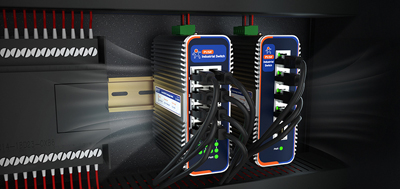
Power IoT Three-Year Battle: Terminal Online Rate from 95% to 99.9% — The Gap is One Reliable Industrial Router
How many midnight fault tickets lie between 95% and 99.9%?
Everyone working on Power IoT projects has run this calculation —
Three-year battle, terminal online rate from 95% to 99.9%. Sounds like just 4.9 percentage points.
But on the project site, that 4.9% means:
A distribution automation system with 10,000 terminals — at 95% online rate = 500 terminals could go offline at any time. At 99.9% online rate = only 10.
500 vs 10.
This isn't a number gap. It's 500 inspections, 500 dispatch orders, 500 "why did it go down again?" accusations.
The question is — you think that 4.9% is a signal coverage issue, a platform issue, a protocol issue.
But the real answer might be hiding in that unremarkable router sitting in your cabinet.
Let's set the background first.
State Grid and China Southern Power Grid have been pushing Power IoT in recent years. One of the core KPIs is terminal online rate. From "can connect" to "always connected," from 95% to 99.9% — this isn't a tech upgrade. It's a complete re-examination of infrastructure.
Why is it so hard?
Because Power IoT terminals aren't the Wi-Fi cameras in your office.
They're fault indicators mounted on utility poles, temperature and humidity sensors buried in underground pipe galleries, smart DTUs hanging on ring main units, image surveillance cameras running on remote mountain transmission lines.
The working environment of these devices is something you can never imagine sitting in your air-conditioned office:
Under these conditions, you want to talk to me about "99.9% online rate"?
Can the router you're using hold up?
I've worked with countless Power IoT projects. For those stuck at 95% online rate, the reasons basically come down to these:
Many projects use commercial routers to save costs.
Commercial routers typically operate at 0°C ~ 40°C. But outdoor cabinets at power sites easily exceed 60°C internally in summer.
Result? Router CPU overheats, triggers protection, auto-reboots. One reboot = 5~10 minutes of terminal downtime. Two or three thermal reboots a day, and online rate plummets below 90%.
You think it's the terminal's problem. Actually, the router died first.
The electromagnetic environment at power sites is dozens of times harsher than residential scenarios. VFDs, switchgear, transformers — all interference sources.
Ordinary routers have very weak serial port EMI resistance. Data gets corrupted, protocol parsing fails, and the terminal is flagged as "offline."
What you see on the platform is "terminal offline." But in reality, the terminal is working fine — it's the router that can't receive clean data.
Commercial routers usually have a single link. 4G goes down? It's down. No auto-switchover.
But what does Power IoT require? 99.9% online rate = no more than 8.76 hours of downtime per year.
Single link, no hot standby — how is that even possible?
10,000 terminals spread across hundreds of sites. Which router failed? You don't know. By the time you find out, it's been offline for days.
No remote management, no alert mechanism, no batch upgrade — O&M costs are so high they make you question your career choice.
You see, the gap from 95% to 99.9% isn't a technical puzzle.
It's the accumulation of countless "small problems." And the source of these small problems is often that router you thought was "good enough."
Let's do a direct comparison. No buzzwords — just real problems you'll encounter on site.
| Comparison Dimension | Commercial Router | Industrial Router (e.g., USR-G806w) |
|---|---|---|
| Operating Temperature | 0°C ~ 40°C | -40°C ~ +70°C |
| MTBF | Tens of thousands of hours (lab data) | Hundreds of thousands of hours, shock & vibration certified |
| Cooling | Fan-based, loud, fails when dust accumulates | Fanless design — heatsink is warm to the touch |
| EMI Resistance | Basically no EMC optimization | Specifically optimized for harsh EMI environments |
| Redundancy Switchover | Not supported, or >10 seconds | VRRP hot standby, millisecond-level switchover |
| Remote Management | Limited or requires extra payment | Cloud management, zero-touch deployment |
| Protocol Support | Basic TCP/IP | Modbus / DNP3 / OPC / IEC 61850, etc. |
| VPN Capability | 1~2 tunnels | Up to 16 VPN tunnels simultaneously |
| Security | Basic firewall | AAA (TACACS+ / RADIUS / LDAP) |
You see the gap now?
This isn't the difference between "a little better" and "a little worse."
This is the difference between "can survive" and "can't survive."
In Power IoT scenarios, a router crashing for 5 minutes could mean a distribution line loses monitoring, a ring main unit's status goes unknown, a fault indicator stops alarming.
The 99.9% online rate is built one device at a time — devices thatdon't crash.
If you're working on a Power IoT project and being tormented by "online rate won't go up" — I suggest you take a serious look at theUSR-G806w industrial router.
Not because it's the most expensive on the market. Quite the opposite — it's the most cost-effective "can pull online rate to 99.9%" solution you can find.
Power IoT terminal data isn't web browsing. It's Modbus polling, IEC 61850 messages, OPC real-time data streams — extremely demanding on router processing power.
The G806w's CPU performance isn't "just enough" — it'sredundant.
Running multi-channel serial collection, VPN encrypted transmission, and remote monitoring uploads simultaneously — CPU usage still has headroom.
What does that mean?
No packet loss during peak hours. No lag. No reboots.
The first line of defense for online rate is: the router must not lag. The G806w delivers.
Installation environments at power sites are all over the place.
Some in standard cabinets, some squeezed next to meter boxes, some mounted on utility poles.
The G806w comes in multiple form factors — from mini to DIN rail, full coverage. Small enough to fit in a gap, large enough for a standard rack.
Interface-wise — serial ports, Ethernet ports, DI/DO, Wi-Fi — it has everything.
No extra protocol converters needed. No extra I/O modules needed. One device solves all access problems.
What does that mean for project integration? One less device = one less failure point = online rate goes up a notch.
Whether it's China Southern Power Grid or State Grid, the Power IoT protocol stack is complex:
Ordinary router? Can't run them. You'd need to add a separate protocol gateway.
The G806w natively supports all these protocols. No extra device, no extra debugging, no extra failure points.
What you save isn't just the cost of one device — it's the entire project's debug cycle and acceptance risk.
This one I have to call out separately.
Because this is the root cause of commercial routers "dying in batches" at power sites.
EMI at power sites isn't "a bit strong" — it'sextremely strong.The moment a VFD starts up, every signal in the cabinet is shaking.
The G806w has dedicated EMC optimization. We actually tested it — during full-load testing, touch the heatsink on the case with your bare hand:
Warm. Not hot.
No fan. No noise.
What does that mean?
You know what that means for online rate?
It means one of the most common causes of "unexpected downtime" is eliminated.
On the road from 95% to 99.9%, what you need to eliminate is exactly these "unexpected downtimes." The G806w eliminates the biggest one.
What's the biggest O&M pain point in Power IoT?
Sites are too scattered. People can't get there.
A single prefecture-level city might have thousands of sites — urban, mountain, rural. You can't be driving out every month to reboot a router, upgrade firmware, or troubleshoot.
The G806w supports cloud management, remote upgrade, remote diagnostics.
Zero-touch deployment. No need to send anyone to site.
Router failed? Remote reboot. Firmware update needed? Remote push. A site went offline? Remote troubleshoot.
Your O&M team goes from "fire brigade" to "monitoring center."
This is the real key to pulling online rate from 95% to 99.9% — not that devices never break, but that when they do, you know immediately, fix immediately, and never have to go to site.
Let's talk price last.
The G806w is priced lower than many so-called "industrial routers." But what you get, it doesn't skimp on a single thing:
You're paying commercial router prices. You're getting industrial-grade reliability.
I've seen too many Power IoT projects stuck at 95% online rate. Teams troubleshoot endlessly — check the platform, check the signal, check the terminals.
Finally they discover: the problem is the router.
Swap in an industrial router, and online rate jumps straight to 99.5%.
It's not the platform's problem. Not the signal's problem. Not the terminal's problem.
It's that router you thought was "good enough" — it's been holding you back all along.
The gap from 95% to 99.9% isn't a technology breakthrough.
It's whether you're willing to replace every link in the chain with a device thatwon't drop the ball.
And the USR-G806w is the option that lets you make your selectionwithout gambling.
Not Saying It's the Only Choice.
But if you're being tormented by "online rate won't go up" —
It deserves a spot on your comparison list. Take a serious look.
After all, in the three-year battle, what you might be missing isn't technology —
It's this one device.