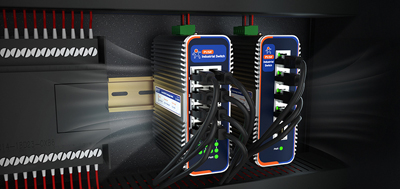
The Game-Changer in Cold Chain Logistics Transportation Monitoring: The 180-Day Endurance of Serial Device Server in -25°C Environments
In the monitoring room of a large pharmaceutical cold chain logistics center in Northeast China, Manager Zhang stared at the temperature curve on the screen, his fingers unconsciously tapping the desktop. This marked the third time this month that vaccine transportation had been disrupted due to equipment failure, with each incident directly caused by the monitoring system malfunctioning in low-temperature environments. This scene epitomizes the most authentic snapshot of the digital transformation process in China's cold chain logistics industry—while enterprises attempt to reconstruct traditional cold chains with IoT technology, equipment stability issues in extreme environments are becoming an insurmountable chasm between ideal and reality.
In extreme low-temperature environments of -25°C, the failure rate of ordinary industrial equipment surges by 300%. A cold chain manager from a biopharmaceutical company revealed, "We tested 12 mainstream temperature and humidity sensors on the market. In a -20°C environment, seven exhibited data jumps within 72 hours, and three stopped working altogether." Such failures not only result in cargo losses but also pose serious compliance risks—according to the Good Distribution Practice (GSP), a temperature deviation exceeding ±2°C in pharmaceutical cold chains is considered a major incident.
A cold chain director from a multinational food company presented a set of alarming data: among its national cold chain network, 37% of transport vehicles still use standalone recorders, whose data must be manually downloaded before being uploaded to the management system, leading to:
An average temperature anomaly response delay of 4.2 hours
A success rate of anomaly event traceability below 65%
Over 20 insurance claim disputes per month due to missing data
A cold chain fleet operating in plateau regions incurs additional annual costs due to equipment failures, including:
Spare part replacement costs: accounting for 23% of total equipment costs
Manual inspection costs: increasing by RMB 18,000 per vehicle annually
Cargo losses: averaging approximately RMB 12,000 worth of cargo per trip
These hidden costs, like submerged reefs beneath an iceberg, are quietly eroding the profit margins of cold chain enterprises.
During field testing in a pharmaceutical cold chain project in Inner Mongolia, the USR-N520 serial device server set a record of 180 consecutive days of stable operation in a -25°C environment. Behind this achievement lie breakthroughs in three key technologies:
Material Revolution: Utilizing military-grade low-temperature grease and special encapsulation processes to ensure that the coefficient of thermal expansion difference among components is controlled within 0.001mm/°C across a wide temperature range of -40°C to +85°C.
Circuit Protection: Built-in 600W lightning protection modules and TVS transient voltage suppressor diodes capable of withstanding ±15kV electrostatic discharge and 8kV surge impacts.
Power Management: Dual power supply redundancy design supporting low-temperature startup at -40°C and reducing power consumption by 40% compared to traditional devices at -25°C.
Edge Computing Capabilities: Equipped with a 32-bit ARM Cortex-M7 processor capable of:Processing 2,000 temperature and humidity data points per second
Executing threshold alarm algorithms locally
Supporting Modbus TCP/RTU protocol conversion
Data Caching Mechanism: Built-in 16GB Flash storage capable of storing 720 hours of sampling data (with a 1-minute sampling interval) during network outages.
Adaptive Communication: Supports multi-link backup for 4G/Wi-Fi/Ethernet, automatically switching to the optimal channel during signal fluctuations.
Structural Protection: IP65 protection rating to withstand salt spray, dust, and condensation erosion.
Electromagnetic Compatibility: Passed IEC 61000-4-6 level testing, with a data packet loss rate below 0.01% in strong electromagnetic interference environments.
Installation Methods: Supports DIN rail and wall-mounted installation, adapting to the bumpy environments of cold chain transport vehicles.
In a provincial distribution project for Pfizer's COVID-19 vaccine, the USR-N520 achieved:
Full-process temperature control: Real-time monitoring of temperatures at different locations within vaccine boxes using six temperature probes, with an accuracy of ±0.3°C.
Anomaly anomaly warning: When the temperature deviates from the set value by 1°C, the system automatically activates backup refrigeration units and sends three-level alarms to the monitoring center.
Compliance certification: Automatically generates electronic reports compliant with FDA/EMA requirements, reducing audit preparation time from 72 hours to 15 minutes.
Over 12 months of operation, the project achieved a record of "zero cargo losses and zero complaints," saving over RMB 5 million in quality costs annually.
A cold chain renovation project for a leading fresh e-commerce company revealed the value of data-driven operations:
Loss Control: By analyzing the correlation between temperature fluctuations and cargo losses, the pre-cooling process was optimized, reducing aquatic product loss rates from 8% to 1.5%.
Route Optimization: Combining temperature data with GPS trajectories, three road sections prone to temperature anomalies were identified, and adjusting delivery routes reduced anomaly incidence by 76%.
Inventory Management: Predicting cargo shelf life based on historical temperature data improved inventory turnover by 25%.
On the cross-border cold chain corridor from Yunnan to Southeast Asia, the USR-N520 solved three major challenges:
Network Coverage: Through 4G+Wi-Fi dual-mode communication, data connections were maintained in areas with weak network infrastructure, such as Myanmar and Laos.
Multilingual Support: Built-in Chinese-English-Burmese trilingual interfaces facilitated use by local operators.
Time Zone Synchronization: Automatically adapted to time zone settings in different countries, ensuring the accuracy of data timestamps.
The project increased the temperature control compliance rate for cross-border transportation from 68% to 99.2% and reduced customs clearance time by 40%.
Operating Temperature Range: Prioritize devices supporting -40°C to +85°C.
Protection Rating: IP65 or higher to withstand the humidity and dust in cold chain environments.
Communication Interfaces: Support at least four RS485 and two Ethernet interfaces.
Data Storage: Recommend devices with built-in 8GB or more Flash storage.
Redundant Power Supplies: Dual power inputs prevent system interruptions due to single power supply failures.
Watchdog Mechanism: Hardware watchdog + software heartbeat detection ensure the device never crashes.
Anti-Interference Capability: Pass IEC 61000-4 series electromagnetic compatibility tests.
Edge Computing: Support local data preprocessing and simple decision-making.
Protocol Conversion: Compatible with industrial protocols such as Modbus, DL/T 645, and IEC 60870-5-104.
Remote Management: Support Web configuration, SNMP network management, and firmware remote upgrades.
With the deepening application of digital twin technology in the cold chain industry, serial device servers are evolving into intelligent terminals:
Predictive Maintenance: Model equipment operation data to predict hardware failures 30 days in advance.
Digital Twins: Create virtual mirrors of cold chain equipment for full lifecycle management.
Autonomous Decision-Making: Edge nodes possess simple decision-making capabilities, such as automatically isolating faulty equipment.
In a national-level smart grid demonstration project, the USR-N520 has achieved deep integration with a digital twin platform, reducing fault location time from hours to minutes through equipment condition assessment algorithms. This technological evolution trend indicates that future cold chain monitoring will no longer be passive data recording but proactive intelligent guardianship.
When we see the indicator light of the USR-N520 steadily blinking in a -25°C environment inside a cold storage facility, it represents not only a technological victory but also a tribute to the craftsmanship of cold chain practitioners. These devices, like "night watchmen" in the digital age, ensure that every vaccine, every box of fresh produce, and every seedling can fulfill their missions under precise temperature control. As a technical director from a cold chain enterprise said, "Renovation is not a denial of the past but a way to help traditional equipment find new value coordinates in the smart era." In this silent technological revolution, serial device servers are writing a warm chapter belonging to the industrial IoT.