Theme Park AGV "Interactive Experience": How Does an Industrial PC Support AR + Navigation Fusion?
— The Immersive Experience You Carefully Designed May Be Dragged Down by a "Wrongly Chosen Computer"
"We spent 8 million on a theme park AR interactive experience, and visitors said 'the AGV is too slow, not cool at all.'"
— A theme park project manager, at the delivery review meeting
What he didn't know: the problem wasn't the AR engine, the navigation algorithm, or the 5G signal.
The problem was the Industrial PC inside the AGV's belly.
This article isn't about feelings or concepts. We're breaking down just one thing: when AR + navigation — two compute-hungry systems — run simultaneously on a single Industrial PC, what kind of machine do you actually need? 90% of the pits you're stepping into were buried during the selection phase.
After reading this, you'll look at your Industrial PC spec sheet with completely different eyes.
Traditional theme park AGVs do "transport" — move guests from point A to point B. Accurate navigation, no collisions. That's it.
But that's not the case anymore.
AR interactive experiences have turned AGVs from "transportation" into "moving stages." It now has to do three things at once:
| Task | Industrial PC Requirement | Typical Compute / Bandwidth Need |
|---|---|---|
| Real-time AR rendering (guest scans AGV with phone, sees 3D dinosaur) | GPU acceleration, low-latency video output | Sustained GPU load 40%–70% |
| SLAM navigation (avoid crowds, precise docking) | LiDAR point cloud processing, real-time path planning | CPU sustained high load, memory ≥8GB |
| Interactive comms (guest scans QR to trigger AR, voice interaction) | Multi-protocol concurrent, low-latency network | Gigabit Ethernet sustained transfer, Wi-Fi/4G module |
Three things running simultaneously, 24 hours non-stop.
AAEON writes clearly in its Industrial PC article:"Traditionally required powerful processors to achieve the accuracy in performance needed to execute tasks to a satisfactory standard. As a result, industrial PCs were once both power-hungry and expensive."
But things have changed. AAEON also points out that new-generation low-power CPUs (like Intel Atom x7000E, Intel N-series) have a TDP of only 6W–15W,"making them ideal for sealed, fanless designs."
What does that mean? It means you don't need a "big, loud, hot" machine to handle AR rendering + navigation + comms simultaneously.
But the premise is — you have to pick the right one.
We've seen too many theme park projects where the AR experience is stunning, but the whole thing falls apart because of Industrial PC selection. Not because the budget wasn't enough — because the wrong questions were asked during selection.
Question 1: "Can this machine run AR and navigation at the same time?"
Most people's first reaction:"I'll just buy a good CPU, right?"
Not that simple.
OnLogic emphasizes in its tech blog:"Industrial PCs are highly configurable,"with customizable OEM services. Why stress this? Because AR + navigation resource allocation is a precision operation — CPU for navigation, GPU for AR, memory fought over by both.
If you buy a "general-purpose" Industrial PC with no multi-task scheduling optimization, the result is: AR frames drop, navigation response slows, guest experience tanks.
The 8-million immersive experience you built? Destroyed by a 2,000-yuan Industrial PC.
Question 2: "Indoor-outdoor temperature swing of 40°C — can the machine handle it?"
How harsh is a theme park environment?
Summer outdoor ground temperature: 60°C+. Winter indoor venue: near 0°C. AGVs shuttle between indoor and outdoor, experiencing a daily temperature swing that can exceed 50°C.
AAEON's products are clearly rated for -40°C to 85°C operating range.
OnLogic also stresses:"Industrial PCs are designed to operate reliably in extreme temperatures, humidity, dust, and vibration-prone conditions."
Can your Industrial PC run AR stably across that temperature range? Many machines are labeled "industrial-grade" but start throttling and crashing above 45°C. Tests fine in the lab, crashes the moment it hits the park.
Question 3: "AR needs low latency, navigation needs low latency — who manages the latency?"
This is the most overlooked pain point.
The core of AR interaction is "instant feedback" — guest scans, 3D dinosaur "jumps" out. If latency exceeds 200ms, the experience goes from "wow, so cool" to "what is this junk."
The core of navigation is also low latency — AGV weaving through crowds, LiDAR data must be processed in real-time, or it "reacts half a beat too late."
Two systems fighting over the same CPU, the same memory bus, the same network interface. If the Industrial PC's architecture doesn't support real-time multi-task scheduling, latencies stack on top of each other.
AAEON's article mentions a key term:"performance hybrid architecture"— designed to solve exactly the problem of "how do heavy and light tasks coexist.""The CPU can allocate less power-consumptive operations to the efficiency cores,"letting AR rendering and navigation computing each take their own lane, never interfering.
Selecting without looking at architecture is like buying a car without checking the transmission — you won't know until you're driving.
Question 4: "Guests can touch it, bump into it — is the machine tough enough?"
Theme park visitors, especially kids, do not "treat things gently."
AGVs get bumped, pushed, things get thrown at them. If the Industrial PC doesn't have sufficient shock and vibration resistance, it'll need replacing in under three months.
OnLogic says it directly:"Industrial PCs feature modular components, allowing for easy customization and scalability."But more importantly — the chassis itself has to be tough.
AAEON's Fanless series uses fanless design. OnLogic uses passive heatsink cooling — this isn't just for dust prevention. It's about reducing moving parts and improving overall shock resistance. The fan is the most failure-prone component. Remove it, and reliability doubles.
Let's go back to that project manager's story.
Their AGV used an ordinary Industrial PC. CPU was fine. Memory was fine. But it had only one 100Mbps Ethernet port, no dedicated video output, fan-based cooling, and a 45°C max operating temperature.
Results:
They didn't pick the wrong "configuration." They picked the wrong "type."
AAEON defines the Industrial PC as"an umbrella term"— it's not a fixed product, but a category of devices with specific capabilities. OnLogic puts it even more clearly:"The ideal industrial computer for your application will vary depending on factors such as performance benchmarks, available power source, and the environment it's being deployed in."
So what does the "ideal Industrial PC" for a theme park AR + navigation AGV look like?
| Capability | Why It's Mandatory |
|---|---|
| Dual Gigabit Ethernet | AR video stream + navigation data on separate channels, no contention |
| Hybrid CPU (P-core + E-core) | AR rendering on GPU/efficiency cores, navigation on performance cores — parallel, no fighting |
| Fanless passive cooling | Dust-proof, shock-resistant, 7×24 non-stop |
| -40°C ~ 85°C wide temp | No throttling no matter the indoor-outdoor swing |
| Rich I/O (USB3.0, RS485, CAN Bus, etc.) | LiDAR, AR module, dispatch system — not a single one can be missing |
| Full Windows driver support |
AR engines and navigation algorithms mostly run on Windows — driver incompatibility is a disaster |
After all that, you're probably thinking:"Is there a machine that checks every single box above?"
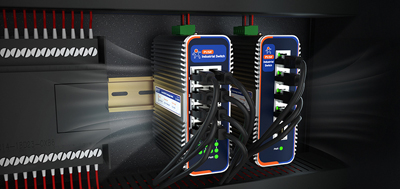
TheUSR-EG628 Industrial Computeris the "standard answer" for this scenario.
| Your Selection Anxiety | USR-EG628's Answer |
|---|---|
| AR and navigation fight for resources, stutter each other | Hybrid CPU, multi-task parallel scheduling — AR doesn't drop frames, navigation doesn't lag |
| One Ethernet port isn't enough, video and data clash | Dual Gigabit Ethernet — AR stream on one port, navigation data on the other, zero interference |
| Can't run outdoors in summer, CPU throttles | Fanless design + wide temp -40°C~85°C — full speed even at 60°C ground temp |
| Fan dies, whole system crashes | Passive cooling, zero moving parts, 24/7 non-stop |
| AR engine only supports Windows, drivers are a nightmare | Full Windows 10/11 drivers, gigabit实测 full speed, plug and play |
| Need to add LiDAR, 4G module later — what then? | Rich I/O (USB3.0×4, RS232/485, CAN, GPIO) — expand on demand |
| Budget is tight, 10Gig solution is too expensive | Gigabit solution, 60%+ cheaper than 10Gig — best value right now |
It's not letting you "settle." It's letting you "stop thinking about it."
Drop it into the AGV, connect the AR module and LiDAR, power on — and then you can focus on the guest experience instead of worrying whether the machine will crash in the next second.
Theme parks in 2024 compete on immersion.
Guests don't want "a ride and a view." They want "interaction with virtual characters, surrounded by AR, feeling like they've truly entered another world."
And underneath all of it is an Industrial PC you probably never gave a second look.
AAEON says:"Industrial PCs are the backbone of the fourth industrial revolution."
OnLogic says:"Industrial PCs epitomize the convergence of technology, innovation, and industrial growth."
In the theme park scenario, the Industrial PC is the bridge between AR experience and navigation safety. The bridge collapses, and the 8 million you invested goes straight down the drain.
So —
Don't wait until a guest posts on social media"that dinosaur AGV was lagging like a PowerPoint"before you remember the few thousand you saved during selection.
Go check your AGV's Industrial PC right now: Is the Ethernet fast enough? Is the cooling reliable? Can it handle the temperature? Are the Windows drivers complete?
If you can't answer any of those —
It's time for the USR-EG628.