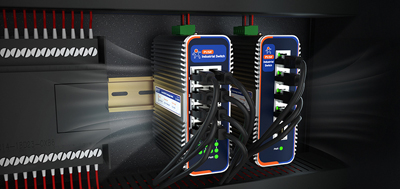
Welding Line Network Instability Caused a 5% Yield Drop? This Industrial Wireless Router Solution Helped an Auto Parts Factory Recover Its Losses
It's 2 AM, and Quality Manager Lao Chen is staring at the yield report on his screen, sighing for the umpteenth time.
95% — this number hasn't budged in three straight weeks.
On the surface, it looks like welding parameter drift. The process engineers have adjusted everything over and over — temperature, current, wire feed speed… all parameters are within the tolerance range in the spec sheet. But every batch coming off the line always has a few weld points that aren't full enough, and they get rejected at final inspection.
Lao Chen knows the truth: it's not a process problem.
It's a network problem.
This line has over a dozen IoT sensors deployed, collecting welding temperature, current waveforms, and ambient humidity in real time. The data needs to be uploaded to the MES system for SPC analysis. But the electromagnetic environment in the shop is brutal — WiFi signals get shredded by metal dust from welding splatter and electromagnetic interference. The packet loss rate is as high as 8%. The MES system receives data in fits and starts, and SPC analysis constantly throws "false alarms" — no warning when it should warn, and line stoppages when it shouldn't.
A 5% yield loss, converted to real money, is over two million yuan a year.
Lao Chen isn't unaware that he should switch the network solution. What he's afraid of is — what if he switches and it still doesn't work?
This mindset? You've definitely felt it before.
Anyone who's done industrial projects knows: the hardest part of selection is never comparing specs. It's not knowing whether the thing you're dropping into your site will actually survive.
WiFi? Runs beautifully in the office, falls apart the moment it hits the shop floor.
Wired? Cabling costs eat half the project budget, and the moment the line changes, it's all for nothing.
4G industrial wireless router? There are tons on the market, they all look the same, and they all claim "up to 300Mbps" — but when you actually toss one into a welding shop, a -20°C cold storage room, or next to a vibration table, how many can actually hold up?
What you're really worried about isn't how much it costs. What you're worried about is —
"I buy this thing, it dies in three months — who do I call?"
"One network outage, the whole line stops for half a day — who pays for the loss?"
"The supplier talks a big game, but when something goes wrong, you can't find anyone."
Every one of these concerns is valid. Every one of them is money.
So when Lao Chen heard about a solution that was "plug-in-and-go, metal enclosure, auto-recovery, zero manual maintenance," his first reaction wasn't excitement — it was skepticism.
Until he saw the real data from that auto parts factory.
An auto parts factory in Zhejiang, specializing in welding battery trays for new energy vehicles. 12 stations on the line, 4 sensors per station — data needs to be sent back to the MES system in real time for quality traceability.
They were previously using a certain brand's industrial WiFi solution, with 6 APs deployed. The result?
Near the welding stations, signal attenuation exceeded 40dB.
Average daily packet loss of 12%, with MES data delays up to 8 seconds.
At least 2 unplanned line stoppages per month due to "network false alarms," each costing about 40,000 yuan in losses.
Yield stuck at 95%, with Quality and Production departments fighting every day.
Then they ripped out all 6 APs and replaced them with PUSR's industrial-grade cellular industrial wireless router (USR-G809s) — one per station, SIM card plug-and-play, running on 4G Cat 4 networks.
The changes started showing in the second week.
Week 1: Nothing changed. Lao Chen even got a little panicked — "Did we just waste the switch?"
Week 2: Packet loss dropped from 12% to 0.3%. The MES system received complete, continuous, gap-free welding data for the first time. The SPC control charts finally stopped "jumping around."
Week 3: The process engineer re-adjusted the wire feed speed at Station 3 based on the complete data. Yield jumped from 95% to 97.8%.
One month later: Yield stabilized at 99.2%.
After three months, they ran the numbers:
| Item | Before | After |
|---|---|---|
| Avg. monthly unplanned downtime | 2 times | 0 times |
| Yield rate | 95% | 99.2% |
| Monthly network maintenance hours | 16 hours | 0 hours |
| Monthly combined losses | ≈280K yuan | ≈30K yuan |
Over two million yuan saved in a year. And the cost of those industrial wireless routers was less than one-tenth of the losses.Lao Chen later said something I found incredibly honest:
"I wasn't won over by the specs. I was won over by 'I don't have to manage it.' I drop it in, it runs on its own, the data comes back on its own, and I can finally sleep at night."
Many people ask: why not just keep optimizing the WiFi solution? Add more APs, add antennas, do roaming… won't that work?
It's not that it won't work — it's that the cost-performance ratio is abysmal, and the underlying logic is wrong.
WiFi was designed for "people going online." Its protocol is inherently unsuitable for "machines continuously uploading small data packets." In industrial environments with severe electromagnetic interference, WiFi's channel congestion and retransmission mechanisms cause latency and packet loss to skyrocket exponentially.
Cellular networks — 4G LTE Cat 4, even 5G — were designed from the ground up to keep devices stably connected while moving, in harsh environments, and amid electromagnetic interference.
PUSR's industrial wireless router is built on exactly this logic:
Metal enclosure, wide-temperature and wide-voltage: runs from -40°C to 70°C. The heat of a welding shop, the cold of a northern winter storage room — neither is a problem. Plus a built-in watchdog that auto-restarts on system crash — no need to get up at midnight to manually reboot.
Level 3 EMC protection: this isn't a spec thrown in for show. Welding arcs, variable frequency drives, high-current equipment — these "electromagnetic killers" on industrial sites are lethal to ordinary industrial wireless routers. For this one, they're just another day at the office.
VPN encrypted tunnel: OpenVPN protocol, data encrypted end-to-end from sensor to cloud. Your process parameters and yield data won't be intercepted halfway. For a sensitive industry like auto parts, this isn't a bonus — it's a necessity.
Edge computing capability: not all data needs to go to the cloud. Critical alarm decisions can be made locally on the industrial wireless router, with latency reduced to milliseconds. When the line hits an anomaly, you don't wait for the cloud to respond — it triggers locally, instantly.
Put plainly: it's not a "box that can connect to the internet." It's a "communications infrastructure built for industrial sites."
Let's go back to Lao Chen's original worry — "What if I switch and it still doesn't work?"
The essence of this question isn't technical — it's about trust.
You don't need a product with pretty specs. You need a solution you can drop in and forget about, one where someone has your back if something goes wrong, and one that's still running after three years.
What PUSR has done is turn that promise into reality:
The product has passed a complete quality system certification — it's not a no-name OEM knockoff from a back-alley factory.
It's being used in over 40 countries worldwide, from hydroelectric dams to smart logistics to cold chain transport — validated in every extreme scenario imaginable.
No annual fees, no license fees, no hidden follow-up costs. You buy it, it's yours, and upgrades are free.
Global technical support coverage — you have a problem, send an email. No begging and pleading for a response.
You focus your energy on your process and your yield. Leave the networking to the professionals.
This is what an industrial wireless router should be — not one more device for you to worry about, but one less thing to worry about.
If your production line is going through any of these:
Yield inexplicably won't climb — you've checked the process, checked the materials, but can't find the cause.
MES data keeps dropping out, and SPC analysis can't produce any meaningful conclusions.
Network maintenance has become a daily chore, and IT and Production fight about it every day.
Every time you think about switching the network solution, you get a headache — afraid of the cost, afraid of the hassle, afraid it still won't work.
Then I suggest you seriously consider the industrial-grade cellular industrial wireless router direction.
No major line changes, no rewiring, no touching your MES or SCADA. Insert a SIM card, swap out the old WiFi APs, and watch for two weeks.
After two weeks, you'll have your answer.
Just like Lao Chen said:
"Some money isn't spent — it's recovered."
If you want to learn more, take a look at PUSR's industrial wireless router series — it's a proven solution built exactly for scenarios like this, and they can also make customized recommendations based on your line scale. No consultation fee — let's just talk first.