In building automation commissioning, the standard setup is a laptop plus a USB-to-RS485 adapter plus CCT or PCT. Wire the terminals, plug in the USB, run the software, catch an I-Am frame, and confirm a node is online. For one-off commissioning—tweaking a VAV, writing a Present_Value, then logging out—this setup works fine. The trouble starts when devices need to stay on the network long-term and a supervisor has to poll them concurrently. Many field engineers hit the same wall: the USB link worked perfectly during commissioning, then fails to scale once the SCADA package and a web dashboard are added on top.
The adapter is a pure physical-layer device: USB signals go in, RS485 differential signals come out. Windows or Linux exposes it as a COM port; the BACnet commissioning tool writes bytes to that port, and the bytes travel onto the MS/TP bus. It looks like simple hardware, but three hidden dependencies come with it:
For short sessions none of this matters. Cheap adapters from online marketplaces often cover exactly this short-session use case, and that is the point worth pinning down before deciding what to keep in the toolbox.
Commissioning is temporary; deployment runs around the clock. Any of the following triggers a switch away from the USB adapter.
Trigger 1: temporary commissioning turns into permanent polling.Even a 30-second poll cycle from a supervisor means the USB link needs a PC that never powers down.
Trigger 2: a single laptop becomes multiple concurrent clients.One laptop owns the bus during commissioning. In production, two supervisors, a web client, and a third-party interface may all need to read the same MS/TP subnet at the same time. A USB adapter has exactly one USB port; the hardware itself cannot serve multiple clients.
Trigger 3: the work moves from the field to the central control room.MS/TP runs a few hundred meters at most. Spreading across machine rooms or buildings means access has to ride on the IP network.
Trigger 4: the commissioning tool gets swapped for a supervisor package.Different software calls virtual COM ports differently and paces polling differently. Switching tools usually means revalidating the link.
The USB adapter covers three conditions at once: short sessions, a single laptop, and local work. Any change moves the job from "commissioning" to "deployment."
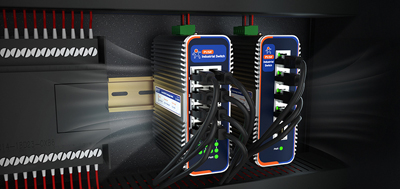
Bringing the MS/TP bus onto the IP network, the RS485 to Ethernet converter also works at the physical layer: differential signals get encapsulated into TCP or UDP byte streams. On the commissioning side, a virtual COM (VCOM) driver still presents the remote serial port as a local COM, so the software side barely changes—but the link is now independent of any one specific PC.
Concrete shifts:
A common scenario when moving from commissioning to deployment: one laptop running CCT or PCT was enough, then two supervisors started polling concurrently, a new colleague needed a web client, and the laptop still had to stay around as a mobile debug entry point. That is the ceiling for the USB link.
The USB adapter does not need to be replaced during commissioning—it was never designed for permanent network attachment.
For deployment, the RS485 to Ethernet converter splits into two layers by scale and use case.
Single MS/TP bus with occasional debug access:
Multiple MS/TP buses consolidated, or edge computing needed:
The moment the USB adapter puts the bus on a PC is the start of commissioning, not the destination of deployment. Temporary access belongs to USB; permanent access belongs to th