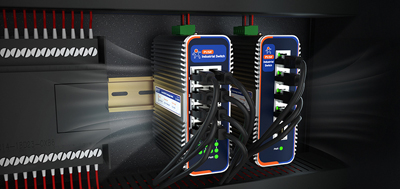
At the far end of a plant building sits a device with nothing but an RS-232 port. The requirement is plain enough: open a COM port on a networked Windows machine and read from and write to that device as if a serial cable ran straight to it, with the existing network carrying the traffic in between. The description is clear; the obstacle is not technical. Without knowing what this class of hardware is called, there is no way to know what term to search for.
That situation is common. One and the same piece of hardware goes by four or five different names depending on whether the speaker builds equipment, integrates systems, or writes host software. Different names return different search results, and quotations and model selection drift along with them.
Serial to Ethernet converter is the most literal of them: a serial port on one side, an Ethernet port on the other, transparent bidirectional transfer in between. Three other names circulate around that same box, each stressing a different facet. None of them points to a different product; each describes the same hardware from the angle of whoever is speaking.
Serial device serveris the category name, the one that shows up most often in vendor selection guides. "Server" refers to the job it takes on for the serial device: plug in the network cable, assign an IP address, and from then on it handles the sending and receiving.
Serial-to-Ethernet converterstresses the action — turning signals on RS-232 or RS-485 into Ethernet packets. Single-port and dual-port boxes are usually labeled this way.
Serial-over-IPstresses the method: serial data is wrapped into IP packets unchanged and unwrapped unchanged at the far end. The term appears mostly in manuals and protocol descriptions, rarely on the case.
Virtual COM portis not hardware at all. It is a piece of software installed on the PC that creates a COM port inside Windows, so legacy applications keep opening COM3 while the data actually travels over the network. Skip this step and an application that only understands a port number will not connect, no matter how solid the hardware is.
A terminal server also moves serial traffic onto a network, but its form factor belongs in the equipment room: a dozen or more ports, rack mounted, used mainly for remote console access to switches and routers.
A serial gateway does one layer more than transparent transfer — it understands protocols and can convert Modbus RTU to Modbus TCP, so a host reads registers as though it were talking to an Ethernet device. When PLCs, meters, or instruments are involved, searching for "gateway" lands closer than "converter."
A common assumption is that buying a converter settles the matter. The hardware moves the serial port onto the network; turning that into a COM port on the PC is a separate job, and both halves have to meet. Engineers who use this class of device for serial consoles have reported that the same box feels perfectly smooth for console logins and less steady when moving data continuously — the difference usually lies not in the hardware but in how the software layer on the PC handles timeouts, dropped links, and reconnects. Beyond baud rate and operating mode, one more question belongs on the checklist: which Windows versions the bundled virtual COM software supports, and whether it reconnects automatically after a link drops. The hardware side only moves bytes; what a broken session looks like to the application is decided by the driver on the PC. The same kind of serial redirector software is what connects analyzers to workstations in laboratories.
Port type and count.RS-232 is point-to-point, good for a dozen meters or so of cable; RS-485 is a differential bus that carries multiple devices over hundreds of meters. The two use different signal levels and cannot be joined with a passive adapter. List what interfaces the site has and how many of each before discussing models.
What the host software understands.Legacy software that only recognizes a COM port makes a virtual COM port mandatory. A platform reading over Modbus TCP needs a gateway to translate from RTU. Code written directly against sockets is fine with plain TCP or UDP passthrough.
Where it mounts and what powers it.DIN rail, wall mount, or a small box tucked inside the equipment. Wide-range input with reverse polarity protection removes the need for a separate power module on site. Models rated for -40 to 85°C hold up better in outdoor enclosures and shops without air conditioning.
USR-TCP232-410sfits the case where one device exposes both interface types: one RS-232 port (DB9, with RTS/CTS hardware flow control and XON/XOFF software flow control) plus one RS-485 port, both able to run at the same time without interfering with each other. Baud rates run from 600 bps to 230.4 Kbps. Alongside TCP Server/Client, UDP Server/Client, and HTTPD Client, it also supports MQTT, Modbus RTU to Modbus TCP conversion with multi-host polling, and ships with USR-VCOM for the virtual COM port. SSL/TLS encryption, wide-range power input with reverse polarity protection, -40 to 85°C operation, hardware and software watchdogs, wall mounting, and a Reload button that restores factory defaults after a long press.
USR-N540suits four or more serial devices brought together at one point: four serial ports, each configurable as RS-232, RS-485, or RS-422, all four working independently. Each serial port supports two sockets that back each other up. It also carries the Modbus gateway, virtual COM, and SSL/TLS, with wide-range power input with reverse polarity protection, a metal IP30 housing, and -40 to 85°C operation.
USR-DR132/USR-DR134covers the case where space is tight and a single serial port is enough: lipstick-sized, mounted on a 35 mm DIN rail, one RS-232 port (DR132) or one RS-485 port (DR134), up to 16 clients in TCP Server mode, Modbus RTU convertible to either TCP or JSON, and USR-VCOM included as well.
Once the names line up, selection follows: for a serial port that needs to reach a network, search for a serial to Ethernet converter; for legacy software that must not change a line, confirm a virtual COM port is bundled; for protocol conversion, search for a serial gateway. The vocabulary is only the entry point; the three checks are what keep a purchase from coming back. Counting