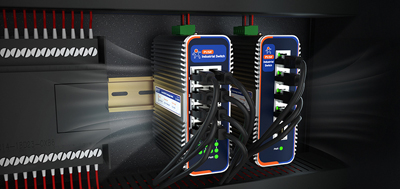
An Industrial PC, also known as an IPC, is a computing device specifically forged for industrial environments. It is not the computer on your office desk that occasionally blue-screens — it is the sentry on the production line that never blinks, the silent brain running deep in the mines, and the nerve center making decisions every second at smart traffic intersections.
Compared to a standard computer, the core DNA of an Industrial PC is completely different:
| Dimension | Standard Computer | Industrial PC |
|---|---|---|
| Design Goal | Everyday usability | Continuous stable operation in extreme environments |
| Operating Temp | 0°C–40°C | -40°C–85°C (fanless models) |
| Dust/Water Protection | No special protection | IP65/IP67 rating, fully sealed design |
| Runtime | 8 hours/day | 7×24, 365 days non-stop |
| Shock/Vibration Resistance | Barely considered | MIL-STD-810G certified |
| Failure Rate | Occasional downtime acceptable | MTBF up to 37,000–50,000 hours |
In short: an Industrial PC is a computer built tosurvive. Its mission is not to run fast — it is to keep running steadily amid the siege of dust, extreme heat, heavy vibration, and electromagnetic interference.
As the underlying platform for industrial switches, the reliability of an Industrial PC directly determines the lifeline of the entire data link. Pick the wrong one, and it is not a matter of being a little slower — it is a matter of the entire production line shutting down.
Looking back from the vantage point of 2026, the Industrial PC is undergoing four profound technological transformations:
In the past, all industrial data was uploaded to the cloud for processing — high latency, expensive bandwidth. Today, edge Industrial PCs run AI models directly on the device. In machine vision inspection scenarios, edge solutions respond several times faster than cloud-based ones. Over 50% of industrial data is now generated and processed at the edge. The Industrial PC is evolving from a "data mover" into an "on-site decision maker."
General-purpose large models are being infused with industrial domain knowledge, giving birth to industry-specific industrial large models. The IPC no longer just executes commands — it now has the ability to predict failures, optimize processes, and self-adapt. The Industrial PC of the future will be able to diagnose its own health.
Driven by supply chain security, domestic CPUs (Phytium, Loongson, Zhaoxin) and domestic operating systems (Kylin, UOS, HarmonyOS) have been progressively embedded into Industrial PC product lines. In government, energy, and power sectors, self-reliance is no longer an option — it is a necessity.
Fanless passive cooling, low-power chips, dynamic power management — these are no longer bonuses, but entry requirements. Under the "Dual Carbon" targets, the energy efficiency ratio of the Industrial PC is being redefined.
The Industrial PC family is vast. By structure and application scenario, it can be divided into six categories:
| Type | Core Features | Typical Applications |
|---|---|---|
| Embedded IPC Motherboard | 3.5"/MINI-ITX/PC104/ARM/COMe modules, compact and embeddable | Traffic signal control, vending machines, medical devices |
| Fanless IPC (Complete Unit) | Fully sealed aluminum chassis, passive cooling, zero noise, zero openings | Labs, medical equipment, dusty workshops, automated production lines |
| Rackmount IPC | 1U/2U/4U standard rack, rich expansion slots | Data centers, power dispatch, cybersecurity, SCADA servers |
| Industrial Panel PC | Touchscreen + IPC integrated, IP65 protected, 7–32" options | MES terminals, kiosks, shop floor stations, smart retail |
| Rugged Industrial PC | Military-grade three-proof, MIL-STD-810G certified, outdoor sunlight-readable | Vehicle computing, outdoor monitoring, logistics tracking, battlefield environments |
| Domestic Industrial PC | Domestic CPU + domestic OS, self-reliant | Government, energy, power, defense and other critical infrastructure |
Among these, the fanless IPC is the fastest-growing category in recent years. It replaces fan cooling with an aluminum enclosure, eliminating the only entry point for dust. Its MTBF can reach 3–5 times that of fan-equipped models. In the companion selection for industrial switches, the fanless IPC has virtually become the default choice.
Selection is not about picking the most expensive — it is about picking the best fit. Below is a battle-tested selection framework:
| Environmental Challenge | Recommended Type |
|---|---|
| Heavy dust, noise-sensitive (hospitals, labs, food plants) | Fanless IPC, passive cooling, IP65 |
| Extreme temperature range (-40°C–85°C) | Wide-temp fanless or rugged |
| Bright outdoor, mobile operations | Rugged Industrial PC, high-brightness display, IP67 |
| Centralized server room management | Rackmount IPC, 1U/2U/4U |
| Production line HMI interaction | Industrial Panel PC, touch operation |
| Task Level | Recommended Processor | Memory Suggestion |
|---|---|---|
| Light HMI / Data acquisition | Intel Celeron / ARM / Domestic CPU | 8GB |
| Automation control / Multi-task HMI | Core i3 / i5 | 16GB |
| Machine vision / Edge AI inference | Core i7 / i9 / Xeon | 32GB+ (ECC) |
For storage, SSD is a must in industrial scenarios — no moving parts, vibration-resistant. NVMe solutions deliver read speeds up to 3,500 MB/s, far exceeding mechanical hard drives.
As the partner of an industrial switch, the interfaces must be sufficient:
| Scenario | Recommended OS |
|---|---|
| General industrial control | Windows 10/11 IoT |
| High-reliability server | Linux (Ubuntu/CentOS) |
| Critical infrastructure | Domestic OS (Kylin/UOS) |
An Industrial PC is not an off-the-shelf product you "buy and use." It is a systems engineering project — from cooling architecture to interface configuration, from processor selection to OS adaptation. Every link answers the same question:Can this device hold up for you in the harshest environment?
In our long-term Industrial PC solution deployments, our selection of upstream hardware platforms is nearly unforgiving. After multiple rounds of real-world testing and production line validation, we have come to one conclusion: selection ultimately comes down not to the spec sheet — it comes down towho is still online at 3 AM when your line goes down.