Is Your Box Transformer Monitoring Device "Faking Online"? 90% of Power Ops Staff Haven't Spotted This Invisible Fault
—Lights on, data transmitting, platform showing green. But your device might already be "blind."
2 AM. Operations duty room of a county-level power supply company in Hebei.
Engineer Wang gets a call from dispatch:"The temperature alarm went off on that box transformer in your jurisdiction. Go check it now."
He opens the monitoring platform, finds that box transformer—Status: Online. Temperature: Normal. Communication: Good.
Everything looks fine.
He calls back:"The platform shows normal. Must be a false alarm."
The next morning, the inspection team arrives on-site: the internal temperature of the box transformer has already hit 95°C. Winding insulation is softening. Two more hours and it would have been a burnout incident.
When Wang later pulled up the historical data, he discovered:that device's temperature data hadn't updated at all in the past 72 hours.The "normal" on the platform was just 3-day-old cached data playing on a loop.
The device had been "pretending to be online" the entire time.
And he never noticed.
In the power industry, there's a failure mode more dangerous than "device offline"—device fake online.It doesn't alarm. It doesn't drop. It doesn't flash red. On the platform, everything looks normal. But in reality, the data died long ago—the system is just "performing" for you using the last successfully uploaded data.
You think you're monitoring equipment. You're actually watching a "recording playback."
This article won't preach theory or pile up specs. I want to work with you to drag this "invisible killer" hiding behind your monitoring platform into the light.
Let's clarify a concept first.
Your box transformer monitoring system, from device to platform, goes through these steps:
Sensor collection → Collection terminal packaging → 4G industrial router transmission → Base station reception → Master station parsing and display
The "online" status in most systems is determined by one logic:the industrial 4g router is still sending heartbeat packets to the master station.
Note—a heartbeat packet ≠ a data packet.
A heartbeat only says one thing:"I'm still alive."It contains zero device data.
So this absurd scenario emerges:
| Phenomenon | Platform Shows | Actual Reality |
|---|---|---|
| Industrial 4g router sending heartbeats normally | Online | Collection terminal's data packets never left the device |
| Sensor data cut off for 3 days | Temperature Normal | Platform is looping 3-day-old cached data |
| 4G module has signal | Communication Good | Data was discarded inside the industrial 4g router, never reached the antenna |
| All LEDs green | Running Normal | CPU is frozen on a process, only the heartbeat task is still running |
The device didn't drop offline. The data is dead.
This is "fake online"—a failure mode scarier than offline. Because when it's offline, you know. When it's fake online, you never know.
Inseego mentions a key concept in its tech blog:Failover.A good industrial 4g router should automatically switch to a backup connection when the primary link fails, minimizing network interruption. But think about it in reverse—if your industrial 4g router can't even recognize that the data channel is completely blocked, it won't even give you the chance to failover.
It just quietly sends heartbeat packets, letting you believe everything is fine.
You might ask:"My equipment is from reputable manufacturers. How could it be fake online?"
It's not the equipment. It's that industrial 4g router in the middle—quietly "paralyzed" where you can't see it.
Let me break down the five most common causes of "fake online":
This is the most insidious one.
During operation, certain processes in the industrial 4g router slowly eat up memory. Day 1: fine. Day 2: fine. By Day 7: memory is full, data packets start getting dropped. But heartbeat packets have the highest priority—they still get through.
Result: Platform shows online. All data is lost.
Perle wrote on its product page:"For a small site, even with 99.5% fixed-line availability, downtime costs can exceed $1 million per year. A single minute of downtime can adversely affect customers, operations, and revenue."
In a power scenario, 72 hours of undetected data interruption might not cost $1 million—it costs a burned box transformer, a regional blackout, a safety incident.
Box transformer monitoring collection boxes are mostly outdoors. Summer, direct sunlight—internal temperature easily exceeds 60°C.
Ordinary industrial 4g routers have a max operating temperature of 45°C. Beyond that, the CPU auto-throttles. After throttling, data processing capability collapses—packets queue up, time out, get dropped.
But heartbeat packets are tiny. They still squeeze through.
Result: Summer packet loss rate spikes, but the platform shows everything normal.
You think it's a signal problem. It's actually your industrial 4g router getting "heatstroke."
What's next to a 10kV box transformer? Switchgear, capacitors, transformers. The intense EMI these generate causes the error rate of ordinary industrial 4g router 4G modules to skyrocket.
The result:full signal bars, but zero data transfer.
Inseego emphasizes Security and Compatibility in its blog. But on a power site, more fundamental than security and compatibility is one question—can your industrial 4g router get data out "cleanly" in a high-interference environment?
If not, everything else is empty talk.
Indirect lightning doesn't need to hit your device directly. The ground potential rise from lightning current flowing through the nearby grounding system surges along communication lines straight into your industrial 4g router.
One surge might not completely fry it. But it puts the comm module into a "half-dead" state:can send heartbeats, cannot transmit data.
Result: After a thunderstorm, the device is "online"—but all data is zero.
5 collection terminals on one line, but you only gave it an industrial 4g router that can handle 3.
The industrial 4g router won't tell you"I can't take it anymore."It just quietly starts dropping packets—unimportant ones first, then important ones, until only heartbeats are left flying.
Result: You think all 5 terminals are online. In reality, only 2 are actually transmitting data. The other 3 were "silently discarded" long ago.
This is the essence of the problem from your last article.
Here's a self-check list. If you hit 3 or more, your device is most likely "performing":
| Self-Check Item | The Truth Behind It |
|---|---|
| Platform data update time always stuck at a fixed timestamp | Data died long ago; cached data is looping |
| On-site inspection: all LEDs green, but data doesn't match the platform | Classic fake online |
| Data quality noticeably worse in summer than winter | Heat throttling |
| Need to manually reboot the industrial 4g router after thunderstorms to restore data | Surge left the comm module half-dead |
| Ops staff spend huge time monthly handling "online but no data" tickets | Systemic cost of wrong industrial 4g router selection |
| Changed SIM card, changed terminal—problem persists | The problem is the industrial 4g router, not the terminal or card |
If you checked 3 or more, consider this seriously: it's not your monitoring equipment that's broken. It's your industrial 4g router turning your entire monitoring system into a "video recorder."
Enough problems. Time for the solution.
In box transformer monitoring, you don't need an industrial 4g router that "can connect to the internet." You need one that"keeps data truly alive all the way to the platform."
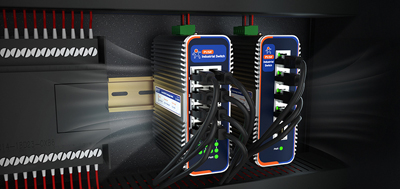
That's why, in distribution automation and box transformer monitoring projects, more and more engineers are choosing theUSR-G806w industrial 4g router.
Not because it's the most expensive. Because it understands the pain of the power site the best.
This is what impresses me most about the G806w.
During testing, we ran it at full load for 72 hours straight. Then touched the enclosure heatsink—warm, not hot.
What does that mean? Heat is being efficiently conducted away. The chip is running at a comfortable temperature.
No fan = no noise = no dust ingress = cooling won't degrade over time = no maintenance.
Why does Perle's industrial 4g router dare to spec -40°C to +70°C? Because it knows temperature is the enemy. The G806w's passive cooling design lets it run at full data capacity even inside a 60°C collection box.
Install it and forget it exists. It won't remind you it's alive with fan noise at 2 AM—because it's always alive, quietly alive.
The G806w's multi-terminal concurrent processing ensures all collection terminals on a line transmit simultaneously—no queuing, no silent discarding.
No "Terminal A is transmitting, so Terminal B has to wait." 5 terminals, 5 channels, all running at full capacity.
This is "truly online"—not heartbeats flying, but data flying.
Deep EMC optimization for the intense electromagnetic environment near 10kV box transformers. Built-in multi-stage surge protection—comm interfaces withstand surges of4kV and above.
Full signal bars AND data actually transferring—that's "truly online."
Multiple sizes available, fitting any outdoor collection box or indoor panel. Ethernet, serial, DI/DO, USB—everything in one box.
Before, you might have needed: industrial 4g router + serial server + protocol converter. Now,one G806w handles it all.
And it supports router, gateway, and bridge modes—just as Perle says:"IRG routers can be easily configured as Router, Gateway, or Bridge"—flexibly fitting your network architecture. No master station changes, no re-debugging.
Supports IEC 60870-5-104, IEC 61850, Modbus TCP/RTU, DNP3, and other mainstream power protocols. Compatible with the vast majority of SCADA systems and distribution master stations on the market.
No system changes. No re-debugging. No arguing with the master station vendor.Pull the old one out, install the G806w, import the config, go live.
Perle emphasizes on its product page:"We do not charge any annual subscription fees or license fees to maintain operation, download software updates, or access features."
The G806w is the same—no hidden fees, no annual subscription. Buy it, it's yours.
More importantly: passive cooling, wide-temp design, anti-interference, surge protection—these combined mean your ops staff don't need to climb poles every month to reboot the industrial 4g router, don't need to replace devices every thunderstorm season, don't need to question reality every time data looks weird.
Ops pressure drops. That's the real cost-effectiveness.
Back to the opening story.
Engineer Wang later said something I've never forgotten:
"I used to think 'online' meant everything was fine. Now I know—online doesn't mean alive."
Your box transformer monitoring system is the same.
That green "online" status on the platform might just be an industrial 4g router sending heartbeat packets, "performing" for you. While your temperature data, your load data, your alarm data—might have died three days ago.
You're monitoring equipment. The equipment is "acting."
The USR-G806w can't prevent your box transformer from faulting. But it can ensure—when a fault actually comes, your data is alive, your alarms are real, and you won't be fooled by a "false alarm" at 2 AM only to face a burned box transformer the next morning.
Let your devices go from "fake online" to "truly online."
Let your data go from "playback recording" to "live broadcast."
Let your operations go from "firefighting" to "fire prevention."
If your box transformer monitoring system also has that industrial 4g router that "only sends heartbeats, no data," contact us for the USR-G806w's detailed specs and box transformer monitoring deployment plan.
Device online isn't enough. Data online—that's enough.