A full-metal portable industrial computer from the 1990s is still in service as a development workstation. The chassis, CRT display, power supply and ISA backplane are all original. Only the 386 motherboard has been swapped for a 366MHz AMD Geode, the hard drive replaced with a 32GB CF card, and a lightweight Linux installed. It sits beside a workbench running AVR development. Thirty years on, the machine still does its job — not because of compute power, but because of that chassis and that backplane.
When buying an industrial computer, the easiest thing to compare on a datasheet is CPU clock speed and memory. The hardest thing to judge is whether it will survive on site. Breaking "industrial environment" into seven items that can be checked one by one gets closer to reality than picking a model by benchmark score.
Commercial models are usually rated only for 0–40°C indoor conditions. Industrial sites more often mean the inside of a distribution cabinet, a workshop with no air conditioning in summer, or an outdoor enclosure, with day-night swings of more than 20°C. Wide-temperature designs typically specify -25 to +75°C, and that range needs to appear on the datasheet, not only in marketing copy.
How to check: measure the actual hottest and coldest temperatures on site first, then leave a 10°C margin. Where cabinet ventilation is poor, the internal temperature often runs more than 10°C above ambient.
The fan is the first component to fail, and the path that carries dust and moisture into the enclosure. A fanless design with a metal housing conducts heat through the case, removing both a continuously rotating mechanical part and an air intake.
How to check: look at housing material and whether fanless operation is explicitly stated. Mounting orientation and clearance around the unit follow the manual; placing it flush against other heat sources shortens service life.
DC voltage on site rarely sits exactly at 12V. Battery banks, rectifiers and solar supplies all fluctuate. Wide-voltage input covers that fluctuation, reverse-polarity protection survives a miswired connection, and automatic restart after power returns is a precondition for unattended sites.
How to check: verify the input range (for example DC 9–36V), and confirm reverse-polarity protection and power-on auto-start.
Instruments, VFDs, PLCs and power meters on a production line mostly still use RS-232, RS-485 and CAN; some also need DI/DO and analog input. When ports run short, external converters get added — and each added layer brings another power supply, another driver and another point of failure.
How to check: list the field devices, count by interface type and quantity, then leave two spare ports. The number of serial ports often decides whether a project can be deployed more than the CPU model does.
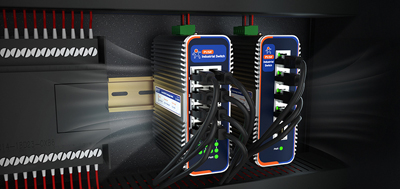
An industrial computer eventually goes into a cabinet or onto a wall, and mounting method and dimensions determine how hard the installation is. Workshops with rotating machinery and stamping equipment also bring continuous vibration: terminal blocks loosen and mechanical hard drives suffer. A fanless structure with no mechanical drive is less trouble.
How to check: confirm cabinet space, mounting hole positions and cable routing first, then choose the model.
Remote sites and equipment mounted in high places are not easy to reach. Whether a hung program resets itself, whether a changed configuration can be rolled back remotely, and whether firmware can be upgraded remotely determine whether maintenance requires a site visit. A dual hardware-and-software watchdog is the most direct indicator.
How to check: list the operations that must be done remotely, then compare them against the device's capabilities item by item.
For that 1990 machine, the trouble is not hardware but software. 32-bit Linux distributions are disappearing, and the Geode cannot run 64-bit binaries. Replacing the motherboard means an ISA-format industrial Atom board costing an order of magnitude more than an ordinary board. Part of what "industrial grade" costs goes into interface continuity and long-term serviceability.
How to check: ask three questions — how long the operating system is supported, whether the same series will be supplied long term, and whether the interface standard is still in the mainstream ecosystem.
Treating higher performance as a better fit for the site. Desktop-class high clock speeds usually come with high power draw and a fan, which makes cabinet temperature harder to control. On site, the bottlenecks are mostly power, temperature, interfaces and restarts, not compute.
Whether an industrial computer suits a site comes down to whether these seven items line up: temperature, cooling, power, interfaces, installation, unattended operation and longevity. None of them read clearly off a datasheet; site conditions have to be compared against them one at a time, and any item that does not match gets paid for later in maintenance labor.