Amid the wave of Industry 4.0 implementation, an increasing number of factory and production line practitioners have heard the claim that "installing a GPU in an industrial computer enables edge intelligence". However, many people fail to clarify the real value of GPUs, and often fall into the misconception of blindly stacking performance and wasting budgets during selection. To understand the practical role of industrial GPUs, we can start from the most fundamental core differences, and gradually sort out the tangible industrial pain points they can address.
Both are silicon-based microprocessors in computers, essentially data processing units, but their underlying design logics are completely different. This determines that their divisions of labor in industrial scenarios are vastly different:
Difference in Computing Logic: The CPU adopts a serial computing architecture, which can only process tasks one after another in sequence. It is equivalent to an experienced senior supervisor, good at handling scattered tasks with complex logic, ensuring the stable operation of the operating system and various conventional applications, and is known as the "brain" of the computer. The GPU, on the other hand, follows a parallel computing path. It can launch thousands of computing tasks simultaneously, equivalent to hundreds or thousands of skilled assembly line workers, who can process a large number of repetitive computing tasks in batches at the same time.
Difference in Core Scale: A CPU usually has only a few to dozens of cores. Even for embedded processors oriented to high-performance scenarios, the maximum number of cores is only a few dozen. However, a GPU can have hundreds or even tens of thousands of cores. For example, the NVIDIA Blackwell GPU for high-end industrial AI scenarios is equipped with 24,064 CUDA cores, plus an additional 752 5th-generation Tensor cores and 188 4th-generation RT cores specially designed for AI acceleration. Its computing power scale far exceeds that of a CPU of the same volume.
In short, CPUs are suitable for general-purpose work of "orchestration and scheduling", while GPUs are inherently designed for batch processing of high-concurrency intensive computing tasks. This is the fundamental reason why they can become the core computing power carriers for industrial edge intelligence.
In the early days, GPUs were only used to process image, 3D graphics and video rendering tasks. But with technological development, their parallel computing power advantages have been extended to more industrial fields. The core adaptation scenarios cover the following major categories:
The first category is industrial vision scenarios: real-time defect detection of assembly line products, identification of abnormal behaviors of personnel in the factory area, rapid inventory of workpieces in logistics warehouses, and real-time violation identification on intelligent traffic lanes. These scenarios need to process dozens or even hundreds of frames of high-definition image data every second. Without the support of GPU computing power, it is impossible to meet the requirements of real-time processing.
The second category is deep learning and AI inference scenarios: real-time calculation for predictive maintenance of equipment, dynamic intelligent optimization of production process parameters, and local deployment of large edge-side models. These scenarios require a large number of matrix operations. The Tensor cores of GPUs can increase the inference speed by dozens of times, and the results can be output locally without transmitting all data back to the cloud.
The third category is complex industrial data processing scenarios: batch cleaning of massive time-series data on industrial sites, real-time rendering of 3D industrial modeling, and real-time calculation of motion paths of industrial robots. For these tasks with high computing power requirements, the efficiency of GPU processing is several times higher than that of a pure CPU solution.
GPUs in industrial scenarios are mainly divided into two types: integrated GPUs and discrete GPUs. Many users cannot tell the difference between them, and it is easy to encounter problems of "overkill" or "insufficient computing power":
Integrated GPU (iGPU): It is directly built into the CPU and shares system memory with the CPU. Its advantages are extremely low power consumption and compact size. It is naturally adapted to the design of fanless industrial computers, can adapt to harsh industrial sites with heavy dust and strong vibration, fully meets the needs of lightweight image recognition and simple AI inference, and the hardware investment cost is controllable. The disadvantage is that due to memory sharing, when running heavy-load GPU tasks, it may compete for resources with the CPU, resulting in latency, and it is not suitable for running complex deep learning large models.
Discrete GPU: It is completely independent of the CPU and comes with exclusive high-speed video memory (VRAM). It can directly access the AI large model dataset, as well as the texture and geometric data of high-definition images, without occupying the running memory of the system CPU. Its performance in heavy computing power scenarios is extremely strong. However, discrete GPUs have high power consumption and generate a lot of heat during operation. Special heat dissipation design is required to avoid overheating and frequency reduction, and the overall hardware cost is also higher.
Many industrial users are prone to pitfalls when installing GPUs. For example, randomly selecting a PCIe slot leads to bandwidth waste, or failing to consider the harsh environment of industrial sites, resulting in equipment failures in less than half a year. To ensure the stable operation of industrial computers with GPUs, you can refer to these practical principles:
Prioritize GPU solutions with standard PCIe interfaces, which can be hardware-expanded through the PCIe slots built into industrial computers. For some special scenarios, you can also choose an external eGPU solution, which connects to a GPU docking station through Thunderbolt or USB-C interface to achieve computing power expansion.
Clarify the difference between PCIe slots and lanes: The physical sizes of PCIe slots are divided into x16, x8, x4 and x1, but the slot size is not equal to the actual available lane bandwidth. For example, some x16 physical slots are actually only connected with x8 lanes. For many lightweight industrial AI scenarios, PCIe 4.0 with x8 lanes can already provide a throughput of 128GT/s, which fully meets the computing power requirements. There is no need to blindly pursue full-speed x16 slots, and the saved expansion space can be used to connect other industrial peripherals.
Select an appropriate heat dissipation solution according to the on-site working conditions: For harsh sites with heavy dust and strong vibration, prioritize fanless industrial computers with integrated GPUs. They do not require fan air intake at all, so dust will not be sucked into the equipment, ensuring higher reliability. If a discrete GPU must be used, prioritize industrial computers with an isolated heat dissipation structure. The heat dissipation air duct of the GPU is completely separated from sensitive electronic components such as the motherboard, which not only ensures GPU heat dissipation, but also avoids dust pollution to core hardware.
Many factories have invested a large budget in building cloud AI platforms, only to find that they face obstacles everywhere in actual implementation. GPUs paired with industrial-grade industrial computers can precisely solve the core pain points of these traditional solutions:
Solve the high-latency pain point of cloud AI: The traditional model of "transmitting all on-site collected data back to the cloud for calculation" brings a latency of hundreds of milliseconds or even several seconds for the back-and-forth transmission of high-definition images and high-frequency sensor data. It cannot meet the requirements of real-time defect detection on assembly lines at all, resulting in a high missed detection rate. Industrial computers equipped with GPUs can complete AI inference directly on the production line locally, compressing the detection latency to within a few milliseconds. This can fully keep up with the operation rhythm of high-speed assembly lines and prevent unqualified products from flowing to the next process.
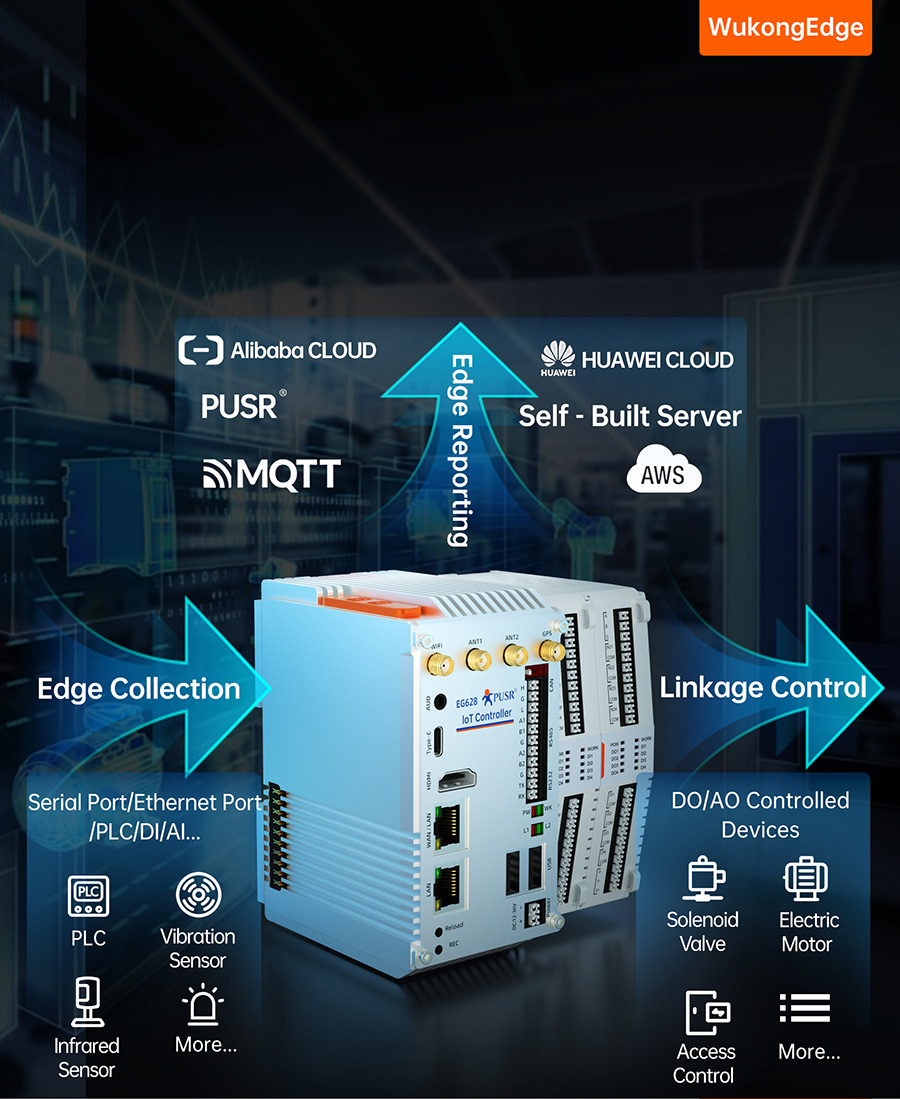
Solve the reliability pain point under complex working conditions on industrial sites: Ordinary commercial computing power equipment cannot withstand the wide temperature, high humidity and strong vibration environments in factories, and will frequently freeze and restart in less than a few months. For example, the USR-EG628 industrial controller with an integrated GPU is specially reinforced for industrial scenarios. You can complete the configuration quickly by referring to the official documentation, and finish the basic settings with zero prior experience following the quick application manual of USR-EG628. It can cover the needs of lightweight AI inference, conventional protocol conversion and data cloud uploading, enabling edge intelligence implementation without high hardware investment, and fully adapting to the harsh operating environment of factories.
Solve the bandwidth cost pain point of industrial data transmission: If all the terabytes of data generated every day by hundreds of high-definition cameras and thousands of sensors in the whole factory are transmitted back to the cloud, the annual bandwidth rental cost alone will reach hundreds of thousands, and a large amount of redundant data has no transmission value at all. GPU industrial computers can complete data screening, cleaning and pre-analysis locally, and only transmit the key data of abnormal events back to the cloud. This can reduce cloud bandwidth costs by more than 70%, and at the same time avoid information security risks caused by the external transmission of a large amount of sensitive production data.
GPUs in industrial scenarios are never a "performance gimmick of stacking parameters". They are computing power carriers that genuinely help factories reduce costs, improve efficiency and lower risks. By selecting a solution that adapts to your own scenarios, you can easily turn edge intelligence from a promotional concept into reality in every process of actual production.