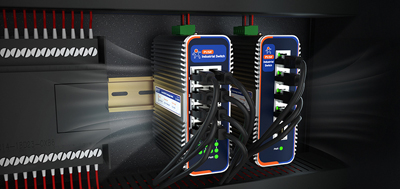
Guide to Avoiding Pitfalls in FSU Selection for Power Environment Monitoring: Why Ordinary Commercial Fanless Industrial PC Are Not Recommended as a Substitute for Industrial-Grade Gateways
In power environment monitoring scenarios such as machine rooms, base stations and outdoor power distribution rooms, the FSU (Field Monitoring Unit) serves as the "data nerve ending" of the entire system. Its stability directly determines the accuracy of power and environment data collection, the timeliness of alarm response, and even affects the operational safety of the entire infrastructure. Many purchasers, in order to cut initial costs during the selection process, attempt to directly use ordinary commercial fanless industrial PC as the core of FSU to replace professional industrial-grade gateways. However, they overlook the special working condition requirements of power environment scenarios, which leads to frequent hidden faults after deployment, and ultimately incurs higher operation and maintenance costs. From the perspective of practical power environment monitoring applications, this article breaks down the core differences between the two, helping you avoid common traps along the selection journey.
Many people's understanding of FSU stays at the basic level of "being able to collect data and upload it to the network". But the requirements for equipment in real power environment scenarios are far more stringent. Whether it is an outdoor base station in a remote mountainous area, a high-humidity underground power distribution room, or a meteorological station with a huge temperature difference span, FSUs often need to operate in unattended conditions for a long time. They must simultaneously meet multiple mandatory requirements, including extreme environment tolerance, heterogeneous multi-protocol interconnection, local edge linkage, no data loss during network disconnection, and information technology application innovation compliance. Ordinary commercial fanless industrial PC are originally designed for standardized office or lightweight operation and maintenance scenarios in constant-temperature machine rooms. From the very beginning of underlying hardware design, no targeted optimization has been carried out for these special requirements, so it is naturally difficult for them to adapt to complex power environment working conditions.
The normal operating temperature range of most ordinary commercial fanless industrial PC is mostly concentrated between 0℃ and 50℃, which can only adapt to standard machine rooms with precise air conditioning and constant temperature control. Once deployed in outdoor base stations without constant temperature conditions, weak current wells, or industrial plants with high dust levels, high temperatures in summer can easily trigger overheating and crashes of chips, while low temperatures in winter may cause condensation and short circuits on the motherboard. The equipment repair rate generally stays at a high industry level of 2% to 5%.
In contrast, professional industrial-grade gateway FSUs adopt industrial-grade wide-temperature components from the hardware selection stage. For example, models like the USR-EG628, which is optimized specifically for power environment scenarios, can stably support wide-temperature operation from -20℃ to +60℃, fully meeting the temperature requirements specified in YD/T 1068 "Technical Specifications for Power Maintenance in Telecommunications Stations (Sites)". Equipped with an all-metal anti-interference shell, it can operate stably for a long time in power distribution room environments with high humidity and strong electromagnetic interference. Its equipment repair rate is far lower than that of commercial devices, truly meeting the operation and maintenance requirement of "zero on-site attendance" for remote sites.
The interface design of ordinary commercial fanless industrial PCs is generalized. Most of them do not natively integrate DI/DO digital input and output interfaces. To implement instant control logic such as triggering exhaust ventilation via smoke alarms and linking water immersion detection to valve shutdown, additional serial port I/O modules must be connected externally. This not only increases the cost of hardware procurement and wiring, but also adds multiple extra fault points. More critically, the control logic of such devices mostly relies on cloud distribution. Once the on-site network fluctuates or disconnects, the local side completely loses linkage capabilities, and alarm information cannot trigger actions in time, which can easily lead to machine room safety accidents.
Professional industrial-grade gateway FSUs, on the other hand, natively integrate hardware I/O interfaces and support local logic programming on the edge side, with linkage response latency controlled within hundreds of milliseconds. Even if the network is completely interrupted, they can independently execute preset control strategies, eliminating the fatal problem of "losing control as soon as the network is disconnected". Taking the USR-EG628 as an example, its built-in WukongEdge edge intelligence platform supports graphical configuration of local linkage rules. Functions such as triggering air conditioning linkage when temperature and humidity exceed limits, and synchronously activating audible and visual alarms for smoke alarms can be realized without complex code development, fundamentally avoiding the response latency risk caused by cloud dependency.
The types of devices that need to be interconnected in power environment scenarios are extremely complex. UPS units, precision air conditioners, battery packs and access control systems from different manufacturers often adopt private Modbus protocols, and some old sites also need to be compatible with power communication protocols such as IEC 104 and DL/T 645. The protocol libraries of ordinary commercial fanless industrial PCs are mostly oriented to general scenarios, with extremely low adaptation to exclusive power environment protocols. When interconnecting non-standard devices, a large amount of manpower has to be invested in secondary development, which greatly prolongs the project implementation cycle. The hidden interconnection cost even far exceeds the procurement price of the device itself.
Industrial-grade gateways designed for power environment scenarios come with built-in protocol libraries of hundreds of mainstream power environment devices right out of the box. They support standard functions such as Modbus RTU two-way conversion and IEC 104 protocol reporting, and can directly interconnect with the vast majority of mainstream power and environment devices on the market. There is no need to develop protocols from scratch, which greatly reduces the on-site debugging difficulty for system integrators and improves project implementation efficiency by more than 60%.
The collection capabilities of ordinary commercial fanless industrial PC are usually not optimized for power environment scenarios. The upper limit of collection points for conventional models is mostly at the hundred-point level. When facing the access requirements of doubled supporting equipment in 5G base stations and thousands of sensor nodes in large and medium-sized machine rooms, data congestion and alarm delays are prone to occur. Many projects only discover in the later site expansion stage that the hardware computing power of commercial fanless industrial PCs cannot support the newly added collection points, so they have to replace all the equipment as a whole, resulting in a total waste of previous procurement costs.
Professional industrial-grade gateway FSUs are specifically optimized for massive node access. For example, the USR-EG628 can support up to 2000 collection points, and expansion can be completed through software authorization without replacing hardware equipment. It fully meets the long-term expansion needs of small and medium-sized macro base stations and regional convergence machine rooms, avoiding repeated investment in later iterations.
An FSU that is truly competent for power environment monitoring scenarios cannot only focus on superficial parameters such as "whether it can run the system". It must align with these core hard indicators: first, it must have an industrial-grade wide-temperature hardware design, complete domestic and foreign authoritative certifications such as 3C, CE and FCC, and be able to operate stably for a long time in complex working conditions; second, it must natively support the full series of mainstream power environment protocols, have local edge linkage capabilities, and be able to independently execute control logic even when the network is disconnected; at the same time, it must have sufficient redundancy of collection points to support smooth later site expansion; finally, it must be compatible with mainstream power environment monitoring platforms, support remote operation and maintenance debugging, and reduce the operation and maintenance cost of on-site business trips.
Industrial-grade intelligent control gateways built specifically for power environment FSU scenarios, such as the USR-EG628, not only retain the open expansion capabilities of fanless industrial PCs, but also make targeted enhancements in hardware reliability, power environment protocol adaptation and edge control capabilities. They perfectly avoid all kinds of shortcomings of ordinary commercial fanless industrial PCs, and are currently a cost-effective selection solution for power environment projects in small and medium-sized base stations, government and enterprise machine rooms, and outdoor power distribution rooms.
Power environment monitoring is the "invisible safety defense line" of infrastructure. Choosing ordinary commercial fanless industrial PC to replace professional industrial-grade gateways in pursuit of low initial procurement costs essentially turns the saved procurement costs into hidden operation and maintenance risks that may break out at any time in the later stage. Only by starting from the scenario's rigid requirements and selecting professional equipment that truly adapts to the complex working conditions of power environments can we achieve long-term stable unattended operation and maintenance, and fundamentally reduce the comprehensive cost of the entire life cycle.