Why Does the Energy Storage & PV Industry Prefer the USR-EG628? A Person Who Has Been Doing Power Station Projects for 10 Years Tells the Truth
In the last two or three years, if you visit any energy storage or PV power station project site, six or seven out of ten project managers have the same machine sitting in their cabinet — PUSR's USR-EG628.
This is no coincidence.
This machine, to be honest, doesn't have the most explosive specs, the most top-tier compute power, and it doesn't look the coolest. But it has quietly become the "default option" in the energy storage and PV circle.
Why?
In this article, I don't want to talk to you about technical specs. I want to talk to you about a more fundamental question — what kind of industrial computer does the energy storage and PV industry actually need? And why did the EG628 happen to hit every single point?
The project sites for energy storage and PV are completely different from manufacturing, logistics, or transportation.
It has a few very "brutal" characteristics, and these characteristics happen to be the "death points" for most industrial computers.
First, heat.
The electrical cabinet next to a PV inverter — in summer, direct sunlight hits it, and the temperature inside the cabinet easily soars above 55°C. Inside an energy storage container, it's even more extreme — battery heat dissipation plus ambient temperature, 60°C is the norm. You throw a regular industrial computer in there, the fan spins like a helicopter, dust builds up in half a year, it throttles in a year, and it quits in two years.
Second, scattered.
Energy storage stations cover hundreds of acres; PV stations stretch for dozens of kilometers. Equipment is extremely dispersed, and O&M personnel simply can't stand in front of every cabinet every day. What does this mean? It means your industrial computer must "handle things on its own" — if there's a problem, it can be remotely diagnosed, it can recover by itself, it can't wait for someone to show up to fix it.
Third, messy.
In one energy storage project, you have to connect to at least a dozen types of equipment: BMS battery management system, PC energy storage inverter, EMS energy management system, weather station, meters, fire system, video surveillance… The communication protocols are all over the place — RS485, CAN, Modbus, MQTT — all of them need to connect. If you pick a machine with not enough interfaces, the adapter modules alone can blow up your electrical cabinet.
Fourth, urgent.
Energy storage and PV is the hot industry of recent years, and project delivery cycles are being squeezed shorter and shorter. The owner is rushing, the general contractor is rushing, the grid-connection deadline is locked — you simply don't have time to slowly debug a complex industrial computer. What you need is — power on and it runs, drag-and-drop HMI to get screens up, ideally delivered today and online tomorrow.
You see, these four characteristics — high temperature, dispersed, messy interfaces, urgent schedule — any one of them alone is enough to give a selection engineer a headache. All together? That's simply "industrial computer selection hell."
And the EG628 happens to be custom-made for this "hell."
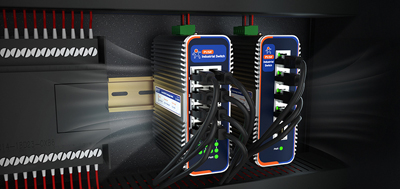
The EG628 uses a fanless passive cooling design.
What does this mean on an energy storage/PV site? It means you don't have to worry about fan dust buildup causing overheating and throttling. You don't have to worry about the fan failing and the whole machine going down. You don't have to worry about the fan spinning at max RPM in high heat, making noise that disturbs people.
The reference material says it clearly: "Fanless operation through precise component design ensures continuous operation even in settings where industrial PC are exposed to dust and other contaminants." In plain English — no fan means no biggest failure point, and the machine can run continuously and stably in dusty, high-temperature, harsh environments.
Inside the electrical cabinet of an energy storage station — high temperature, lots of dust — the EG628's fanless design is not a "bonus," it's a "must-have."
And it supports wide-temperature operation. You don't need to add extra AC, you don't need to add cooling fans, you don't need to do any environmental modifications — you just drop the machine into the cabinet and it works.
For a project manager, this saves not just money — it saves schedule.
To be honest, this is the EG628's most underrated and most valued feature.
Built-in HMI software.
What does that mean? You don't need to buy separate HMI software. You don't need to hire someone to write the upper computer. You don't need to debug communication drivers separately. The machine comes with HMI tools built in — you open it up, drag and drop screens, configure points, bind variables, and you can have the entire station's monitoring screens up in half an hour.
Do you know what this means for an energy storage/PV project?
It means your project delivery cycle can be shortened by 30%–50%.
It means you don't need to keep a dedicated HMI engineer on staff.
It means when the owner comes for acceptance, you can demo on the spot, instead of saying "wait two days, we're still tuning."
In the energy storage/PV industry where "speed is everything," built-in HMI is not icing on the cake — it's a lifeline.
The EG628 runs Linux and supports secondary development. This means you can customize flexibly based on project needs.
But more importantly, its base I/O configuration exactly covers the most common communication needs in energy storage/PV:
RS485 — connects to BMS, meters, inverters. This is the "number one communication protocol" in energy storage/PV.
Ethernet — connects to EMS, cloud platform, uploads data via MQTT/Modbus TCP.
CAN — some scenarios need to connect to PCS or automotive-grade energy storage systems.
You don't need to hang a bunch of adapter modules. You don't need to worry about not enough interfaces. You don't need to frantically add CAN cards and serial cards on the debugging site.
Clean, simple, done in one step.
As mentioned earlier, energy storage/PV stations have dispersed equipment, and O&M personnel can't stand in front of every cabinet.
The EG628 supports remote management. What does that mean? You sit in the central control room and you can see the status of every industrial computer in every cabinet: CPU load, memory usage, temperature, network connection… If there's a problem, remote reboot, remote upgrade, remote diagnosis — no need to send someone to the site.
This isn't "convenient" — this is "saving money."
For a 100MW energy storage station, one less trip to the site saves hundreds of yuan in labor + transport + lost work costs. Over a year, the O&M savings alone can add up to tens of thousands.
3.5 Fifth, It's a "Classic Bestseller" — Stability Is What Energy Storage/PV Can't Afford to Gamble On
The EG628 is PUSR's classic bestseller.
Why has it been a bestseller for so long? Because it's been validated by a massive number of projects.
The energy storage/PV industry has one characteristic: once a project is grid-connected, it can't have problems. A problem isn't just your problem — it's the entire station's power output, the owner's revenue, the grid's safety.
So the selection logic in energy storage/PV is different from other industries — you don't seek the strongest, you seek the most stable.
The EG628 runs Linux — stable, reliable, 24/7 non-stop operation, long lifecycle. It won't suddenly be discontinued, or have supply cuts, or lose support halfway through.
For energy storage/PV, "stability" is the biggest performance spec.
I don't want to blow the EG628 up into a miracle machine.
If you need 46T compute power for AI vision inspection, the EG628 isn't for you — look at the USR-EG1000.
If you need ultra-slim embedded installation, the EG628 isn't for you — look at the USR-EG218.
If your project has extremely complex interfaces and needs deep customization, the EG628's standard config might not be enough — look at the USR-EG828.
But if your project is an energy storage station, a PV station, needs fast deployment, needs stable operation, needs built-in HMI, needs to handle high temperatures — the EG628 is that "most right choice."
Not the most expensive, not the most powerful, but the most "right."
I know where you are right now.
The owner is rushing for a proposal, the general contractor is rushing for a quote, the site conditions aren't fully clear yet, and you're staring at a pile of industrial computer spec sheets — picking this one, you're afraid it's unstable; picking that one, you're afraid the interfaces aren't enough; picking the cheap one, you're afraid it'll break; picking the expensive one, you're afraid it'll blow the budget.
Stop overthinking it.
If your project is energy storage or PV, the EG628 is most likely your optimal solution.
It won't give you the most explosive specs, but it will give you the most solid delivery. It won't let you panic on the debugging site, but it will let you walk into project acceptance with confidence. It won't make you famous overnight, but it will let your power station run steadily for five years, ten years.
The energy storage/PV industry doesn't compete on who has the coolest machine. It competes on who has the most stable, fastest, most worry-free machine.