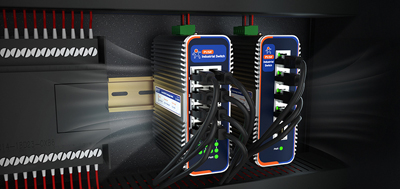
In the process of intelligent manufacturing and industrial digital transformation, the demand for equipment networking in a large number of manufacturing workshops continues to rise. Many engineers initially tried to use USB interfaces to complete data transmission and debugging of on-site equipment, but frequently encountered problems such as communication interruptions, data packet loss, and even interface damage during actual operation. Eventually, they found that ordinary USB solutions are completely unable to adapt to the complex and harsh industrial field environment.
The theoretical effective transmission distance of the ordinary USB protocol is only 5 meters. Even if extended through extension cables, it is difficult to break through the stable transmission upper limit of 10 meters. However, equipment such as PLCs, sensors, and meters in industrial sites are often distributed throughout production lines tens or even hundreds of meters away. USB cables simply cannot cover such long-distance transmission requirements. Forcing the extension will easily lead to signal attenuation and connection disconnection, which completely fails to meet the equipment networking requirements across workshops and regions.
Industrial sites are constantly subject to working conditions such as alternating high and low temperatures, strong electromagnetic interference, electrostatic shocks, and voltage surges:
Ordinary USB interfaces have no industrial-grade protection design. In environments below -20°C or above 60°C, internal components are prone to abnormal operation, and the plastic material of the interface will accelerate aging and cracking.
Electromagnetic interference generated by the operation of on-site motors and frequency converters will directly break through the weak signal transmission link of USB, resulting in distorted data transmission.
USB interfaces lacking ESD electrostatic protection and surge protection designs are easily burned out by on-site electrostatic shocks and voltage fluctuations, causing complete interruption of equipment communication.
USB is essentially a point-to-point short-distance communication protocol. It does not support distributed networking of multiple devices, nor can it directly access the Ethernet to realize remote data interaction. If manufacturing enterprises continue to use USB solutions, they can only connect to computers locally at the equipment to read data. They cannot realize centralized management of multiple devices on the production line, nor can they upload equipment data to the cloud or the central control platform. This completely fails to keep up with the development requirements of remote monitoring and centralized operation and maintenance in the Industrial Internet.
Ordinary USB connections are non-fixed pluggable connections, which are prone to interface loosening under scenarios such as equipment vibration in the workshop and accidental touches by personnel, leading to unexpected communication interruptions. At the same time, USB solutions do not have mechanisms for reconnection after network disconnection and data caching. Once the connection is disconnected, key production data will be lost directly. Subsequent troubleshooting and communication restoration require a large amount of manual operation and maintenance costs, which seriously affects the continuous production efficiency of the production line.
Aiming at the various failure pain points of USB in industrial scenarios, the serial to Ethernet converter has become the core solution for manufacturing enterprises to realize traditional equipment networking: it can transparently convert the data of serial port devices such as RS232/RS485/RS422 into TCP/IP protocol, and directly access the industrial Ethernet, completely breaking the limitations of traditional short-distance communication.
The transmission distance is no longer limited by the physical bottleneck of USB. Relying on Ethernet, remote data transmission of several kilometers or even across regions can be realized, which perfectly adapts to the distributed production line layout of large factories.
The industrial-grade serial to Ethernet converter supports wide-temperature operation from -40°C to 85°C, and has multiple protection capabilities such as built-in ESD electrostatic protection, electrical fast pulse immunity, and surge protection, which can fully resist complex interference in industrial sites and ensure 7*24-hour stable operation.
It supports simultaneous networking of multiple devices, and is compatible with mainstream industrial protocols such as Modbus RTU to Modbus TCP. Without hardware modification of the original old equipment, it can quickly access the enterprise's Industrial Internet platform, realize remote equipment monitoring, fault warning, and centralized data collection, greatly reducing operation and maintenance costs.
Starting from the R&D of Ethernet serial to Ethernet converters, PUSR has been deeply involved in the industrial communication field for more than ten years. As a national high-tech enterprise and a national "specialized, refined and new" small giant enterprise, PUSR relies on a 10,000-square-meter self-built factory to guarantee stable quality and delivery efficiency. With a R&D team accounting for 40% of the total staff, it has established a strict testing system covering the whole process. All products have passed multiple industrial-grade verifications such as high and low temperature environment tests, electrostatic protection tests, and surge immunity tests. So far, PUSR has accumulated practical application verification from 250,000 industry customers, with a global shipment volume of 30 million units. It can provide manufacturing enterprises with highly reliable and cost-effective overall serial port networking solutions, completely solve the failure problem of traditional USB solutions in industrial scenarios, and build a solid communication foundation for enterprises' digital transformation.