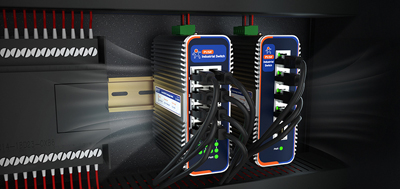
A recently released industrial gateway drew a long discussion in an overseas networking community, and three scenarios kept coming up — more telling than any product brochure:
① An ammonia compressor room. One operator had no choice but to rack a router inside the machine room, and later described that room flatly as "terrible" — heat, corrosive gas and constant mechanical vibration, all at once.
② An attic. Another was hunting for gear that survives high temperatures, for the simple reason that "it gets hot up there" — beyond the rated operating range of ordinary switches and routers.
③ An RV. One owner planned to replace a cloud gateway, a wireless AP and a PoE switch with a single box, and listed the requirements: wall-mountable, DC-powered, tolerant of vibration, dust and heat, then tucked behind a cabinet and never touched again.
Three scenarios, one fact: office-grade network gear placed in an industrial setting doesn't fail by accident. Failure is the norm — the only variable is how soon.
Four paths stand out:
Fans fail first.Commercial routers depend on fans for cooling. In dusty environments, filters and blades clog within months, bearings wear down, spin speeds drop, and the unit overheats and reboots. In the community discussion mentioned above, "fanless" was named by more than one user as the main reason for moving to industrial gear — not for silence, but because the fan is the first moving part in the box to die.
Temperature goes out of spec.Commercial equipment is typically rated for 0–40 °C. Compressor rooms, outdoor cabinets and attics cross that line easily in summer. Semiconductors running beyond their rated temperature for long periods show significantly higher failure rates.
Vibration shakes things loose.Vehicles, vessels, and cabinets bolted next to running machinery all live with constant vibration. RJ45 plugs, power connectors and plastic clips don't hold up under long-term micro-vibration. The resulting intermittent faults come and go with no pattern in the logs — the hardest kind to troubleshoot.
Power isn't clean.Industrial sites often offer DC power only, and contactors and variable-frequency drives push surges and transients back into the supply lines every time they switch. Equipment without EMC hardening responds with random reboots, corrupted data, or outright failure.
Swapping a commercial router for a tougher industrial router solves just a fraction of the problem. The full requirement at an industrial site is two things holding at the same time:
First, remote connectivity.Compressor rooms, remote pump stations and mobile equipment rarely have broadband. 4G cellular is often the only uplink, and the device has to provide routing and VPN to tie the field network back to the control center.
Second, data acquisition.Field devices speak Modbus RTU and PLC dialects, not IP. Temperature, pressure and current data stay locked inside PLCs and meters; getting them out, translating them into MQTT and delivering them to a cloud platform takes a protocol-conversion layer in between.
Put the two together and that is the product definition of an Industrial IoT Gateway. A device that only does the first is an industrial router; one that does both is an IoT gateway — the most commonly blurred line in product selection.
Take PUSR's edge computing gateway USR-M300 as an example, mapped point by point against the failure paths and the two requirements above:
Environmental endurance.Operating range of -25 to 75 °C covers unconditioned cabinets through winter and summer. Fully fanless, passively cooled — no moving part to clog. DIN-rail and wall mounting both supported, and rail clipping holds far better against vibration than a shelf placement. DC 9–36 V wide-range input draws power directly from 12 V or 24 V systems. Level-3 EMC protection deals with the electrical noise from contactors and drives.
Remote connectivity.Global-band 4G plus dual Ethernet ports (one configurable as WAN), with routing, VPN and firewall — the network exists even where no broadband reaches.
Data acquisition.One RS232/485 multiplexed serial port and one dedicated RS485, alongside 2 DI, 2 DO and 2 current-type analog inputs, connect directly to PLCs, drives and meters. Modbus RTU/TCP conversion and mainstream PLC protocols are supported, with up to 2,000 data points collected in parallel and reported over standard MQTT or TCP to PUSR Cloud, AWS, ThingsBoard and other platforms.
Edge computing.A dual-core 1.2 GHz processor running Linux, with Node-RED graphical programming built in. Data preprocessing and threshold alarms run locally on the gateway, with no cloud connection required.
On compliance, the M300 carries more than ten certifications including CE, FCC and ROHS, and meets the EU EN 18031 cybersecurity standard. For export projects or security-sensitive deployments, that line deserves a separate check during selection.
First, the site's realistic summer temperature peak against the device rating, with margin to spare. Second, what power the site actually provides — an AC outlet, or 12 V/24 V DC. Third, whether serial acquisition is genuinely needed: for connectivity alone, an industrial router is enough; for pulling data from PLCs and meters at the same time, an Industrial IoT Gateway is the right choice.