In the daily operations of cold chain warehousing, wireless coverage in low-temperature environments has long been a recognized technical challenge in the industry. Many enterprises invest heavily in deploying ordinary commercial APs, only to find that large signal dead zones still exist in areas such as deep inside cold storage, along the sides of high racks, and between freezer equipment rooms. PDA scanners frequently drop connections, AGV navigation disconnects, and temperature/humidity sensor data uploads are delayed—directly reducing the efficiency of cold chain cargo inbound and outbound operations, and even creating food safety compliance risks due to gaps in temperature control data.
The core issue here has never been insufficient AP transmit power, but rather the multiple attenuations of wireless signals caused by the special environment of cold chain scenarios, combined with the inability of ordinary networking equipment to operate under extreme -30°C conditions.
Breaking it down from a technical perspective, the WiFi coverage pain points in cold chain warehousing are essentially the superposition of three contradictions: "environmental characteristics + network architecture + equipment reliability."
Cold chain warehouses commonly use polyurethane insulation panels as the envelope structure. The interior of such materials contains a large number of closed-cell foam structures that strongly absorb WiFi signals in both the 2.4G and 5.8G bands. After penetrating insulated partition walls, ordinary commercial AP signals can attenuate by over 60%. Combined with multiple reflections and obstructions from densely stacked frozen goods and metal racks, signal dead zones easily form in aisle ways and cold storage corners.
Ordinary commercial switches typically have an operating temperature range of 0°C to 40°C. When deployed directly inside a -30°C cold storage, the internal capacitor parameters drift and crystal oscillator frequencies shift. This not only causes the equipment to reboot repeatedly, but also causes the data transmission packet loss rate to spike above 15%, completely failing to meet the 7×24 hour uninterrupted operation required by cold chain logistics.
Traditional solutions require every AP to be connected to a switch via an Ethernet cable. Extensive cabling inside a cold chain warehouse not only requires drilling holes in the insulation layer—compromising the cold storage's thermal performance—but also significantly increases installation costs. Subsequent adjustments to the warehouse layout entail extremely high retrofit costs for adding new coverage points.
To achieve comprehensive WiFi coverage without dead zones in cold chain warehousing under extreme -30°C environments, the "Wi-Fi 6 + Mesh networking" solution powered by industrial switches is the optimal approach proven through numerous project deployments.
The core logic of this solution is threefold: use Wi-Fi 6 technology to increase the concurrent capacity of each AP, use Mesh self-organizing network architecture to eliminate reliance on full-point cabling, and rely on the hardware reliability of industrial switches to ensure long-term stable operation of the entire network in low-temperature environments—attacking the cold chain coverage challenge from three dimensions simultaneously.
In cold chain warehouses, large numbers of PDA scanners, temperature/humidity tags, and AGV vehicles are online simultaneously. Ordinary Wi-Fi 5 networks easily suffer from channel congestion. Wi-Fi 6's OFDMA technology, however, can divide a single channel into multiple sub-channels, allocating resources to dozens of terminals at the same time, increasing terminal capacity by more than 3× under the same bandwidth. Combined with the 1024-QAM higher-order modulation scheme, single-stream throughput can reach 1.2 Gbps, fully meeting the demand for simultaneous data upload from numerous terminals in cold chain scenarios.
Real-world test data shows that under full load with 50 connected PDAs, the average transmission latency of a Wi-Fi 6 network can be stably controlled within 5 ms—far lower than the 30 ms latency of traditional Wi-Fi 5 networks—completely eliminating the lag issues where scanned data fails to upload promptly.
This architecture requires only one wired main AP deployed in the weak-current room outside the cold storage. All other sub-APs distributed inside the cold storage and along rack sides only need a power source; they can establish wireless backhaul links over the 5.8G band, automatically forming a self-organizing and self-healing mesh network. There is no need to drill numerous holes through the insulation layer for cabling, which both preserves the cold storage's thermal integrity and shortens the overall construction timeline by 70%.
When the cold chain warehouse adjusts its layout or adds a temporary frozen zone, simply powering on a new sub-AP allows it to automatically join the existing network and extend coverage—no new cabling required, and retrofit costs are nearly negligible. Additionally, the Mesh architecture supports the 802.11r fast roaming protocol, allowing mobile terminals like PDAs and AGVs to switch between APs in under 10 ms, completely eliminating roaming disconnections and ensuring uninterrupted network connectivity throughout mobile operations.
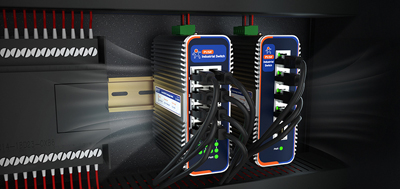
Ordinary commercial switches cannot operate in low-temperature environments and must be deployed outside the cold storage, where long-distance Ethernet cable runs cause signal attenuation. Industrial switches, in contrast, feature all-metal fanless heat dissipation designs and use wide-temperature components throughout. They can be deployed directly inside equipment cabinets within the cold storage, providing PoE power and data forwarding to nearby main APs and surveillance cameras. This not only shortens cable distances and reduces signal attenuation, but also guarantees continuous operation without downtime in extreme -30°C environments.
Furthermore, industrial switches have surge-proof and static-proof port designs. Even when facing electrostatic discharge shocks generated by the low-temperature, dry environment inside cold chain warehouses, they operate stably without port burnout or network disconnection failures.
Among the many industrial switch products suitable for cold chain scenarios, the USR-ISG is a high-reliability option with targeted optimizations. Its hardware is fully designed to industrial standards, with an operating temperature range covering -40°C to 85°C. It can be deployed directly inside -30°C freezer rooms without the need for additional insulated enclosures, significantly reducing deployment costs.
All ports support IEEE 802.3af/at standard PoE power delivery, with a maximum output of 30 W per port, capable of directly powering Wi-Fi 6 APs without separate power adapters, simplifying cabling complexity inside the cold storage. It also supports intelligent link backup: when the Mesh primary link experiences brief interference, the switch automatically switches to the backup link within 20 ms, ensuring no data transmission interruptions. This guarantees that temperature and humidity monitoring data in the cold chain is never lost, meeting food cold chain compliance traceability requirements.
Multiple deployed project measurements show that the Wi-Fi 6 + Mesh networking solution powered by the USR-ISG industrial switch achieves full coverage without dead zones across a 12,000 m² cold chain warehouse using only 8 APs. The average signal strength for all terminals is greater than -65 dBm, and the data upload success rate reaches 99.99%, thoroughly resolving the signal dead zone problem that has long plagued cold chain warehousing.