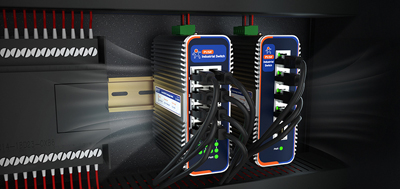
You Spent 20 Million on a Power Station — But Manage Its Data with a $30 Cellular Wi-Fi Router?
A Fact You Don't Want to Face
Let me ask you a question first.
What percentage of your distributed energy project's total investment goes to communication?
5%? 3%? Some projects — less than 1%.
You spend heavily on solar panels, on storage batteries, on inverters. For communication? You grab any cellular Wi-Fi router off the shelf. As long as it connects, it's fine.
But here's a number nobody in the industry wants to say out loud:
80% of "data anomalies" in distributed energy projects don't come from equipment. They come from communication.
It's not that the solar panel broke. It's that the data didn't come through — so you thought it broke.
It's not that the storage had an incident. It's that the alert was delayed by ten minutes — so you thought it was fine.
It's not that the turbine stopped. It's that the cellular Wi-Fi router crashed — so you thought the turbine stopped.
You think you're managing a power station. In reality, you're managing a bunch of invisible network cables that can snap at any moment.
This article isn't about solar, storage, or batteries. It's about one thing:
From the rooftop to the basement, from the solar panel to the storage cabinet — that "communication line" you never took seriously. How should it be built to actually support your 20-million-yuan asset?
Most people's requirement for communication: "as long as it's online."
That works fine at home. In a distributed energy scenario, it's fatal.
Why? Because when your home network drops, you can't watch videos. When a power station's network drops, you lose data, alerts, subsidies, and safety.
Between "connected" and "data collected," there are three pits you never thought about:
1.1 Protocol mismatch.
Your solar inverter speaks Modbus RTU. Your turbine speaks IEC 104. Your storage BMS speaks CAN-to-MQTT. These are industrial devices' "native languages."
A standard cellular Wi-Fi router only speaks HTTP. You ask it to listen to Modbus — it doesn't understand. Data comes in as garbage. The cloud platform can't parse it. The big screen stays blank.
You think data is flowing. In reality, it's spinning in place.
1.2 Not enough bandwidth.
A rooftop station: 30 inverters, each spitting out dozens of data points per second. A standard cellular Wi-Fi router can't handle the forwarding load. Packets start dropping.
1% packet loss? You think it's nothing. But 1% × 30 units × 86,400 seconds — that's over 20,000 lost data points per day. Over a month, your generation stats are always lower than reality.
You explain to the client: "the data has some error." The client doesn't care. He only looks at results.
1.3 Zero real-time capability.
A standard cellular Wi-Fi router has no edge judgment. All data goes to the cloud. The cloud analyzes. Then pushes alerts. The whole loop: 30 seconds to 3 minutes is normal.
3 minutes. The window for battery thermal runaway is 3 to 5 minutes. By the time you get the alert, the window is already closed.
You don't have "connectivity." You have "disconnectivity."
Someone says: just run fiber, right?
Can you? Yes. But have you run the numbers?
A 500-site distributed energy project — if every site runs fiber, construction costs alone run into the millions. Rooftops need drilling. Mountaintops need poles. Basements need trenching. Timeline: three months minimum.
And fiber has a fatal flaw: it's fixed.
You run fiber to the rooftop today. Tomorrow you add ten more panels and two more inverters — the fiber isn't enough. You re-run it.
Turbines on mountaintops may shift position with the seasons. The fiber you ran last month is already wrong.
The essence of distributed energy is "scattered." Scattered means wired solutions can never keep up with change.
So the real answer for this scenario isn't fiber. It's industrial-grade wireless communication.
But not a standard 4G cellular Wi-Fi router. The kind that can actually survive industrial environments.
What does it need to survive? Three words: concurrency, disconnection, environment.
Concurrency: dozens of devices pumping data in simultaneously — no clogging.
Disconnection: signal drops without warning — it must survive on its own, without losing data.
Environment: 60°C on rooftops, -20°C on mountaintops, hot and humid in basements — the device can't be picky.
Only something that meets all three deserves to be called the "communication backbone" of distributed energy.
I've seen too many projects treat the cellular Wi-Fi router as an "accessory."
During procurement: the equipment is the star, the router is a filler. During selection: the inverter gets compared across three vendors, the router is whatever's cheapest that works.
This is a structural mistake.
Think about this chain:
Sensor → Collector → Cellular Wi-Fi Router → Public Network → Cloud Platform → Monitoring Screen → Your Decision
The cellular Wi-Fi router sits right in the middle.
In front of it: all your device data. Behind it: all your basis for judgment. If it goes down — everything before it is wasted collection, everything after it is wasted visibility.
It's not a supporting role. It's the lifeline of the entire chain.
When the lifeline breaks, it's not a "data is a bit slow" problem. It's a "you have no idea what's happening" problem.
That's why I say: the communication budget shouldn't be 1% of total investment. It should be the money you least afford to cut.
Cut that budget, and you'll spend ten times more to make up for it later.
Scenario A: Rooftop Solar — "Data Exists, But It's Wrong"
A rooftop station at an industrial park: 2MW, 40 inverters, one standard 4G cellular Wi-Fi router.
After six months of operation, the client noticed: the generation shown on the monitoring platform was 8% lower than the meter readings.
They checked everything. Inverters: fine. Meters: fine. Final finding: the cellular Wi-Fi router was dropping packets badly in high heat. Every day from 11 AM to 2 PM, packet loss hit 15%.
Those three hours are peak generation. Data lost = generation underreported.
The client doesn't care about "it was too hot at noon." He only looks at numbers.
After replacing the cellular Wi-Fi router: hardware forwarding engine, no throttling in high heat, packet loss below 0.1%. Data accurate. Client says nothing.
Scenario B: Commercial Storage — "Alert Arrived, But Too Late"
A factory basement storage: 500kWh, BMS data uploaded through a standard cellular Wi-Fi router.
One time, battery temperature spiked. The BMS triggered an alert. But the router was busy uploading a batch of historical data. The alert got stuck in the queue — sent out 4 minutes later.
4 minutes. By the time O&M received the alert and arrived on site, the battery had already triggered secondary protection and forced a shutdown.
Factory halted for half a day. Loss: several hundred thousand yuan.
After replacing the cellular Wi-Fi router: edge judgment, local alert trigger, no queue, no waiting. From anomaly to push: 1.5 seconds. O&M hadn't even finished their water — the alert was already there.
Same project. Different router. Completely different outcome.
It's not that the router is magic. It's that the one you were using before didn't belong on that chain at all.
No fluff. Three hard specs. Lock these down during selection and you won't go wrong:
| Spec | Why It's Non-Negotiable | Minimum Standard |
|---|---|---|
| Edge Collection Protocols | Without Modbus/IEC104/MQTT, collected data is useless | Must support Modbus TCP + MQTT at minimum |
| Multi-Link Auto Failover | Single-SIM 4G in mountains/basements is gambling | Must have dual-SIM + watchdog |
| Industrial Wide Temperature | Rooftop 60°C, winter -20°C — standard routers can't handle it | -40°C ~ 75°C |
If any one of these is missing, don't even consider it.
Distributed energy has been built aggressively in the past two years. But the communication layer? Most projects are still at the "good enough" stage.
You spent 20 million building the asset — then managed its data with a $30 cellular Wi-Fi router.
That's like building a skyscraper with a manual elevator. The building is done. But nobody can get up.
Communication isn't a cost. It's infrastructure. It doesn't generate power directly — but it determines whether your power can be seen, measured, and protected.
If you're in the selection phase, take a look at the USR-G809s. Dual-SIM 4G, edge collection, industrial wide temperature, watchdog, cloud management — covers both rooftop solar and commercial storage. It's not the only option, but under these requirements, the number of products that tick all these boxes is small — and it's one of them.
Of course, it ultimately depends on your site count and protocol needs. If the specs match, go for it. If they don't, keep looking.
Don't save money on the backbone. Because when the backbone breaks, everything above it is empty.