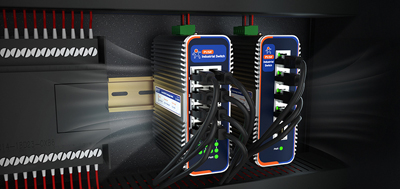
The day the router arrives, it gets clipped onto the DIN rail in the cabinet, the antennas are tightened, the DC terminals are wired, and a laptop is plugged in. What happens during the next twenty minutes decides much of what this device will cost to maintain over the following years.
Inside the web interface of an industrial wireless router, VLAN, VPN, firewall, static routing, NAT and port forwarding usually sit side by side at the same menu level. Configuring all of them before powering up and testing is the most common way to start, and also the hardest to recover from later: when an HMI panel cannot read its PLC, nobody can tell which rule is blocking the traffic.
A different order works better. One thing per round, verify immediately, and step back one level if the check fails.
The management address and the initial credentials are printed on the chassis label or listed in the quick start guide. Set the laptop to an address on the same subnet and the login page opens in a browser — the usual defaults are 192.168.1.1 with the account admin. Once inside, the first action worth taking is replacing the default password with one that belongs to the site.
Teams often leave this until the end, after dozens of units are already installed; logging into each one afterwards costs noticeably more than doing it on the spot. Verification is straightforward: try the old credentials once more. Being unable to log in is the expected result.
Many configurations start planning forwarding paths at this stage. The order should be reversed — establish first that this device can reach the outside at all. One question settles it: is fixed-line broadband available at this location?
If it is, the wired WAN port becomes the primary link. If not, cellular carries the traffic. If both exist, the second one becomes a backup rather than a second active path. On models such as the USR-G806w, cellular, wired and Wi-Fi access can back each other up, and the link recovers quickly when a fault occurs.
Two things stall this step more often than anything else. One is a private APN or VPDN SIM issued by the carrier: until the APN field matches what the carrier assigned, the cellular link never registers, and the symptom looks like a dead unit rather than a missing parameter. The other is a second router or a switch already sitting in the cabinet — if machines hang behind it, a static route pointing to that subnet has to exist on the industrial router before any traffic can find its way back. Both are worth ruling out before touching anything else.
Verification here takes hands. With the link up, unplug the Ethernet cable, ping the far end from the device that actually carries production data, and time the recovery. Whether it takes tens of seconds or several minutes, and whether the process tolerates that, becomes known now instead of after commissioning, when the first call comes in from the site.
Segmentation is less about enabling VLANs and more about deciding identities first: which devices must see each other, and which pairs create risk by seeing each other at all. PLCs and the supervisory computer need to talk. Inspection cameras and the office network usually do not.
With identities clear, the rules stay simple: one allow rule naming source, destination, protocol and port, and one deny-all rule underneath. Order matters — allow rules first, the catch-all deny last. A reboot before testing again is cleaner than repeatedly pressing save-and-apply in the interface.
More Ethernet ports make this step cheaper. The USR-G809s provides two WAN/LAN combo ports, six LAN ports and two SFP cages, one of them shared with its electrical port so it runs either copper or fiber. Device classes can therefore be wired to separate ports first and mapped into VLANs afterwards. Serial devices and discrete signals in the same cabinet can also come in over the built-in RS485/RS232 and DI/DO without an extra gateway in between.
Remote access sits second to last. Broader VPN support on a single unit leaves more room to match whatever platform the end customer already runs — OpenVPN, IPsec, PPTP, L2TP and GRE are the five that come up most often.
Enhanced OpenVPN is valuable mainly because it lowers the skill floor. It can act as a client connected to three different VPN servers at once, or act as the server itself, and it accepts a one-click import of the .ovpn configuration file together with the PKCS#12 certificate, so no long parameter list has to be typed in by hand. For an electrical engineer with no background in certificates, that difference is practical rather than cosmetic.
After fleet commissioning, day-to-day work rests on two things. One is a remote management platform able to open the router's built-in web page for parameter changes, reboots and firmware upgrades. The other is alerting on the three events worth knowing about — device offline, weak signal, traffic allowance exceeded — pushed by email or SMS, with repeated push supported. The USR-G816 covers both, and adds dual SIM slots that can back each other up across two carriers, which suits vehicle fleets and field cabinets spread over wide areas.
Once the configuration is final, export it to a file whose name carries the site number and the date. A factory reset happens sooner or later — sometimes somebody only wanted to glance at basic information on the display, held the button a little too long, and took the unit back to its shipping state. On a unit with an OLED display such as the USR-G809s, a short press of one to three seconds switches the screen while a long press of five to fifteen seconds triggers the reset; the boundary between those two gestures belongs on a label inside the cabinet rather than in a manual nobody opens.
For a manufacturer still choosing models, without a dedicated network engineer on staff, the decision narrows to two questions. Whether the port count is enough decides whether a port-rich model like the G809s is needed. Whether the link needs a backup decides whether dual SIM and automatic failover on the G816 earn their place. Everything else can be enabled round by round in the order above, staying half-usable even while only half-configured.
An industrial wireless router is rarely difficult because it has too many features. It becomes difficult when those features are never put in order.