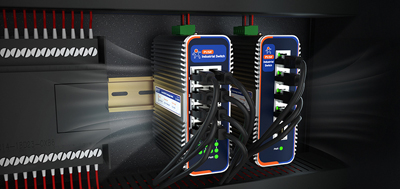
Explosion-Proof Certification + Electromagnetic Shielding: Precise Navigation for the "Last Mile" of Safe Communication of RS485 to Ethernet Converter in Flammable and Explosive Chemical Workshops
In the production sites of the chemical industry, flammable and explosive gases are omnipresent, and electromagnetic interference lurks like an undercurrent. When the Distributed Control System (DCS) needs to achieve Modbus-to-TCP/IP communication with intelligent instruments through an RS485 to Ethernet converter, the dual challenges of explosion-proof certification and electromagnetic shielding stand as two formidable mountains on the road to data transmission, posing the "last mile" dilemma for safe communication in chemical workshops. This article delves into this pain point and explores how technological breakthroughs can achieve precise navigation, helping chemical enterprises overcome communication challenges.
The air in chemical workshops is filled with flammable and explosive gases such as hydrogen and methane, where any tiny electrical spark can trigger a catastrophic explosion. Traditional RS485 to Ethernet converters, lacking explosion-proof certification, are like lit matches in a powder keg, becoming a "safety minefield" that enterprises dare not touch. A fertilizer plant once experienced an explosion caused by a short circuit in a non-explosion-proof RS485 to Ethernet converter, resulting in significant casualties and property damage. Subsequently, the demand for explosion-proof equipment among enterprises shifted from "optional" to "essential," yet products that have truly passed authoritative explosion-proof certifications such as Ex ib IIC T4 Gb are scarce in the market.
Electromagnetic interference generated by equipment such as motors and frequency converters in chemical workshops acts as an invisible "data killer," causing communication interruptions and data loss. In the temperature monitoring system of a reactor in a petrochemical enterprise, electromagnetic interference prevented the DCS from reading data from intelligent instruments, leading to temperature runaway and raw material scrapping, with direct economic losses exceeding one million yuan. The enterprise attempted to mitigate interference by adding filters and optimizing wiring, but the effects were limited, and operational and maintenance costs increased.
Faced with the dual challenges of explosion-proof certification and electromagnetic shielding, customers generally exhibit the following psychological states:
Safety Anxiety: Fear of the potential risks associated with non-explosion-proof equipment leads them to prioritize safety over efficiency.
Technological Skepticism: Doubts about the actual effectiveness of electromagnetic shielding technology arise, with concerns that it may only address symptoms rather than root causes.
Cost Sensitivity: The high cost of explosion-proof equipment makes customers worry about an imbalanced return on investment, trapping them in a dilemma of "not daring to use" and "not being able to use."
True explosion-proof equipment requires optimization for intrinsic safety throughout the entire chain, rather than relying solely on casing protection. Taking the USR-TCP232-302 RS485 to Ethernet converter as an example, its explosion-proof design covers the entire process from chip selection and circuit design to casing protection:
Chip-Level Protection: The use of low-power chips reduces heat generation, minimizing the risk of electrical sparks at the source.
Circuit Optimization: Techniques such as isolation transformers and optocoupler isolation block electrical connections, preventing energy transfer.
Casing Protection: An aluminum alloy casing, passing the IP67 protection level test, can withstand dust, water splashes, and mechanical impacts.
This device has passed the Ex ib IIC T4 Gb certification and can operate safely in high-risk explosive environments with IIC-class gases such as hydrogen and methane. The temperature group T4 indicates that its surface temperature does not exceed 135°C, well below the ignition temperature of flammable gases.
Electromagnetic shielding technology must address both the goals of "preventing external interference from invading" and "avoiding internal radiation leakage." The USR-TCP232-302 achieves electromagnetic compatibility through the following designs:
Shielding Layer Design: A copper foil shielding layer is placed around the circuit board, forming a "Faraday cage" to block external electromagnetic fields.
Filter Circuits: Filters are installed at the power input and signal output ends to suppress high-frequency noise.
Grounding Optimization: A single-point grounding design is adopted to avoid ground loop interference and ensure signal stability.
Actual measurement data shows that the device maintains a communication bit error rate below 0.001% under an electromagnetic field strength of 10V/m, meeting the stringent electromagnetic environment requirements of chemical workshops.
In the ethylene oxide reactor scenario of a chemical enterprise, the USR-TCP232-302 faced the following challenges:
Temperature Shock: The temperature around the reactor fluctuates between 50°C and 120°C.
Gas Corrosion: The air contains 0.5% hydrogen chloride gas.
Vibration Interference: The reactor body vibrates at a frequency of 10Hz with an amplitude of 2mm.
Test results showed:
The device operated continuously for 720 hours at 120°C with a communication packet loss rate of 0%.
After hydrogen chloride corrosion testing, the change in contact resistance was less than 5μΩ, meeting the IEC 60068-2-42 standard.
During vibration testing, the serial port connector remained loose-free, and data transmission was error-free.
In the raw material warehouse of a fertilizer plant, the USR-TCP232-302 had to cope with:
Dust Concentration: The PM10 concentration in the air reached 5mg/m³.
Temperature Fluctuations: The day-night temperature difference reached 40°C.
Network Delay: Uneven Wi-Fi signal coverage in the warehouse resulted in delay fluctuations of up to 200ms.
Through the following optimizations:
Adding a dust screen to block 99% of particles larger than 5μm.
Adopting adaptive baud rate technology to dynamically adjust the communication rate based on network delay.
Enabling a heartbeat packet mechanism to detect connection status every 10 seconds.
The final results achieved were:
The device operated in the dusty environment for six months without clogging of the cooling vents.
Data transmission delay remained stable within 50ms.
The completeness rate of instrument data collection reached 100%.
The integration of explosion-proof certification and electromagnetic shielding technology upgrades communication safety in chemical workshops from "post-event remediation" to "proactive prevention." The USR-TCP232-302 supports remote management through the USR Cloud platform, enabling real-time monitoring of device temperature, voltage, and communication status, and providing 30-day advance warnings of potential failures to avoid safety accidents caused by communication interruptions.
Production Line Utilization: A chemical enterprise reduced production line downtime from 120 hours per year to 10 hours through stable communication.
Data Utilization: Real-time data collection shortened the production optimization cycle from once a week to once a day.
Compliance Costs: With improved completeness of environmental data, annual penalty expenditures decreased by 80%.
The USR-TCP232-302 supports remote management through the USR Cloud platform, improving operational and maintenance efficiency by five times:
Fault Warning: Real-time monitoring of device status through temperature and voltage sensors provides 30-day advance warnings of potential failures.
Batch Configuration: Simultaneous firmware upgrades for up to 200 devices reduce the time required from 16 hours to 20 minutes.
Cost Analysis: Generating reports on device energy consumption and failure rates helps optimize procurement strategies.
In flammable and explosive chemical workshops, explosion-proof certification and electromagnetic shielding technology serve as the "safety armor" and "immune system" for communication equipment, erecting a dual defense line for data transmission. The USR-TCP232-302 RS485 to Ethernet converter successfully overcomes the "last mile" dilemma of safe communication in chemical workshops through full-chain intrinsic safety design, electromagnetic compatibility optimization, and scenario-based validation, enabling data to flow smoothly like blood and devices to operate steadily like hearts. When technological breakthroughs deeply resonate with industry needs, the digital transformation of the chemical industry is entering a new stage—where safety and efficiency have become ingrained instincts.