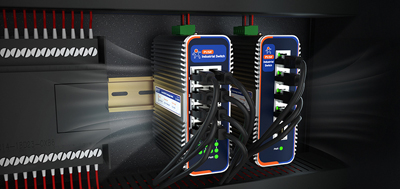
A renewable-energy operations team ran into a situation like this: more than 70 sites across the country — over 50 PV plants, 10+ energy storage stations, and 10 hydropower plants — each with nearly identical network infrastructure: a 4G router with an IoT SIM card, a few unmanaged switches, an NVR with 7 to 15 IP cameras, an alarm system, and fiber receivers plus media converters pulling distant devices into the network.
That setup ran for years without issues. Things changed when the company started planning a second-level SCADA system: data from dataloggers and PLCs had to reach an external server, and the equipment requirements turned into a long checklist:
This checklist is fairly typical for distributed industrial sites. Going through it item by item: points 1, 3, 4, and 6 are well within reach of an ordinary industrial cellular router. The real sticking point is point 2 — because "supports industrial protocols" is an ambiguous phrase.
The first is passing protocol traffic: when Modbus TCP runs between a PLC and a SCADA server, the router simply routes and forwards, never touching the payload. Any industrial cellular router can do this.
The second is protocol conversion: reading Modbus RTU data off an RS485 bus, converting it to Modbus TCP for the local SCADA, or packaging it as MQTT messages for a cloud platform; going further, acting as an OPC UA server or client so upstream systems can subscribe to field data points directly.
The second is where IIoT data acquisition actually gets hard. It requires a serial port, a built-in protocol stack, and edge processing capability — none of which are "networking features" in the usual sense. In a traditional architecture, this means deploying a separate protocol gateway next to the router: two devices, two configuration interfaces, two failure points.
The answer is yes — provided the selection process distinguishes which kind of "support" the spec sheet is referring to. The verification method is straightforward:
Check for a serial port.Beyond its 4 gigabit Ethernet ports and dual SIM slots, the USR-G816 includes one RS232/RS485 interface. A serial port means the industrial cellular router can attach directly to a Modbus RTU bus, pull data up from the dataloggers, and — in Modbus gateway mode — convert RTU to TCP, serving both the local HMI and the remote server. For a site preparing to add SCADA, that serial line is essentially a dedicated channel for the dataloggers.
Check how deep the protocol stack goes.Edge routers such as the USR-G809s ship with built-in protocol libraries for Modbus TCP/RTU, MQTT, and OPC UA, plus a Python development environment and local storage — field data can be cleaned and cached on the industrial cellular router side first, so nothing is lost during a network outage and backfilled once the link recovers. The value of OPC UA lies in its security model: certificate-based encryption and subscription-based push make it far better suited than plaintext Modbus TCP for sending data across public networks.
Check that the networking features are still complete.After taking on gateway duties, the industrial cellular router must not lose its day job: VLANs, VPN (OpenVPN, IPsec, etc.), DDNS, dual-SIM backup, and WAN failover are all standard on the G816 and G809s. At remote sites where LTE is the only option, dual SIM and link backup directly determine the availability of the SCADA data path.
Point 3 deserves a separate note. When a site's SIM card runs over its data cap, the post-mortem usually points to one camera or NVR quietly syncing to the cloud in the background. Traffic analysis therefore cannot stop at total volume — it needs to see anomalies and raise alarms proactively. The G816's approach: device offline, weak signal, and traffic overrun all trigger real-time alerts via email or SMS, with no centralized management platform required. For teams on a tight budget with no plans to buy management software, this kind of local, out-of-the-box alerting is the most practical option.
There is also a lesson in network sequencing: put SCADA on its own VLAN as early as possible. Even if only two or three segments exist today, reworking the network after PLC data comes online doubles the effort.
Most distributed renewable-energy sites rely solely on LTE; fiber is the exception. Grouped by site type:
Back to the question in the title: can one industrial cellular router handle Modbus TCP, MQTT, and OPC UA at the same time? The key is telling "pass-through" apart from "conversion". Confirm three things during selection — the serial port, the depth of the protocol stack, and edge capability — and a single router plus the existing switch can carry the full chain from field data acquisition to cloud upload, with no extra gateway stacked next t