Cross-Border Cold Chain Data Export Compliance Risk? How Industrial Switches' "Regionalized Storage" Meets GDPR
The European market offers high margins, strong customer stickiness, and high entry barriers. But what truly blocks you is never product quality, never price competition —it's compliance.
Your cold storage temperature and humidity data, pharmaceutical warehousing records, supply chain logistics information — all flowing across borders every day. Inside this data: personal information of EU citizens, health-related sensitive data, operational information that could be classified as "important data."
And your IT architecture? Probably still one system connecting the globe, all data sent back to the domestic HQ cloud platform for unified management.
Five years ago, nobody cared. Today, that bomb could go off at any moment.
GDPR Article 44 is crystal clear: Personal data transferred cross-border to a third country must ensure the recipient provides a protection level equivalent to the EU. Can't do it? Fines up to4% of global annual revenue.
For a cold chain company with 1 billion in annual revenue, that's 40 million.
This isn't "might get fined." It's"will definitely get investigated."In 2025, EDPB enforcement cases on cross-border data transfers grew 37% year-on-year. Customs, drug regulators, data protection authorities — three-way coordination is now the norm.
You don't lack the will to comply. You just don't know where to start.
Most cross-border cold chain companies run this data architecture:
European Cold Storage Sensors → POE Industrial Switch → 4G/Ethernet → Domestic Cloud Platform → HQ Dashboard
Looks smooth. But every hop is a compliance minefield:
| Link | GDPR Risk | Real-World Consequence |
|---|---|---|
| Data sent back to China | Violates data localization requirements (GDPR Articles 44–50) | Cross-border transfer lacks adequacy decision |
| Unified cloud storage | EU citizen data stored in a third country, protection level not equivalent | Deemed illegal transfer |
| HQ unified access | Domestic O&M staff can access EU data, lacks access control | Violates data minimization principle |
| Centralized logs | Operation logs cross borders, cannot meet 6-month local retention (MLPS 2.0 + GDPR Article 30) | Audit non-compliant |
Even trickier: cold chain data isn't just temperature and humidity. Pharmaceutical cold chain also involves patient records, medication logs — this falls underGDPR Article 9's "special category data" (health information), with a processing threshold one level higher than ordinary personal data.
Once caught, it's not just a fine —your entire European operation could be shut down.
This isn't alarmism. In 2024, a well-known multinational pharma company was ordered to rectify by the Dutch DPA for sending European GSP temperature data to a non-EU cloud platform. European operations were suspended for 3 months.
What you thought was "unified management" is, in GDPR's eyes,"running naked."
GDPR's core logic is actually simple:data is processed where it's generated. Unless necessary, it doesn't leave.
Applied to cold chain, the compliant architecture should look like this:
European Cold Storage Sensors → POE Industrial Switch (Local) → European Edge Node → Local Storage + Local Alarms → Only anonymized statistical data sent back to HQ
The key change?Data no longer exits the border.
All raw temperature/humidity data, device logs, alarm records — everything stays in Europe locally. What HQ sees is only anonymized statistical reports — e.g., "European cold storage average temperature 2.1°C, compliance rate 99.7%."
This is the core idea behindGDPR Article 45's "adequacy decision": You don't need to prove the data transfer is secure. You just need to provethe data never left.
But here's the problem: with so many devices in the cold chain field, how do you ensure data doesn't cross borders?
The answer is hiding in a device you might have overlooked —the POE industrial switch.
Many think data compliance is a cloud thing, a software thing. But in reality, the decisions on where data is aggregated, where it's stored, where it's forwarded —all happen at the on-site network device.
The POE industrial switch is the "gatekeeper" making those decisions.
Next-generation POE industrial switches support local data aggregation and preliminary storage. Temperature/humidity sensors, PLCs, BMS devices in the cold storage — all data aggregated locally at the switch,no need to upload to any cloud.
This means: from the moment raw data is generated, it has never left EU territory.
Compliance isn't just "data doesn't leave." It's also "operations must be compliant."
POE Industrial switches with edge computing can run a rules engine locally: temperature exceeds limit → local alarm triggered → local refrigeration linkage → alarm records stored locally.
The entire chain bypasses the cloud, involves no cross-border transfer. Even if HQ's network goes down, the European cold storage runs independently and stays compliant.
This is especially critical for surprise inspections — what drug regulators check is "has the data chain ever broken? Are records stored locally?" Local rules engine + local storage, done in one step.
Cold chain field devices are a mess of brands and protocols: RS485 temperature sensors, Modbus PLCs, ZigBee wireless probes… Traditional setups need a protocol converter for each — long chains, many failure points, data flow hard to trace.
Multi-protocol POE industrial switches let all sensor data be accessed, processed, and output locally in one place.Data flow is clear and auditable, meeting GDPR Article 30's requirement to "record all data processing activities."
GDPR Article 30 requires: logs of all data processing activities must be retained for at least 6 months. MLPS 2.0 has the same requirement.
POE Industrial switches support distributed local log storage, searchable by time, device type, and log level.Logs never leave the factory, never cross borders, never get lost, never get tampered with.During an audit, pull them directly — no need to dig through a domestic cloud platform.
A cross-border cold chain company, 12 cold storages in Europe, originally sent all data back to China for unified management. Before vs. after:
| Metric | Before | After (Regionalized Storage) |
|---|---|---|
| Data crosses border? | All sent back to China | Zero raw data export, only anonymized stats sent back |
| GDPR compliance status | High risk, repeatedly questioned by DPA | Fully compliant, passed annual audit |
| Surprise inspection response time | 15 minutes (cloud forwarding delay) | 30 seconds (local rules engine trigger) |
| Network outage impact | All cold storages go offline | Each storage runs independently, no cross-impact |
| Audit logs | Scattered across domestic cloud, slow to retrieve | Locally retained, one-click search |
It's not that the equipment got more expensive. It's that the architecture got right.
If you're doing a GDPR compliance retrofit for European cold chain, or you're already on DPA's radar, lock onto these four when selecting an industrial switch:
| Spec | Why It's a Hard Requirement | Pass Line |
|---|---|---|
| Local Data Storage | Prerequisite for zero data export | Must support local caching/storage, cannot force cloud upload |
| Edge Rules Engine | Alarms and linkage work even when network is down — this is the GSP + GDPR dual floor | Must support local logic, cannot depend on cloud |
| Multi-Protocol Access | Cold chain sensors are mixed brands — one device must handle them all | Modbus + RS485 + ZigBee, at least two protocols |
| Industrial-Grade Wide Temperature | Cold storage runs -25°C to -10°C — consumer gear quits immediately | Operating range at least -30°C to 75°C |
| Certification Coverage | Exporting to Europe without full certs = wasted money | CE is mandatory, EN 18031 series is even stronger |
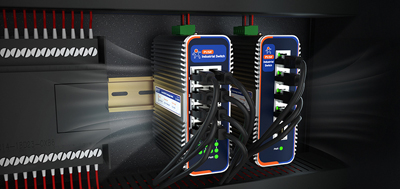
If you want to avoid repeated selection pitfalls, take a look at the Industrial Switch. It has built-in edge computing, supports local rules engine and multi-protocol collection, industrial-grade wide-temperature design, full CE certifications, and already has many deployed cases in European cold chain and energy storage scenarios. It's not the only option — butchoosing the right direction is what keeps DPA off your back.
GDPR isn't checking whether you have a monitoring system installed. It's checking whether your data has ever left the place it was supposed to stay.
Network down? What then. Cloud platform shut down? What then. DPA surprise audit? What then.
There's only one answer:Keep the data on-site. Put the judgment at the edge. Weld compliance into the architecture.
This isn't a tech upgrade. It's the entry ticket to the European market.
You can dislike GDPR. But you can't pretend it doesn't exist.