Centralized Monitoring of Multiple Robots Lags? How "Virtual Serial Port Shunting" of Serial Device Servers Boosts Data Throughput
3 a.m. The phone rings.
It's the workshop director. Voice low, but you can hear it shaking.
"The monitoring system froze again. All six AGVs are stuck in the aisles, interlocks won't release, dispatching system won't refresh status. Line's been down for forty minutes. The client's people are already on the road."
You sit up. First thought isn't "how to fix it." It's—
Again.
Third time this month.
First time: two AMRs reported status simultaneously, screen froze, eight minutes to recover. Second time: four AGVs' serial data crammed together, dispatching system got all garbled, two carts hit the guardrails. Third time: right now.
You hang up. Open remote desktop. Watch the monitoring software's CPU usage—97%.
You stare at that number for a long time.
Then you make a decision: tomorrow, no matter the cost, this problem gets solved. For good.
Let me ask you: where exactly does your robot monitoring system get stuck?
Most people's first reaction: "the server is bad." CPU too old, not enough RAM, graphics card can't handle it. So you swap the server, add RAM, put in SSDs.
Does it help?
Yes. For two weeks.
Because you haven't found the real bottleneck.
The real bottleneck isn't the server, isn't network bandwidth, isn't the database—it's the serial port.
Every AGV, every AMR, the underlying communication is serial. RS-232, RS-485, baud rate 115200 or 921600. One robot spits out a few hundred bytes per second—position, speed, battery, sensor status, fault codes.
One robot, a few hundred bytes. Doesn't sound like much.
But what about ten? Twenty? Fifty?
Ten robots, 500 bytes each per second—that's 5KB per second. Still doesn't sound like much. But the problem isn't data volume—it's how serial ports work.
Traditional serial communication: one line, one device. Your monitoring system needs to read ten robots' data simultaneously—so you open ten serial ports, or poll one port sequentially.
What's polling? Asking one by one.
"Robot One, what's your status?"—wait.
"Robot Two, what's your status?"—wait.
...
"Robot Ten, what's your status?"—wait.
Then start over.
Ten robots, one polling cycle—the fastest one waits nearly a full second before being asked again.
One second. On a factory floor, one second is enough for an AGV to move 300mm, enough for a robot arm to complete half a cycle, enough for a safety interlock to go from "normal" to "stale."
Your monitoring screen freezes—not because the server is slow, but because your data arrives too slow, too chaotic, too uneven.
Like ten people pouring water into one funnel with one opening. Of course it clogs at the bottom.
That's what "virtual serial port shunting" solves.
Most people's understanding of a serial device server still stops at "converts serial to Ethernet."
"It's just a protocol converter, right? I'll buy a cheap one."
That was fine five years ago. Today, it'll kill you.
Because today's robot clusters aren't one or two units. Your factory might have 30 AGVs, 20 AMRs, 15 robot arms, 8 conveyor lines—all uploading data via serial ports.
Hundreds of serial ports, thousands of data streams, all flooding into your monitoring system at once.
A traditional serial device server: one Ethernet port per serial port. Data arrives, still queues up one by one. Essentially, it just moves the "physical bottleneck" from the shop floor to the server room. The bottleneck stays.
A real serial device server doesn't do "conversion." It does "shunting."
What's virtual serial port shunting?
Simply put: at the network layer, one physical serial port is virtualized into multiple independent logical channels. Each channel has its own buffer, its own priority, its own flow control.
Analogy time.
Traditional serial device server: like a toll booth with one window. Whether you're an ambulance or a truck, you wait in line.
Virtual serial port shunting: like a toll booth with ten windows, each with smart routing—ambulances take the ETC lane, trucks take the regular lane, green-pass vehicles go first.
Data doesn't queue. It flows in parallel.
What does this mean for robot monitoring?
It means your monitoring system can receive every robot's data simultaneously, independently, in real time—no polling, no waiting, no fear that one device's data delay drags down all the others.
Each AGV's status update interval changes from "determined by polling cycle" to "pushed the moment data arrives."
From "ask everyone, wait a second" to "every robot is real-time."
That's the power of shunting.
I've talked to many factory automation leads. Their fear of monitoring lag goes far beyond "choppy screen."
What they truly fear is the loss of control.
Picture this:
Your monitoring screen shows ten AGVs all "running normally." Green, all green. You relax, grab a coffee.
But in reality, AGV Three's battery is at 12%. Its data, clogged by serial congestion, hasn't updated in three minutes. The "normal" on your screen is cached data from three minutes ago.
Three minutes later, AGV Three runs out of power in the middle of the aisle.
The carts behind it don't know. They keep going.
Collision.
You get called back. You check the monitoring logs. There's a warning: "Serial Port 3 data timeout"—timestamped four minutes ago.
Four minutes. You had four minutes to intervene. You didn't know.
That's the scariest part. Not the lag itself—it's the information black hole behind the lag. You don't know which device's data is real-time, which is delayed, which is offline but still shows "online."
Virtual serial port shunting doesn't just solve throughput.
It solves "every device's data is traceable, verifiable, trustworthy."
Because each virtual channel has independent traffic stats, error detection, heartbeat mechanisms. Which channel is clogged, which is dropping packets, which device's data latency exceeds the threshold—the system tells you instantly, down to the millisecond, down to the device ID.
You're no longer "don't know where things will go wrong."
You're "already know before anything goes wrong."
I know what you're thinking.
"We've got twenty devices now. Polling works fine. We'll deal with it when we have more."
I've heard that a hundred times.
And then?
Devices go from twenty to forty. Polling cycle goes from 500ms to 2 seconds. Monitoring starts lagging occasionally. You endure it.
Up to sixty. Polling cycle hits 4 seconds. Data delay appears. You add a server.
Up to eighty. Two servers can't handle it. You start thinking about edge computing gateways.
Up to a hundred. You realize the whole architecture needs to be torn down and rebuilt.
Every time you "make do," you dig a hole for the future. And that hole will wake you up at 3 a.m. someday.
A serial device server isn't a "nice-to-have" gadget. It's the foundation of your entire robot communication architecture.
If the foundation is crooked, no matter how tall you build, it's a condemned building.
Virtual serial port shunting isn't a "premium feature." It's the only path from twenty devices to two hundred.
Those few thousand yuan you save today will become hundreds of thousands in architecture overhaul costs tomorrow.
By now, you're probably asking: what kind of serial device server should I pick?
My advice: three words—look at throughput.
Not port count. Not appearance. Not brand.
Look at whether it can guarantee no data loss, no delay, no congestion on every virtual channel under full load.
Many serial device server on the market claim "supports multi-device connection," but in reality all devices share one internal buffer. Data piles up, internal queuing starts—no different from polling.
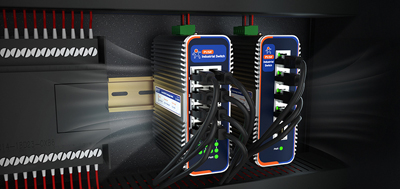
The ones that do it right, like the USR-N520, do virtual serial port shunting at the hardware level. Each serial channel has its own independent FIFO buffer and DMA transfer path. Data comes in from the serial port, goes straight to the corresponding virtual channel—no CPU queuing.
Four serial ports, each shunting independently, total throughput reaches Mbps level. Supports TCP Server, TCP Client, UDP modes—plugs straight into your SCADA or MES system.
And it's fanless, metal housing, wide-temperature design—drop it straight into the electrical cabinet. No extra cooling, no dust or vibration worries.
You don't need the most expensive one. You need the one that won't become a bottleneck at your device count and data rate.
If you've read this far, you probably already know where the problem is.
Your monitoring system lags—not because of the server, not because of the network, not because of the software.
It's because your serial communication architecture was never built for "multi-device concurrency" from the start.
You're using single-channel thinking to manage a multi-channel world.
Virtual serial port shunting isn't some black magic. It just turns "one road" into "many roads," turns "wait in line" into "walk simultaneously."
But that one change turns your monitoring system from "barely usable" into "truly reliable."
It lets you stop answering that 3 a.m. phone call.
It lets your engineers stop staring at 97% CPU usage in a daze.
It lets every AGV and AMR be seen, every second be heard.
Not "good enough." "Not a single device can be lost."
That's what industrial communication should look like.