In CNC machine workshops filled with metal cutting dust and oil mist spray, an industrial PC is never a device that can be replaced by "just buying an ordinary computer off the shelf."
Many plant maintenance personnel have had similar experiences: a newly installed ordinary industrial PC starts showing fan noise, frequent hard drive errors, poor interface contact, or even causes an entire batch of workpiece machining accuracy to be scrapped due to sudden system crashes within less than three months.
In such scenarios, the core of industrial PC selection is never about pursuing the highest specifications, but about ensuring 7×24 hours of stable operation in harsh environments. This is also where many beginners in selection are most likely to make mistakes.
The environment in CNC machine workshops is a completely different world from ordinary offices. Several invisible critical issues happen to be design blind spots of commercial computers.
First is the continuous intrusion of metal dust. Large amounts of suspended iron and aluminum filings are highly conductive. Once they enter the chassis through cooling fans and adhere to motherboard circuits, they can cause a sharp drop in cooling efficiency and frequent CPU throttling at best, or directly lead to short circuits and board burnout at worst. Many fan-cooled industrial PCs have their heat sink fins completely clogged with dust after just three months of operation, doubling the probability of system crashes in high-temperature summer environments.
Second is the ubiquitous vibration and shock. The continuous vibration generated by high-speed CNC cutting, conveyor belt operation, and heavy workpiece handling causes the heads of ordinary mechanical hard drives to reset frequently, greatly increasing the rate of bad sectors. A slight severe impact may directly result in loss of production data. Many factories overlook this detail and use ordinary fan-cooled industrial PCs to run MES data collection, only to have the hard drive fail during the night shift, losing the entire day's production records.
Third is the connectivity challenge of mixing old and new equipment. In many domestic CNC machine workshops, equipment that has been in service for over a decade runs alongside newly purchased machines. Older equipment only supports RS232/RS485 serial communication, while new machines use Gigabit Ethernet to interface with PLCs. Ordinary commercial computers either lack enough serial ports or have only one network port, making it impossible to connect to multiple machine tools simultaneously. The final workaround involves adding extra converters, which significantly compromises stability.
Fourth is the compounding effect of extreme temperature and humidity. The emulsified fluids used in metal cutting processes generate large amounts of oil mist. In summer, localized temperatures in the workshop often exceed 40°C. Ordinary industrial PC motherboards lack protective treatment, and in an environment of oil mist and high temperature, interface pins quickly oxidize and rust, leading to frequent communication interruptions.

For these specific pain points, selection should not focus solely on CPU specifications. Instead, priority should be given to building a core selection logic around "environmental adaptability"—a general industry practice validated through extensive on-site experience.
First, a fanless passive cooling structure must be prioritized. The fully enclosed chassis design fundamentally prevents metal dust from entering the interior, completely avoiding failure risks caused by fan dust accumulation and bearing wear. The body uses die-cast aluminum alloy integrated heat sink fins to evenly conduct CPU-generated heat to the housing. Even in workshops exceeding 40°C, it can run stably for extended periods without any fan maintenance concerns.
Second, the protection rating must meet standards. The complete unit should achieve at least IP60, with IP65-rated products being highly recommended. All interface positions should be equipped with waterproof and dustproof plugs, ensuring that even if oil mist and metal dust settle directly on the surface, they will not penetrate the internal circuitry. The body surface should feature anti-corrosion spray coating to prevent rusting or paint peeling from prolonged exposure to emulsified fluid volatiles in the workshop.
Third, storage and structure must be shock-optimized. Mechanical hard drives should be abandoned in favor of solid-state drives as the storage medium. SSDs have no moving head structure and can withstand high-intensity vibration and shock, preventing production data loss. The complete unit should adopt a screw-less reinforced structure, with all boards secured by clips and metal pressure bars to prevent loosening or solder joint failure from long-term vibration.
Finally, interface configuration must accommodate the mixed-equipment workshop scenario. At least two Gigabit Ethernet ports, two or more RS232/RS485 serial ports, and sufficient USB interfaces are required. This setup can interface with both the Ethernet protocols of new machines and the serial communication of older equipment, eliminating the need for unstable external converters. A single device can thus simultaneously connect to multiple CNC machines and PLC equipment.
Many selection personnel focus only on processor spec comparisons, overlooking several critical details that determine long-term stability. The result is that the equipment they purchase appears to have high specifications but proves impractical in the actual workshop environment.
First, do not blindly pursue high-performance processors. Many assume an i7 is necessarily better than a Celeron. However, in metal dust workshops, most use cases involve data collection, protocol conversion, and edge computing, where low-power processors are entirely sufficient. High-power processors generate more heat, increasing cooling pressure and making overheating and throttling more likely in sealed fanless enclosures.
Second, do not ignore wide-temperature and wide-voltage designs. Voltage fluctuations frequently occur in workshop power grids during machine start/stop cycles. Industrial PCs must support 9-36V wide-voltage input with built-in overvoltage and reverse-connection protection, preventing sudden restarts caused by voltage variations. The operating temperature range should cover -10°C to 60°C, ensuring normal startup even in unheated northern workshops during winter.
Third, do not skip conformal coating to save costs. Industrial PCs with motherboards and interfaces treated with conformal coating protect circuits from corrosion in oily and humid environments. While this cost may seem minor, it directly extends equipment service life by 2–3 years, making it an extremely cost-effective configuration.
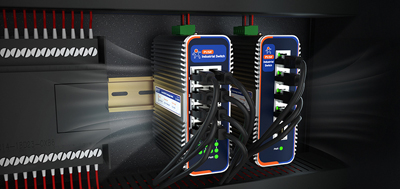
Fourth, confirm the mounting method in advance. Control cabinet internal space in CNC machine workshops is typically very tight. Prioritize compact industrial PCs that support wall-mounting and DIN-rail installation, requiring no additional cabinet space and allowing flexible placement on machine sides, control cabinet inner walls, and other locations.
Based on the diverse application scenarios in CNC machine workshops, multiple industrial PC from PUSR can precisely match different needs without incurring extra costs for unused features.
For core workstations that need to connect to multiple machine tools, run MES systems, and host local data dashboards, the EG628 is a highly suitable choice. It features a fanless fully enclosed design, is powered by a high-performance x86 processor, and offers multiple network and serial ports to connect to multiple CNC machines simultaneously. Its IP rating fully protects against metal dust intrusion, ensuring stable 7×24-hour uninterrupted operation.
For space-constrained small control cabinets that only need to connect to 2–3 machines for basic data collection, compact fanless industrial PCs like the EG228 are more than adequate. Its small size, low power consumption, and flexible wall-mounting capability fully meet the basic networking needs of ordinary small-to-medium workshops.
For edge data collection nodes prioritizing low power consumption and long-term stable operation, the EG528 an ARM-based industrial PC offers clear advantages. With extremely low overall power consumption and a fully dustproof passive cooling structure, it is suitable for deployment in every corner of the workshop, reliably uploading data over extended unattended periods.
If your core need is to uniformly collect and convert data from old machines with different protocols in the workshop and upload it to upper-layer platforms, the EG828-EMS is a gateway industrial PC specifically designed for energy and production management. It comes with a rich protocol library, enabling rapid data integration between old and new equipment without additional development.
For lightweight edge computing and data preprocessing in the workshop, the EG828-GL ARM embedded industrial PC offers ample computing power and strong interface expandability. It can perform local data filtering, reducing cloud transmission load.
For small workshops with limited budgets that only need to connect a few older devices for basic networking upgrades, the EG118—a highly cost-effective ARM industrial PC—is fully capable, achieving initial digital upgrades at a lower cost.
In summary, industrial PC selection for metal dust CNC machine workshops essentially follows a decision-making logic of "environmental adaptability first, computing power second." There is no need to blindly pursue high-end configurations. Choosing the right product for the specific scenario is the true key to achieving long-term stable operation and avoiding the extra costs of frequent maintenance down the line.