Many solar inverters come with two communication options: some models feature a native Ethernet port running Modbus TCP, while others retain only an RS485 serial interface transmitting data via Modbus RTU. System integrators connecting these inverters to monitoring platforms often face a question—should they use the inverter's native Modbus TCP, or add an RS485 to Ethernet Converter?
The answer lies not in price, but in the inverter's built-in communication capability.
Inverters with Ethernet ports (such as the Huawei SUN2000 and SMA Sunny Central series) have a TCP/IP protocol stack built in at the chip level. Port 502 directly listens for Modbus TCP requests. A PLC, SCADA system, or monitoring software connects to a switch via a single Ethernet cable and reads registers using standard Modbus TCP format. The MBAP header replaces CRC checksums, the unit identifier replaces the slave address, communication speed is fast with low latency, and multiple devices each occupy an independent connection for concurrent polling efficiency far exceeding RS485 buses.
These inverters need no converter. Connect them to an existing industrial Ethernet, set the IP addresses, and the monitoring polls them point-to-point.
Many photovoltaic inverters—especially residential and small commercial string models—offer only an RS485 communication interface. The chips cannot support TCP/IP natively. Every Modbus RTU frame the inverter outputs carries a slave address, CRC checksum, and serial timing. Such devices can never directly respond to Modbus TCP requests.
An RS485 to Ethernet Converter is needed here.
The converter performs two core tasks: on one side, it connects as a Modbus RTU slave on the RS485 bus; on the other, it acts as a Modbus TCP server listening on port 502 over Ethernet. When a PLC or host PC sends a Modbus TCP request to the converter, the converter unpacks the TCP frame into an RTU frame, sends it to the RS485 bus, and upon receiving the slave's response, repackages it into TCP format. To the client, it appears as a device accessible via an IP address, completely unaware of the RS485 link behind it.
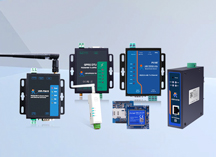
Take the PUSR USR-TCP232-304 as an example. This single-port RS485 to Ethernet Converter has built-in Modbus gateway functionality, supporting Modbus RTU to Modbus TCP protocol conversion. Its operating mode: RS485 side connects to the inverter, Ethernet side provides a standard Modbus TCP interface as a TCP server. The PLC reads data without needing to know what happens on the RS485 bus.
|
Comparison |
Modbus TCP (Native Port) |
RS485 + Converter |
|
Physical Connection |
Ethernet cable directly to switch |
RS485 cable to converter, converter Ethernet to switch |
|
Communication Speed |
10/100 Mbps adaptive |
Limited by RS485 baud rate (commonly 9600–115200 bps) |
|
Polling Efficiency |
Each device on independent connection, concurrent polling |
All devices share one bus, poll time increases with slave count |
|
Cable Distance |
100m per segment, extendable via switch |
RS485 single segment up to 1200m (at low baud rates) |
|
Additional Hardware |
None |
Converter + power supply |
|
System Cost |
Lower |
Additional converter procurement and maintenance cost |
If the inverter has a native Ethernet port, use Modbus TCP directly. No extra hardware needed, shortest signal chain, fewest failure points.
If the inverter has only an RS485 interface and data needs to reach an Ethernet-based monitoring system, an RS485 to Ethernet Converter is the most straightforward solution. It transparently places serial devices on the Ethernet network, allowing clients to read via standard Modbus TCP without changing the existing architecture.
This scenario is common in photovoltaic station retrofits involving older inverter models with only RS485. Through a single RS485 to Ethernet Converter, existing serial inverters can integrate directly into an Ethernet-based monitoring system without replacing inverter hardware.
Modbus RTU runs over serial buses (RS485/RS232), relies on slave addresses for polling, and frames include CRC checksums. Modbus TCP runs over Ethernet, uses IP addresses and port numbers (default 502) for addressing, and replaces CRC with an MBAP header. Both read and write the same set of register addresses with identical protocol logic—only the transport medium differs.
It cannot replace it, only bridge it. The converter allows RS485 devices that lack Ethernet support to be accessed by Modbus TCP clients, but the underlying mechanism remains "half-duplex serial + protocol conversion." Communication speed and concurrency are constrained by the physical limitations of the RS485 bus and cannot match native Modbus TCP performance.
An RS485 bus theoretically supports up to 256 nodes (with high-impedance transceivers), but in actual engineering practice, 16–32 devices is recommended to maintain polling efficiency and communication stability. The more inverters on the bus, the longer each full poll cycle takes.
There will be slight latency. RS485 baud rates are typically 9600 or 19200 bps, and converting an RTU frame from serial to TCP introduces processing delay. For photovoltaic inverter monitoring (where refresh cycles are generally in the seconds range), this latency is negligible. However, if millisecond-level real-time response is required, selecting devices with native Modbus TCP support is recommended.
Mainstream products like the PUSR USR-TCP232-304 provide a web-based configuration interface. IP addresses, ports, and operating modes can be set through a browser without installing additional software. The RS485 side baud rate, data bits, stop bits, and parity must match the inverter's settings.
Photovoltaic station environments typically feature wide temperature swings, electromagnetic interference, and thunderstorm conditions. An industrial-grade RS485 to Ethernet Converter should offer: -40℃ to +85℃ wide temperature operation, 1.5kV or higher electromagnetic isolation, port surge protection (compliant with IEC 61000-4-5), metal chassis for heat dissipation, and 5–36V DC wide-voltage input with reverse polarity protection.
In transparent transmission mode, the converter performs no protocol parsing—it simply packages raw RS485 bytes into TCP packets, suitable for private-protocol non-Modbus devices. In Modbus gateway mode, the converter parses Modbus RTU frames, actively polls RS485 slaves, and maps the collected data into Modbus TCP register spaces. The PLC side does not need to handle complex RTU timing and CRC processing.
In most cases, no. Common causes of RS485 instability include: terminal resistors not connected or incorrectly placed, A/B wire polarity reversed, star topology instead of daisy chain on the bus, shield layer not grounded creating ground loops, and duplicate slave addresses on the same bus. Physical cabling and parameter configuration should be checked first before investigating the converter itself.