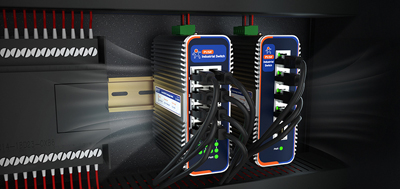
A while back, a buyer ended up with a fanless industrial PC he had bought mostly because it looked interesting: 10 Ethernet ports (8 of them PoE+), an Intel 6500TE processor, 4 GB of expandable DDR4, no fans — just a giant heatsink. He measured it drawing about 23 W idle and roughly 30 W during video playback, installed Debian on it, and planned to use it as a NAS. Then he asked around for other ideas.
If you are holding a box like that, one answer writes itself: run it as a PoE NVR for IP cameras. One industrial PC powers the cameras, pulls their streams, records 24/7, and — because it is a real Linux or Windows machine instead of a locked-down NVR appliance — does the things consumer NVR boxes do badly or not at all: local AI detection, custom alerts, off-site backup, integration with your existing systems. Here is how to actually build it.
A PoE NVR only has four jobs. Keep this list in mind and every decision downstream gets easier:
Power the camerasover Ethernet (PoE) ;
Pull the video streams(almost every IP camera speaks RTSP) ;
Record continuously or on motion, reliably, for weeks ;
Detect and notify— ideally without shipping video to a cloud service .
A consumer NVR does jobs 1–3 out of the box and job 4 poorly. An industrial PC does all four, because you choose the software.
Check your industrial PC's LAN ports first — do they carry PoE?
If yes(like that buyer's machine with 8 PoE+ ports): plug cameras straight in. Eight PoE+ ports means up to eight cameras, each drawing up to 30 W, with no extra hardware.
If no— and most industrial PCs, including ours, ship with standard Ethernet ports — the pattern is: cameras → PoE switch → industrial PC. One uplink between switch and computer carries all the streams.
Do the power budget before ordering the switch. A typical PoE IP camera draws 4–13 W; a PTZ camera with heaters can peak near 25 W. Eight standard cameras run comfortably on a switch with a 120–150 W PoE budget. Give yourself about 1.5× headroom over your calculated load, because cameras draw extra at boot and at night (IR LEDs).
This is where an industrial PC beats an NVR appliance — you run what you want:
Linux ARM (Ubuntu): Frigate for AI-backed event detection, ZoneMinder or Shinobi for classic continuous recording. All three install via Docker. Our EG-series industrial PCs ship with Ubuntu and Docker pre-installed, so setup is genuinely a docker run command, not a weekend project.
x86 (Windows): Blue Iris. If your site is already standardized on a Windows VMS, go x86 — see the EC500 below.
One practical note from the field: if you install a desktop GUI on the recording box, uninstall it when you go to production. Every watt and every gigabyte matters when the box runs for years.
This is the part most people over- or under-buy. Use camera count and resolution as the sizing rule:
2–4 cameras, 1080p, motion recording only.You do not need much. An ARM industrial pc EG528 (quad-core Cortex-A53 at 2.0 GHz, 2× Ethernet, Ubuntu 24.04, TF card for footage) paired with a 4-port PoE switch handles a small shop or workshop. The EG628 fits the same role when you also want serial or CAN devices on the same box.
8–16 cameras, plus AI detection.This is where an NPU earns its keep. TheEG828-GL(RK3568 quad-core at 2.0 GHz, 1 TOPS NPU, 4 GB RAM, 32 GB SSD, Gigabit Ethernet) runs face and object recognition models locally — no cloud, no per-camera subscription. Traffic and site surveillance is exactly the workload it was built for.
Up to 32 cameras, 4K streams, serious AI.The EG928A (RK3588J, 8-core, 6 TOPS NPU, 8 GB RAM, 128 GB eMMC) decodes 8K@60fps H.265/H.264, officially supports connecting up to 32 network cameras, and runs face recognition, license plate recognition, and object detection on-device. The HDMI output doubles as a live-view wall monitor.
Windows VMS or heavy recording load.The x86 industrial pc EC500 (i5-7200U, 5× RJ45, 8× serial, HDMI + VGA) is the pick if your software stack needs Windows or x86, or if you are encoding many streams simultaneously.
Live view at a gate or reception.AnSH800touch panel PC next to the door gives guards a live wall without a separate monitor and PC.
Bitrate math beats guessing. One 1080p camera at 4 Mbps continuous writes about 1.7 GB per hour, roughly 40 GB per day. Four cameras, two weeks of retention, continuous recording: about 2.2 TB. Motion-only recording typically cuts that by 70–90%, but assume less cutting on a busy site — cameras pointed at a street trigger constantly.
Practical rules: record continuous on entrances (the footage you will actually need), motion-only elsewhere. Use the eMMC/SSD for the OS and detection models, and a separate large drive — USB 3.0 SSD or TF card on ARM boxes, SATA SSD on x86 — for footage. Budget the drive for the retention period, not the camera count.
Honestly: if you have two cameras in an air-conditioned office, buy a cheap NVR. The industrial PC pays off where conditions kill consumer gear:
Fanless, −25 °C to +75 °C.It lives in an outdoor cabinet or on a factory wall. No fan means no filter to clean, no bearing to fail at year two.
9–36 V DC input with reverse-polarity protection.It runs off the same DC power as the rest of your cabinet gear, and survives sloppy wiring.
Hardware watchdog.After a power dip, it reboots itself and the recording stack comes back — no site visit.
It is a computer.When you want to add ANPR at the gate, feed events into your SCADA or MES, or run analytics on the same box, you install software. With an appliance, you buy new hardware.
That buyer's fanless machine idling at 23 W with surge protection on the ports and eight PoE+ jacks was never really a NAS — it was an NVR that happened to be available for other work.
Run through this in order on deployment day:
Assign each camera a static IP on its own VLAN; never expose cameras to the internet.
Confirm the RTSP URL and substream of each camera — the mainstream for recording, the substream for detection (halves the CPU load).
Enable hardware-accelerated decoding on the NVR software where available.
Set detection zones and sensitivity per camera; test with a walk-through, not with the config defaults.
Configure retention and verify the disk actually rolls over.
Set up remote access through a VPN — the industrial PC's built-in router, VPN, and firewall functions handle this without extra hardware.
Pull the power once, on purpose, before handover. Watch it come back.
If you are building this today: for most sites up to 16 cameras, an EG828-GL plus a PoE switch plus Frigate is the sweet spot on price and capability. Step up to the EG928A when camera counts grow past that or you need 4K and license plate recognition. And if you already own a fanless industrial PC with PoE ports sitting half-idle in a cabinet — you already own the NVR. You just have not installed the software yet.