The water industry still faces many challenges in automation and digitalization, mainly in the following areas.
High Dependency on Specific Equipment Vendors:
Traditional water plant automation systems often rely on PLCs from a single brand, such as Siemens, Rockwell Automation, or Schneider Electric. Once technical support from the original vendor is unavailable, plant owners may be unable to troubleshoot faults independently for long periods, resulting in heavy dependence on external service providers.
Complex Architecture and High Cost:
Traditional architectures typically require a combination of three separate devices: a PLC, a gateway, and an industrial computer. This results in high hardware procurement and installation costs, large control cabinet space requirements, and complicated wiring.
Protocol Silos:
Equipment from different manufacturers often uses different communication protocols, making cross-brand integration difficult. Future expansion may also be restricted by vendor lock-in.
Insufficient Real-Time Performance:
Traditional cloud-based processing may introduce delays of 200–500 ms, which cannot meet the millisecond-level response requirements of applications such as pump control.
Aging and Poorly Maintained Facilities:
Existing secondary water supply facilities often suffer from inadequate long-term maintenance. Common problems include low water pressure, water quality contamination, leakage, equipment aging, and high failure rates, directly affecting normal residential water use and water safety.
Outdated Management Methods:
Traditional pump rooms are usually managed locally and rely heavily on manual inspections. Remote automated management remains limited, and in many cases there is almost no capability for remote or online equipment monitoring.
Significant Security Risks:
Pump rooms are widely distributed and often have weak security protection, creating risks of unauthorized intrusion and data tampering.
Underutilized Data Value:
The lack of systematic data acquisition and analysis capabilities prevents operational data from effectively supporting management decisions.
Core Challenge:
Water utilities need to reduce hardware and O&M costs while simultaneously improving water supply reliability and water quality assurance. Traditional architectures have difficulty meeting both requirements at the same time.
USR-EG628 is a comprehensive and expandable ARM industrial computer developed by USR IoT. It supports secondary development based on Linux Ubuntu and comes with the WukongEdge application built in.
The device integrates multiple functions, including an edge gateway, local HMI/SCADA configuration, PLC programming, and PAC (Programmable Automation Controller) capabilities, while also supporting I/O expansion.
| Parameter Category | Specification | Description |
| CPU | Rockchip RK3562J | Quad-core 64-bit ARM Cortex-A53, up to 2.0 GHz |
| NPU | 1.0 TOPS @ INT8 | Supports Caffe, Mxnet, TensorFlow, TFLite, ONNX, Darknet, and other models |
| Operating System | Linux Ubuntu 20.04 | Supports C/C++ development, built-in Node-RED, Docker installation supported |
| Memory / Storage | DDR4 4 GB / eMMC 32 GB | Supports SD card expansion up to 128 GB |
| Network Communication | Dual Ethernet ports (Gigabit + Fast Ethernet) | Dual-band WiFi 802.11a/b/g/n/ac/ax; supports 4G; GPS/BeiDou positioning |
| Display Interface | HDMI OUT 2.0 | Supports 4K 60 fps output and external displays for on-site O&M |
| Serial Ports / Buses | 2 × RS485 / 1 × RS232 / 1 × CAN | Supports connection of multiple devices |
| Power / Environment | 9–36 V wide-voltage power input | Operating temperature: -20°C to 70°C; operating humidity: 5%–95% |
| Edge Computing Capacity | 2,000+ data points | Supports edge data acquisition, computation, and active reporting |
Data Source:USR official product page.
USR-EG628 is more than a hardware industrial computer. Its core value lies in the built-in WukongEdge application platform, which integrates four major capabilities into one device.
① Edge Computing
Supports data acquisition from more than 2,000 points and millisecond-level collection of PLC data through Ethernet and serial ports.
After local processing, data can be uploaded via MQTT to platforms such as PUSR Cloud and Alibaba Cloud.
The system can connect up to 256 sensors simultaneously and supports more than 12 industrial protocols, including: Modbus RTU/TCP, OPC UA, IEC104, IEC61850, BACnet, DLT625
② PLC Programming and Control
USR-EG628 includes OpenPLC, whose runtime strictly complies with the IEC 61131-3 standard.
It supports five PLC programming languages:Ladder Diagram (LD), Function Block Diagram (FBD), Structured Text (ST), Sequential Function Chart (SFC), Instruction List (IL)
It can directly replace a traditional PLC for logic control.
③ Local HMI/SCADA Configuration
Only three steps are required:
Data Acquisition → HMI/SCADA Editing → HMI/SCADA Display
This enables local data visualization and supervision on site.
Through an external HDMI display, operators can perform visual local configuration and monitoring, providing a customized on-site user experience.
④ Network Management and Security
The system integrates routing, VPN, firewall, and other network functions.
It supports multi-network redundancy across: 4G, 5G, Ethernet, WiFi
Primary and backup networks can switch automatically, ensuring data transmission reliability of up to 99.99%.
USR-EG628 replaces the traditional three-device architecture of“PLC + Gateway + Industrial Computer”with a single integrated device, offering significant advantages in hardware cost, cabinet space, and O&M efficiency.
| Comparison | Traditional Architecture: PLC + Gateway + Industrial Computer | EG628 Integrated Architecture |
| Number of Devices | 3 independent devices | 1 integrated device |
| Hardware Cost | Baseline | Reduced by approximately 38%–42% |
| Control Cabinet Space | Baseline | Reduced by approximately 65% |
| Critical Task Response | 200–500 ms, cloud processing | <10 ms, local edge processing |
| Protocol Compatibility | Single / limited protocols | More than 12 industrial protocols |
| Secondary Development | Vendor-dependent, closed ecosystem | Open Linux Ubuntu platform, Node-RED / Docker |
The Smart Water Plant Operations System uses USR-EG628 as the main controller to monitor and control the overall operating parameters of the water plant, including key functions such as VFD regulation.
EG628 replaces the traditional PLC for logic control and supports on-site O&M management through an external HDMI display.
Its expandable architecture enables multi-point control across different areas of the plant.
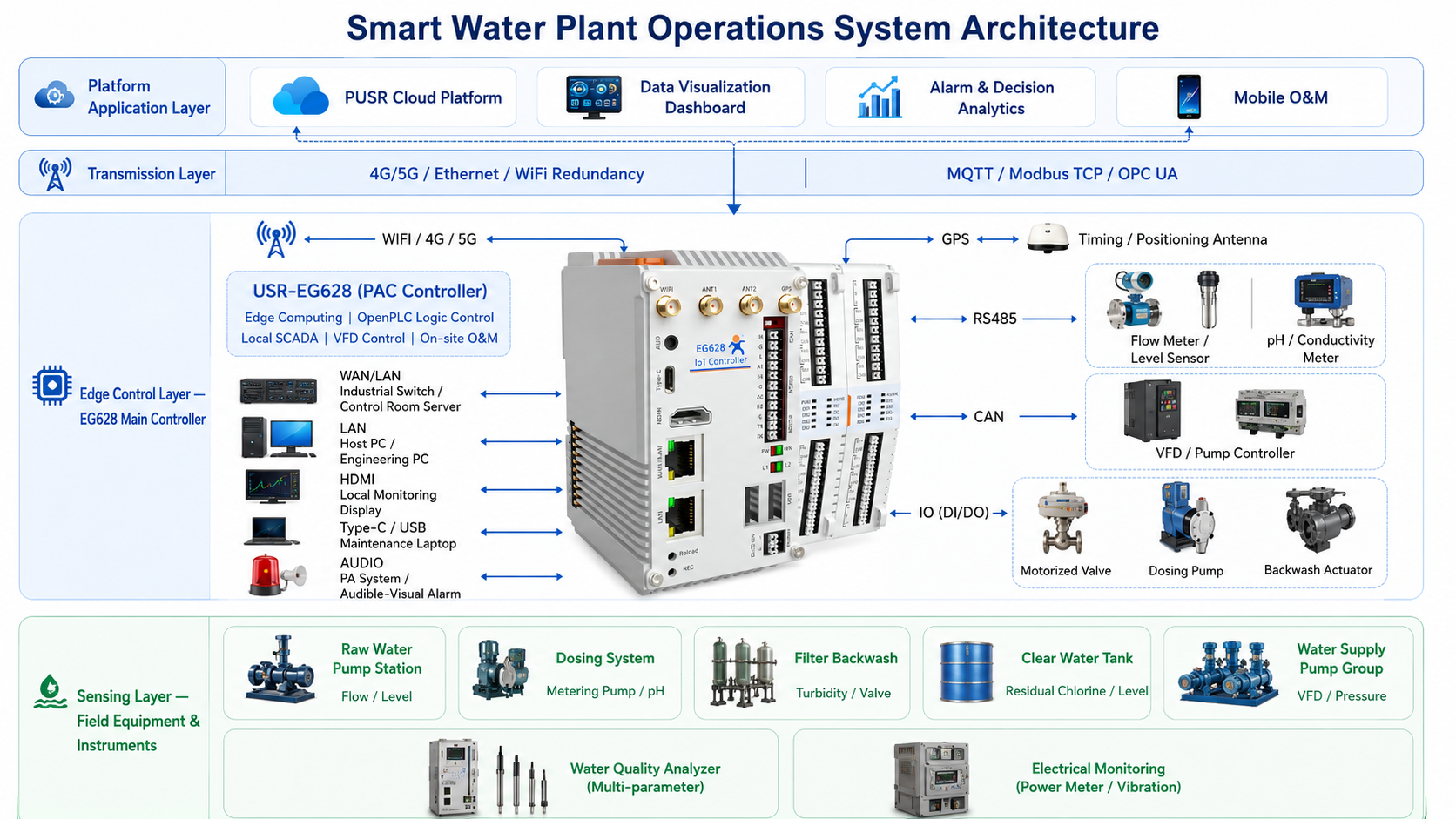
Platform Application Layer: PUSR Cloud Platform, Real-Time Monitoring Dashboard, Alarm and Decision Analysis, Mobile O&M
Transmission Layer: 4G / 5G, Ethernet, WiFi Multi-Network Redundancy, MQTT, Modbus TCP, OPC UA
USR-EG628 (PAC Controller)
Raw Water Pump Station: Flow, Level
Chemical Dosing System: Metering Pump, pH
Filter Backwash: Turbidity, Valves
Clear Water Tank: Water Level
Water Supply Pump Group: VFD, Pressure
Water Quality Analyzer: Multi-parameter Monitoring
Electrical Monitoring: Power Meter, Vibration
Figure 1: Four-Layer Architecture of the Smart Water Plant Operations System
EG628 includes the OpenPLC runtime, which strictly complies with the IEC 61131-3 international standard and fully supports five PLC programming languages.
This means that existing PLC control logic in the water plant, such as: Chemical dosing adjustment, Filter backwash control, Outlet pressure regulation
can be directly migrated to EG628 without rewriting the control program.
EG628 is equipped with an HDMI 2.0 output interface supporting 4K at 60 fps and can be connected to a monitor or industrial display.
Through the local HMI/SCADA configuration function, maintenance personnel can perform the following tasks directly on site: Data acquisition configuration, HMI/SCADA screen editing, Real-time data visualization
There is no need to rely on a remote cloud platform or carry a laptop.
This feature is particularly important in environments with limited network connectivity or where emergency on-site troubleshooting is required.
EG628 features a modular design with flexible I/O expansion and high-speed expansion interfaces.
It includes:
This allows multiple field control nodes to be connected simultaneously.
In a water plant, different process sections such as the raw water pump station, chemical dosing area, filter area, clear water tank, and water supply pump room can all be integrated into one unified control system, enabling coordinated multi-point control.
| Process Section | Monitoring Parameters | Control Functions | Communication |
| Raw Water Pump Station | Raw water flow, level, turbidity | Pump start/stop, valve adjustment | RS485 / Modbus |
| Chemical Dosing System | pH, dosing quantity, metering pump status | Metering pump frequency adjustment, closed-loop dosing control | RS485 / Modbus |
| Filter System | Turbidity, head loss, valve status | Backwash sequence control, valve interlocking | DI/DO + RS485 |
| Clear Water Tank | Residual chlorine, level, temperature | Level alarm, refill control | RS485 / Modbus |
| Water Supply Pump Group | Outlet pressure, flow, motor power | VFD speed regulation, constant-pressure water supply, pump rotation | RS485 / Modbus + CAN |
The Secondary Water Supply Pump Station Operations System uses EG628 as the core controller.
It monitors water quality data in real time to ensure water safety, remotely monitors pump room equipment operating status for intelligent management, and provides stable and reliable data acquisition and processing to support data analysis, alarm management, and decision-making.
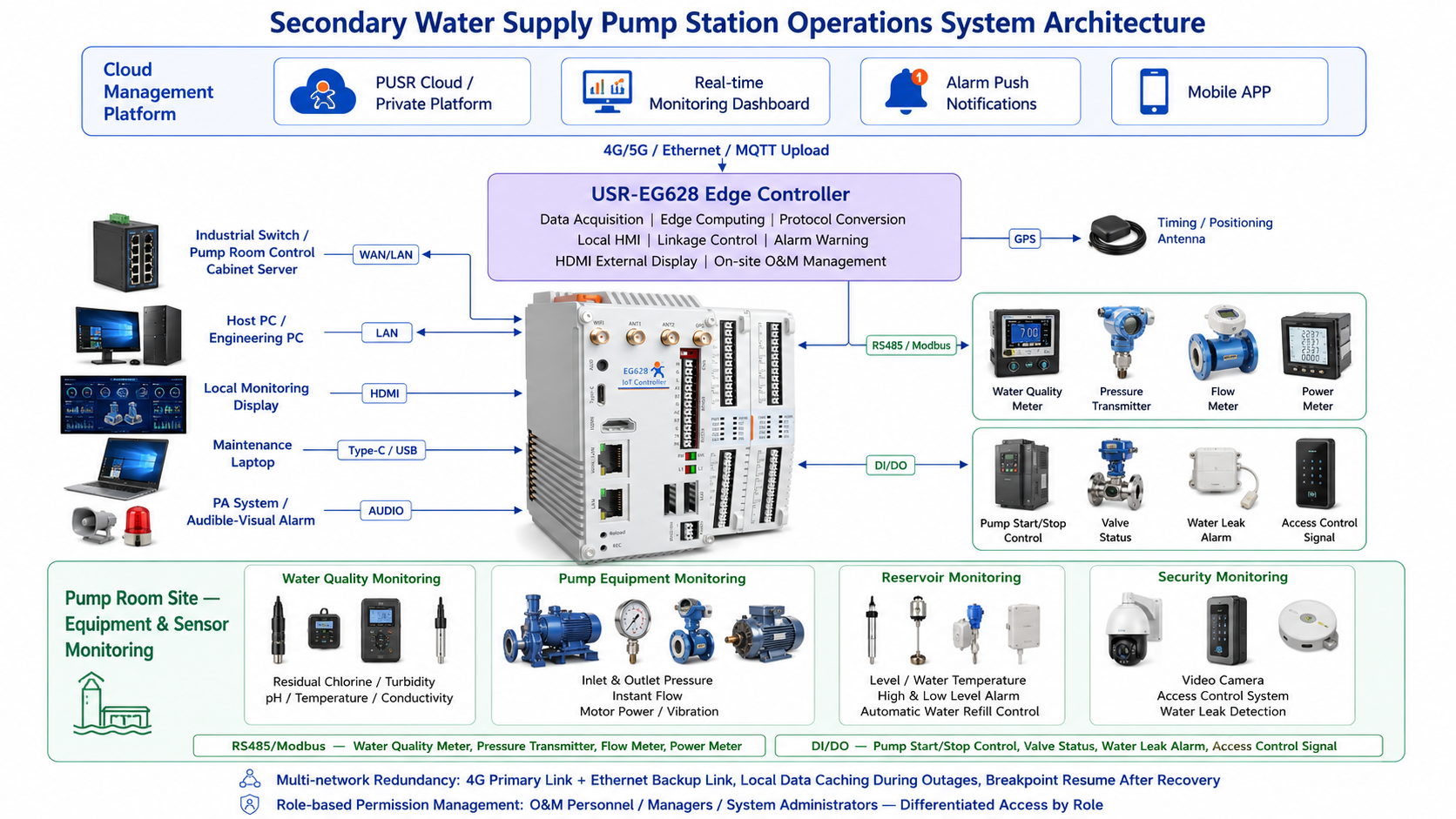
Cloud Management Platform: PUSR Cloud / Private Platform, Real-Time Monitoring Dashboard, Alarm Push Notifications, Mobile APP
Network Communication: 4G / 5G / Ethernet, MQTT Upload
USR-EG628 Edge Controller: Data Acquisition, Edge Computing, Protocol Conversion, Local HMI/SCADA Display, Linkage Control, Abnormality Alarm, HDMI External Display, On-Site O&M Management
Water Quality Monitoring: Residual Chlorine, Turbidity, pH, Temperature, Conductivity
Pump Equipment Monitoring: Inlet and Outlet Pressure, Instantaneous Flow, Motor Power, Vibration
Reservoir Monitoring: Water Level, Water Temperature, High/Low Level Alarm, Automatic Water Refill Control
Security Monitoring: Video Cameras, Access Control System, Water Leak Detection
RS485 / Modbus: Water Quality Instruments, Pressure Transmitters, Flow Meters, Power Meters
DI/DO: Pump Start/Stop Control, Valve Status, Water Leak Alarm, Access Control Signals
4G Primary Link + Ethernet Backup Link: During network outages, data is cached locally and automatically retransmitted from the interruption point after network recovery.
Different access permissions are assigned to: O&M Personnel, Managers, System Administrators
Figure 2: Secondary Water Supply Pump Station Operations System Architecture
Secondary water supply is the “last mile” between the water treatment plant and residential taps, making water quality safety critically important.
Industrial PC EG628 connects to multi-parameter water quality analyzers through RS485 / Modbus interfaces and collects the following key parameters in real time.
Residual Chlorine: Monitors disinfectant residual levels to ensure microbiological safety.
Turbidity: Reflects the concentration of suspended solids in water and directly indicates water clarity.
pH: Monitors water acidity and alkalinity to help prevent pipe corrosion or scaling.
Temperature: Changes in water temperature affect disinfection efficiency and water quality stability.
Conductivity: Reflects the total amount of dissolved solids in water and indirectly indicates changes in water quality.
If any water quality parameter exceeds a preset threshold, EG628 immediately triggers an alarm at the edge.
Maintenance personnel can be notified through multiple channels, including: Web, WeChat, Telephone
This helps ensure that water quality abnormalities are addressed as quickly as possible.
EG628 collects pump operating parameters in real time, including: Inlet and outlet pressure, Operating duration
Using its edge computing capabilities, the system can calculate pump efficiency and evaluate operating status locally without uploading raw data to the cloud for processing.
This reduces response latency from the traditional 200–500 ms to less than 10 ms.
Based on the built-in OpenPLC functionality of EG628, the following control logic can be implemented.
Constant-Pressure Water Supply Control: Automatically adjusts the VFD output frequency according to outlet pipeline pressure feedback to maintain stable pipeline pressure.
Pump Rotation: Multiple pumps automatically rotate according to a predefined strategy, balancing operating hours and extending equipment service life.
Power-Frequency / Variable-Frequency Switching: If the VFD fails, the system automatically switches to power-frequency operation to maintain uninterrupted water supply.
Level-Based Linkage Control: When the reservoir level reaches the low-level alarm threshold, the pump automatically stops for protection. At the high-level threshold, the refill function is activated.
In addition to conventional equipment monitoring, smart secondary water supply pump rooms can incorporate security functions such as: Video surveillance, Access control monitoring
This enables comprehensive and continuous monitoring of pump room conditions and supports a more systematic management system.
EG628 provides multiple interfaces:
These interfaces allow security devices to be connected simultaneously, integrating environmental monitoring and security management into one system.
EG628 supports three networking methods:4G / 5G, Ethernet, WiFi
It supports automatic switching between primary and backup networks, providing data transmission reliability of up to 99.99%.
If the network connection is interrupted, EG628 can cache data locally.
Once the network is restored, the system automatically resumes transmission from the interruption point, ensuring data integrity and preventing data loss.
EG628 includes a rich protocol library and supports conversion between multiple industrial protocols, including: Modbus, OPC UA, JSON, IEC104, IEC61850, BACnet, DLT625
After edge computing and processing, acquired data can be uploaded through MQTT to PUSR Cloud or a customer-owned platform, enabling flexible multi-platform integration and application.
The system supports hierarchical access management.
Users can define different roles according to specific project requirements and assign separate permissions for editing and viewing, enabling differentiated access control.
The cloud platform also supports private deployment to ensure secure data storage.
After operational data collected by EG628 is uploaded to the cloud platform, it can support the following analysis and decision-making functions.
Analyze historical trends of key parameters such as pressure, flow, and water quality to identify recurring problems.
Evaluate pump health based on motor power, vibration, and other data to support predictive maintenance.
Analyze energy consumption during different time periods to optimize pump operating strategies and reduce electricity costs.
Record all alarm events and handling processes to build a complete O&M knowledge base.
This solution adopts the classic four-layer architecture:
Sensing Layer → Edge Control Layer → Transmission Layer → Platform Application Layer
USR-EG628 serves as the central hub, enabling end-to-end data connectivity from field equipment to the cloud platform.
| Layer | Core Components | Main Functions |
| Sensing Layer | Sensors, instruments, actuators | Data acquisition and execution control for field devices including water quality analyzers, pressure transmitters, flow meters, level meters, power meters, vibration sensors, cameras, and access control devices |
| Edge Control Layer | USR-EG628 | Data acquisition, protocol conversion, edge computing, PLC logic control, local HMI/SCADA display, VFD regulation, linkage control, and abnormality alarms |
| Transmission Layer | 4G / 5G / Ethernet / WiFi | Multi-network redundant communication, MQTT / Modbus TCP / OPC UA protocol transmission, VPN encrypted networking, offline data caching, and breakpoint resume |
| Platform Application Layer | PUSR Cloud / Private Platform | Real-time monitoring dashboards, alarm and decision analysis, historical data storage, mobile O&M, hierarchical permission management, and report generation |
System data flow follows the principle of:“Edge First, Cloud Collaboration.”
① Acquisition
EG628 collects raw data from field instruments and equipment through protocols such as RS485 / Modbus.
The data acquisition frequency is configurable.
② Edge Processing
EG628 performs local: Data cleaning, Calculation, Filtering, Logic evaluation
Only valuable results or abnormal information are uploaded to the cloud.
③ Transmission
Processed data is uploaded to the cloud platform through MQTT over 4G or Ethernet.
The system supports two reporting modes: Data-change-triggered reporting, Scheduled reporting
④ Application
The cloud platform stores, analyzes, and visualizes the data.
It supports access through multiple terminals, including:Web dashboards, Mobile APPs
⑤ Downlink Control
The cloud platform or EG628 locally issues control commands based on analysis results to achieve closed-loop control.
By performing data preprocessing and real-time control on the EG628 edge side:
This solution uses the USR-EG628 expandable IoT controller as the core device to build a smart water solution covering two major application scenarios:
EG628 integrates four major capabilities into one device:
Edge Computing + PLC Control + Local HMI/SCADA + Network Management
By replacing the traditional three-device combination of:
PLC + Gateway + Industrial Computer
with a single integrated device, EG628 reduces hardware costs by approximately38%–42%while providing millisecond-level control response and multi-protocol device compatibility.
In theSmart Water Plantscenario, EG628 serves as the main controller and replaces the traditional PLC to implement logic control across the entire water treatment process.
VFD regulation enables constant-pressure water supply and improved energy efficiency.
An external HDMI display supports on-site operation and maintenance, while I/O expansion enables multi-point control.
In theSecondary Water Supply Pump Stationscenario, EG628 provides:
This helps ensure water safety throughout the “last mile” of the water supply system.