Vending machines unable to connect to the internet, customers experiencing lag when scanning QR codes, and POS systems dropping connections frequently—these scenarios are common in small and medium-sized retail stores. Traditional wireless routers handle home environments just fine, but struggle when facing densely deployed self-service terminals, multiple access points, and continuous data exchanges in a shopping mall.
The problems exist on three fronts. First, insufficient equipment stability. Self-service vending cabinets and cloud controllers in retail stores run around the clock with large temperature swings; consumer-grade equipment often crashes or experiences signal degradation under these conditions. Second, fragmented management. A chain store may have anywhere from a dozen to dozens of APs, and technicians must log into each one individually to configure settings—inefficient and error-prone. Third, harsh cabling environments. Retail terminals are typically located in basements, equipment rooms, and backrooms where electromagnetic interference is strong, and standard switch ports are prone to damage from surges.
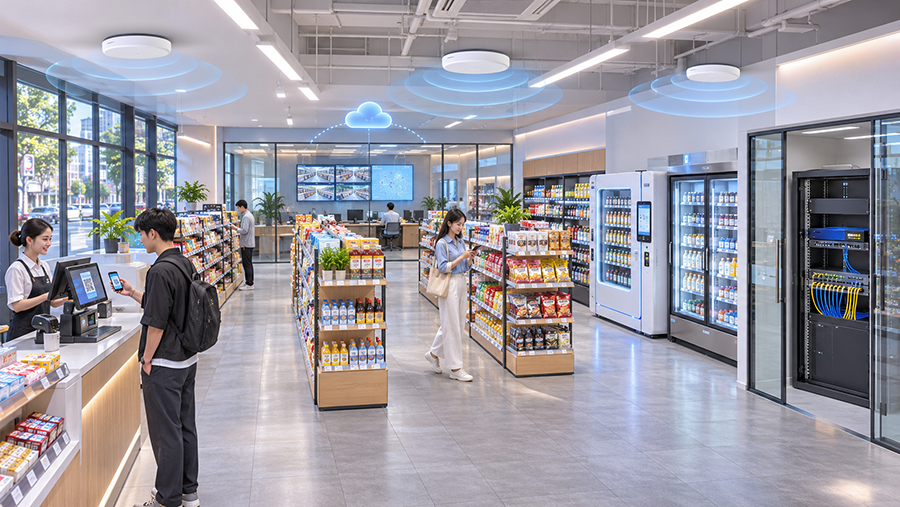
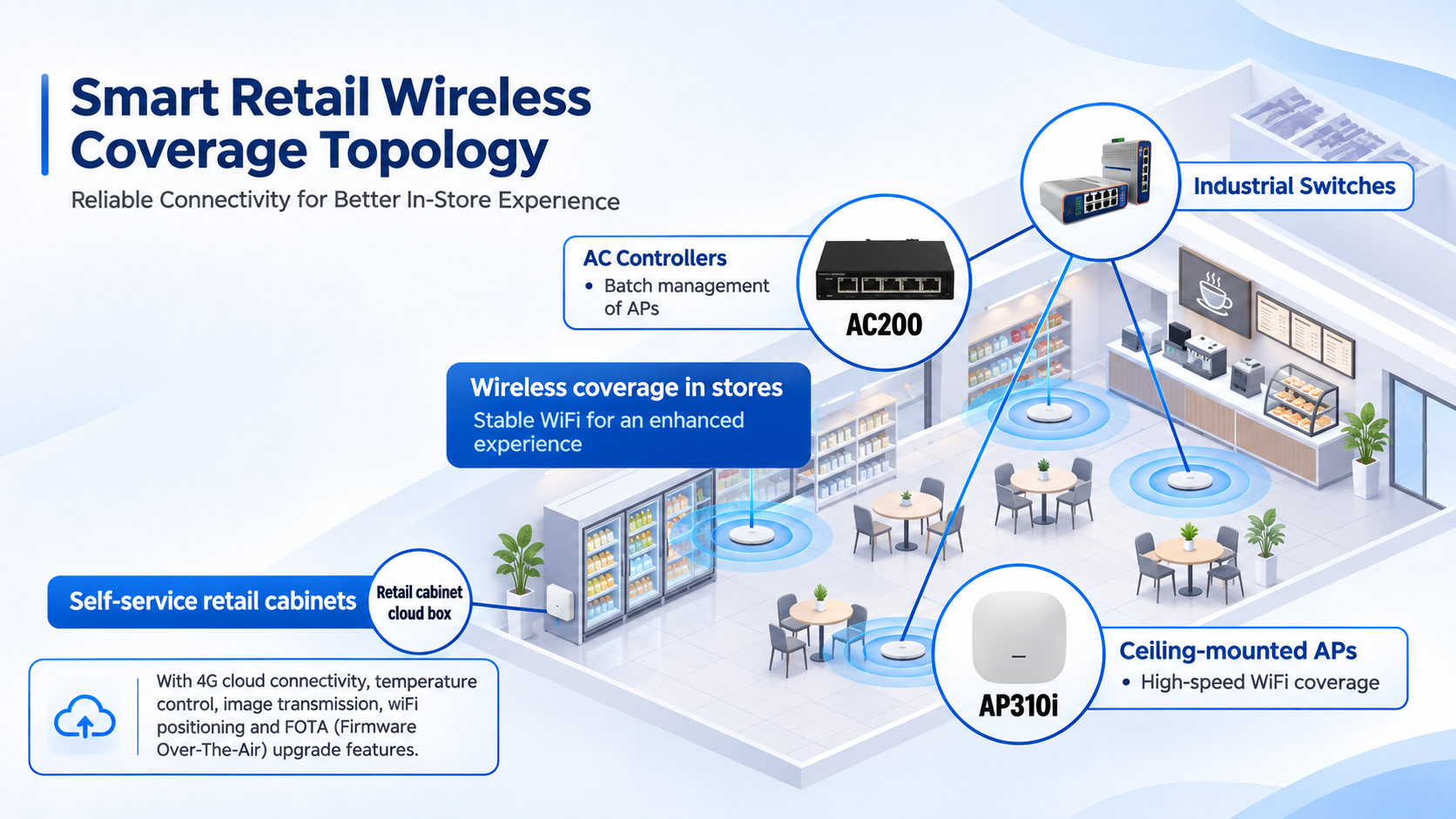
A complete smart retail wireless coverage solution is divided into three layers by function (matching the provided topology diagram):
The AP310i series ceiling-mounted access points provide WiFi coverage throughout the store. Supporting 802.11ac/ax protocols with dual-band concurrent operation, a single AP can stably connect 50 or more terminals. Deployment depends on store size: one AP suffices for stores up to 30 square meters, while stores over 50 square meters benefit from dual-AP overlapping coverage to eliminate dead zones. Mounting height is recommended at 2.5 to 3 meters, avoiding signal-blocked areas near metal equipment cabinets and refrigeration units.
The AC200 wireless controller is installed in the store's electrical room and connected to the core switch via Ethernet cable. Its primary function is batch management of all connected APs: unified SSID and password configuration, automatic channel assignment to prevent adjacent interference, and real-time monitoring of AP online status with failover switching. One AC controller can manage up to 32 APs, which is more than sufficient for a single store. For chain operators, APs can also be managed centrally by region.
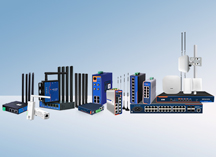
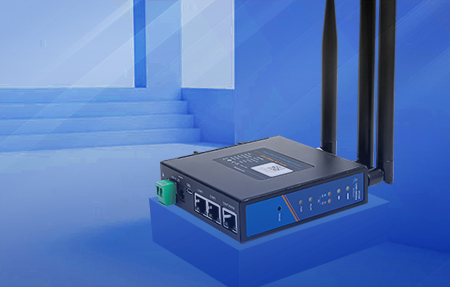
The USR-ISG series industrial Ethernet switch serves as the backbone node of the entire network. Unlike consumer switches, this device features an aluminum housing with fanless design, operating temperature range from -40°C to +85°C, enabling stable operation in equipment rooms and backrooms with large temperature differentials. IP40 dustproof enclosure paired with 6KV lightning protection effectively resists electromagnetic interference and surge impacts. The switch supports DIN-Rail mounting, occupies minimal space, and fits within the limited electrical room space of retail stores.
Regarding certifications, the USR-ISG has passed 3C, CE, FCC, and ROHS certifications, meeting compliance requirements for both domestic and international markets.
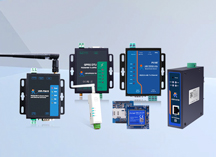
Self-service retail cabinets and smart vending machines in the store connect to the network via cloud controllers. These cloud controllers support 4G cellular connectivity and simultaneously provide temperature monitoring, image transmission, WiFi positioning, and FOTA remote firmware upgrades. Even before the store's fiber optic connection is live, self-service terminals can complete transaction data and inventory synchronization through the 4G link without interrupting business operations.
All self-service terminal management data is aggregated through the wireless link to the AC controller, then forwarded to the cloud management platform via the industrial switch, forming a complete data path from terminal to cloud.
Step 1: Site Survey and AP Placement
Measure the store's area and layout, marking load-bearing columns, refrigeration equipment, and metal shelving that block signals. According to the topology diagram, APs are mounted on the ceiling center and connected to the industrial switch via wired links. Each AP covers a radius of approximately 10 to 15 meters, with 3 to 5 meters of overlap between APs. The checkout counter, main aisle, and end of aisles are the three areas with the highest signal demand and should be prioritized.
Step 2: Cabling Planning with Redundancy
Run Category 6 (Cat6) Ethernet cables from the electrical room to each AP location, with 10% length reserve. PoE switches can power APs directly through Ethernet cables, eliminating the need for nearby power outlets. The industrial switch connects to the AC controller via a dedicated cable, avoiding shared circuits with high-power equipment. Inside the electrical room, the industrial switch is mounted on a DIN-Rail rail to save space and facilitate removal for maintenance.
Step 3: Configuration Optimization and Channel Assignment
After the AC controller is online, execute automatic channel assignment. The 2.4GHz band uses only the three non-overlapping channels 1, 6, and 11, while the 5GHz band dynamically assigns channels 36, 44, 149, etc., based on AP count. SSIDs are named uniformly, and 802.11r fast roaming is enabled so customers experience seamless AP handoff while moving through the store.
Step 4: Stress Testing and Acceptance
Using one smartphone, one tablet, and one POS terminal, conduct speed tests and roaming handoff tests at every corner of the store. Signal strength must be no lower than -67dBm, throughput no lower than 50Mbps, and roaming handoff time under 300 milliseconds for the deployment to be considered compliant.
This networking solution, with an industrial switch as the core backbone, AC controller for centralized management, and ceiling APs for flexible coverage, is designed around the real pain points of retail stores. Stable equipment operation, one-click configuration deployment, and seamless terminal access free technicians from the repetitive task of logging into individual APs, allowing them to focus on business operations.
For chain retail brands, standardized topology reduces deployment time per store from three days to one. For independent store operators, a mature integrated solution proves more hassle-free and cost-effective than piecing together consumer-grade equipment.