In-depth Analysis of Installation Methods for Industrial Panel PC: Embedded, Wall-mounted, and Stand-mounted – How to Precisely Match Corporate Needs?
In industrial scenarios such as smart manufacturing, intelligent logistics, and energy management, industrial panel PC have become core terminals for equipment monitoring, data collection, and human-machine interaction. However, when faced with three mainstream installation methods—embedded, wall-mounted, and stand-mounted—companies often find themselves in a dilemma: Is embedded installation suitable for high-temperature and high-humidity environments? Can wall-mounted installations support multi-screen requirements? Is stand-mounted installation stable and reliable in mobile scenarios? This article will provide decision-making bases for companies from four dimensions—environmental adaptability, installation cost, maintenance efficiency, and scalability—combined with real-world cases and industry data. Additionally, it offers access to customized installation structure diagrams to help companies precisely match their scenario needs.
Embedded installation achieves seamless integration with the mounting surface by embedding the integrated screen into equipment panels, control cabinets, or walls. Its core values are reflected in three aspects:
Impact Resistance: In high-vibration scenarios such as mining machinery and metallurgical equipment, the embedded structure reduces the direct impact of external shocks on the screen. For example, a steel company adopted embedded integrated screens to monitor the operation status of rolling mills, resulting in a 38% year-on-year decrease in equipment failure rates and a 70% reduction in misoperations caused by loose screens.
Protection Level: Some manufacturers offer IP67-rated embedded products that can resist dust intrusion and short-term immersion. In dust-intensive environments such as cement plants and grain processing plants, the mean time between failures (MTBF) of embedded integrated screens is 2.5 times longer than that of wall-mounted screens.
Space Optimization: Embedded installation does not occupy additional space, making it particularly suitable for deployment inside control cabinets. A car manufacturing plant embedded 12.1-inch integrated screens in production line control cabinets, saving 35% of console area while avoiding collision risks caused by protruding screens.
Typical Scenarios: Industrial automation equipment (e.g., PLC control cabinets), outdoor intelligent terminals (e.g., charging pile monitoring screens), and medical testing instruments.
Potential Risks:
Installation Complexity: Pre-reserved hole sizes are required, and equipment replacement later necessitates re-drilling. A wind farm incurred an additional renovation cost of 18,000 yuan due to the lack of reserved spare holes for screen replacement.
Heat Dissipation Challenges: In high-temperature environments (e.g., boiler rooms and forging workshops), embedded installations may suffer from inadequate heat dissipation, leading to shortened screen lifespans. It is recommended to use heat dissipation fins or thermal conductive adhesive. A chemical company extended screen lifespans by 40% through optimized heat dissipation design.
Fixed Angle: The screen angle is non-adjustable, which may affect the viewing experience of operators. In scenarios requiring multi-angle observation (e.g., AGV dispatch centers), embedded installations need to be paired with rotatable stands, increasing costs by approximately 15%.
Wall-mounted installation fixes integrated screens to walls or columns using brackets, with advantages including:
Installation Efficiency: The deployment time for a single device is only 20 minutes, 70% shorter than that of embedded solutions. A logistics warehouse adopted wall-mounted integrated screens to display sorting information, completing the installation of 50 devices in 3 hours, saving 12 hours of labor compared to embedded solutions.
Maintenance Convenience: Screens can be quickly disassembled for troubleshooting or upgrades. A chemical company achieved remote monitoring through wall-mounted installations, reducing annual maintenance costs by 62%, mainly due to the ability to replace screens without disassembling control cabinets.
Multi-screen Splicing Expansion: Through telescopic hydraulic brackets, wall-mounted installations can support multi-screen splicing and front maintenance. A command center adopted six 55-inch wall-mounted screens for splicing, using hydraulic brackets to enable independent maintenance of individual screens, avoiding the pain point of overall disassembly required by traditional embedded splicing and improving maintenance efficiency by 80%.
Typical Scenarios: Workshop monitoring centers, logistics warehouse information screens, outdoor advertising machines, and retail store display screens.
Key Considerations:
Weight-bearing Limitations: When the weight of a single screen exceeds 25 kg, it is necessary to confirm that the wall is a solid load-bearing wall. A shopping mall experienced a screen fall accident due to the installation of wall-mounted screens on gypsum board walls, resulting in direct losses exceeding 80,000 yuan. It is recommended to use expansion bolts for fixation and add diagonal braces for reinforcement.
Vibration Impact: Near heavy machinery (e.g., punch presses and forging equipment), long-term vibrations may cause bracket loosening. It is recommended to use anti-vibration brackets. A machine tool factory reduced screen failure rates by 65% by adding rubber shock-absorbing pads.
Viewing Angle Optimization: Wall-mounted installations should consider the eye level of operators, with the center of the screen typically 1.5-1.8 meters above the ground being appropriate. A hospital improved the operational comfort score of medical staff by 70% by adjusting the wall-mounted height.
Stand-mounted installation supports integrated screens using floor stands or mobile trolleys, with unique values including:
Mobile Flexibility: Mobile trolley stands allow for on-the-fly adjustment of screen positions to meet temporary display or inspection needs. A power inspection team adopted stand-mounted integrated screens for free movement within substations, improving daily inspection efficiency by 50%.
Height and Angle Adjustment: Stands support multi-dimensional adjustment of screen height, pitch angle, and rotation angle to meet the needs of operators of different heights. A hospital improved the operational comfort score of medical staff by 68% by adopting integrated screens with adjustable-height stands.
Multi-device Integration: Stands can simultaneously carry peripherals such as screens, keyboards, and barcode scanners to create integrated operation terminals. A retail store integrated a cash register system and inventory management through a stand-mounted integrated screen, reducing the cash register area by 45% and improving operational efficiency by 30%.
Typical Scenarios: Mobile inspection terminals, temporary command centers, multi-device interactive workstations, and laboratory data collection.
Cost Analysis:
Stand Cost: The price of floor stands varies greatly depending on the material (steel frame/aluminum profile), with a single set ranging from 800 to 2,500 yuan. Mobile trolley stands, which require batteries and motors, cost 40%-60% more.
Space Occupation: Stands require reserved floor space and need careful evaluation in space-intensive scenarios (e.g., small control rooms). A semiconductor factory had to replan its layout due to insufficient operating channel width caused by stand-mounted installations, incurring an additional renovation cost of 30,000 yuan.
Stability Considerations: In tilted or vibrating environments, stands with self-locking functions should be selected. A mining company adopted anti-tipping stands, maintaining screen stability on slopes of 5° and reducing failure rates by 80%.
High-vibration/impact scenarios (e.g., mining, metallurgy, forging): Prioritize embedded installation and enhance stability with anti-vibration brackets.
Low-vibration scenarios (e.g., warehouses, offices, laboratories): Both wall-mounted and stand-mounted installations are feasible, depending on space and maintenance needs.
High-frequency maintenance scenarios (e.g., regular screen replacement or system upgrades): Wall-mounted installation has the lowest maintenance cost, while embedded installation requires reserved spare holes.
Low-frequency maintenance scenarios (e.g., long-term stable operation equipment): Embedded installation can reduce long-term failure rates but requires optimized heat dissipation design.
Space-sensitive scenarios (e.g., inside control cabinets, small consoles): Embedded installation saves space but requires pre-planning of hole sizes.
Space-abundant scenarios (e.g., large workshops, outdoors): Stand-mounted or wall-mounted installations offer greater flexibility but require evaluation of floor or wall load-bearing capacity.
Multi-screen splicing requirements: Wall-mounted installations paired with hydraulic brackets can achieve front-maintenance splicing, while embedded splicing requires overall disassembly.
Peripheral integration requirements: Stand-mounted installations support multi-device integration, while embedded and wall-mounted installations require additional docking stations.
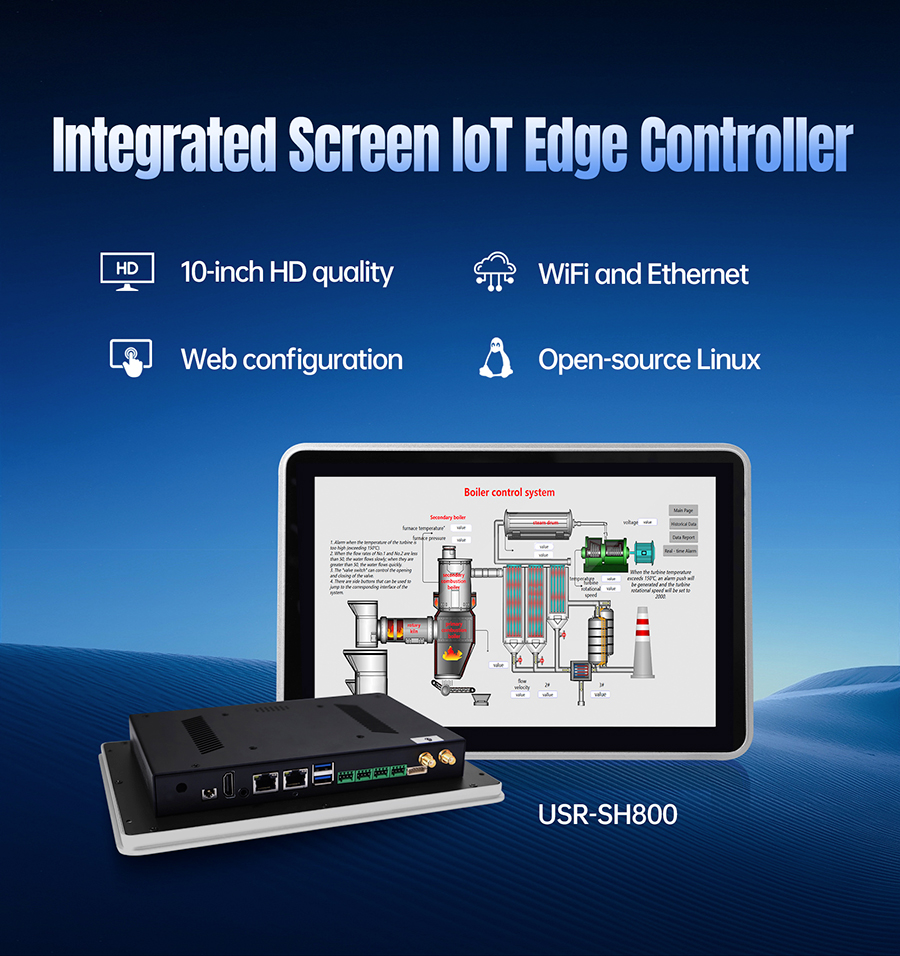
In the deployment of industrial panel PC, network stability is the core guarantee for data transmission. The USR-SH800 industrial-grade switch is specifically designed for industrial scenarios, and its characteristics perfectly complement the installation methods of integrated screens:
Wide Temperature Operation Capability: Supports extreme temperatures ranging from -40°C to 75°C, adapting to outdoor, boiler room, and other high-temperature or low-temperature environments, ensuring stable data transmission for embedded integrated screens under extreme conditions.
Anti-interference Design: Adopts industrial-grade electromagnetic compatibility (EMC) design to effectively resist electromagnetic interference from equipment such as motors and frequency converters, ensuring signal stability for wall-mounted integrated screens near heavy machinery.
Flexible Networking: Supports 8 Gigabit electrical ports + 2 gigabit optical ports, enabling simultaneous connection of embedded, wall-mounted, and stand-mounted integrated screens for efficient data aggregation from devices. A smart factory shortened network interruption recovery time to within 20 ms by forming a ring network with USR-SH800.
Simple Management: Supports Web interface and SNMP protocol for remote monitoring of switch status, reducing network maintenance costs for stand-mounted mobile terminals. A logistics company improved network fault troubleshooting efficiency by 70% through a centralized management platform.
Case: A wind farm adopted USR-SH800 paired with wall-mounted integrated screens to achieve real-time monitoring of wind turbine status through an optical fiber ring network, reducing annual network interruptions from 15 to 2 and improving operational and maintenance efficiency by 85%.
Choosing the installation method for industrial panel PC requires a comprehensive consideration of environmental, cost, maintenance, and scalability needs. To help companies make precise decisions, we offer:
Free Installation Structure Diagrams: Customize embedded, wall-mounted, and stand-mounted installation structure diagrams based on your scenario needs (e.g., high vibration, multi-screen splicing, mobile inspection), specifying hole sizes, bracket models, and wiring schemes.
USR-SH800 Trial Samples: Experience wide-temperature design and anti-interference capabilities, and test network stability and networking flexibility.
One-on-One Consultation with Professional Engineers: Recommend the optimal installation method and supporting products based on your equipment type, spatial layout, and budget.
Limited-time Offer: The first 50 consulting companies will receive a complimentary copy of the "Industrial Panel PC Deployment White Paper," containing 30+ industry cases and cost calculation models to help you avoid deployment pitfalls and achieve cost reduction and efficiency improvement.
In the wave of industrial digital transformation, choosing the appropriate installation method and network solution is a crucial step in reducing operational and maintenance costs and improving equipment stability. Take action now and let industrial panel PC become the "eyes of wisdom" for your smart factory!

















