The "Central Nervous System" of Automotive Final Assembly Line AGVs: How Arm Industrial PC Achieve Millisecond-Level Response
Anyone who works in automotive final assembly lives by one number—takt time.
From the chassis entering the line to the finished car rolling off, the standard takt time on a final assembly line is 47 seconds. Every 47 seconds, your AGV must deliver a set of seats to the workstation, with a positioning error no greater than ±50 millimeters. One second too early, and the worker isn't ready. One second too late, and the entire line stops to wait for you.
How much does one second of downtime cost?
Data from a FAW-Volkswagen final assembly workshop: every minute the line stops costs approximately 12,000 RMB in direct losses. If an AGV delivery deviation causes an assembly misalignment, the cost of one rework is 3,800 RMB and takes 11 minutes. If this happens three times a day, do the math.
So AGVs on a final assembly line aren't "good enough" logistics carts. They are the heartbeat of the production line—every delivery, every positioning, every avoidance must be precise to the millisecond.
And what determines whether that heartbeat is steady isn't the motor, isn't the wheels—it's the arm industrial PC sitting inside the AGV's chassis.
I've talked with final assembly line engineers many times, and I've noticed something interesting: the AGV failure they fear most isn't a collision, a tip-over, or a jam—those are visible, and visible means fixable.
What they fear most is being "a little slow."
What does that mean? Normally, an AGV takes 80 milliseconds from receiving a command to starting movement. But one day, it suddenly takes 150 milliseconds. That 70-millisecond gap—humans can't feel it, the line can't feel it—but the robotic arm at the next station is already waiting.
A 150-millisecond response means the robotic arm waits an extra 70 milliseconds. Once or twice, no problem. But with 120 AGVs running simultaneously on a final assembly line, each 70 milliseconds slow, the cumulative effect shows up—station #15 starts backing up, station #22 starts idling, and the worker at station #30 is already scrolling through their phone.
Then the shift supervisor calls you: "Is there something wrong with your AGVs today? Line efficiency dropped 3 percentage points."
You check the logs. Everything looks normal. No alarms, no fault codes. The AGV's communication module shows full signal. Battery at 98%.
So where's the problem?
It's in the arm industrial PC's CPU scheduling. Some background process stole 12 milliseconds. An I/O interrupt was delayed by 8 milliseconds. Sensor data processing took an extra 50 milliseconds. Add them up—70 milliseconds, gone.
This "invisible slowness" is the greatest enemy of final assembly line AGVs.
Because visible failures you can shut down, restart, swap parts. Invisible latency—you don't even know where to start fixing.
Many people think: an arm industrial PC, it just runs a program, receives a signal, sends a command—how hard can it be?
Let me walk you through the "time budget" of a final assembly line AGV, and you'll understand.
From receiving a delivery command from the MES system to precisely placing the seats beside the workstation, how many steps does a final assembly line AGV go through?
Step 1: Receive command. The line PLC sends the command via PROFINET or EtherCAT. The arm industrial PC's network module must receive and parse it within 5 milliseconds.
Step 2: Sensor fusion. The AGV carries a LiDAR, a vision camera, an IMU, encoders, and proximity sensors. The arm industrial PC must read all this data within 10 milliseconds and perform sensor fusion—stitching the LiDAR point cloud, the camera image, and the IMU attitude data into one complete environmental map.
Step 3: Path planning. Based on the fused environmental data, the arm industrial PC must compute the optimal path within 15 milliseconds—avoiding the AGV next to it that's unloading tires, going around the wrench a worker dropped on the floor, while staying within the virtual track defined by the production line.
Step 4: Motion control. Path computed, the arm industrial PC must send speed, steering, and acceleration/deceleration commands to the motor drives via CAN Bus or EtherCAT, with positioning accuracy within ±5 millimeters. This step: 10 milliseconds.
Step 5: Safety check. Before sending commands, the arm industrial PC must run a safety check—anyone nearby? Any obstacles? Is the emergency stop pressed? This is a hardware-level safety loop, non-negotiable. 5 milliseconds.
Total: 5 + 10 + 15 + 10 + 5 = 45 milliseconds.
Within the 47-second takt, your AGV has only 45 milliseconds to complete all decisions.
The remaining time is for the motor to execute. If the arm industrial PC takes 60 milliseconds, the motor only has 32 milliseconds to move. Not enough distance, delivery deviation, line stops.
So you see—the bottleneck for final assembly line AGVs is never mechanical. It's computational. Every extra millisecond the arm industrial PC spends, the production line takes on more risk.
I've talked with many final assembly line integrators, and I've found a universal trap: the arm industrial PC they use are "good-looking on paper."
What does "good-looking on paper" mean? Intel i5 processor, 8GB RAM, running Windows 10, a few network ports—the specs don't look bad.
But between "good-looking on paper" and "actually good enough," there are three fatal gaps:
Gap 1: The wrong operating system.
Windows 10 is for office work. Its task scheduler is optimized for you opening browsers and playing videos—not for millisecond-level real-time control. Running an AGV on Windows 10, the background might suddenly trigger a Windows Update, a Defender scan, or some driver deciding to refresh. Every "surprise" costs tens of milliseconds of latency.
A final assembly line doesn't need your arm industrial PC to stream iQiyi. It needs Windows 11 Enterprise IoT LTSC—no app store, no automatic updates, no unnecessary background processes. From boot to stable operation, the time is deterministic, not random.
Gap 2: The wrong cooling method.
Final assembly line ambient temperatures can hit 45°C in summer. The AGV itself is a heat source—motor heat, battery heat—and the arm industrial PC sits in the middle, often surrounded by temperatures exceeding 60°C.
A typical arm industrial PC uses fan cooling. The fan spins, temperature drops—but the fan itself is a variable. Speed changes with temperature, speed changes cause vibration changes, vibration transmits to the hard drive and PCB, and I/O latency shifts. You think your arm industrial PC responds in 10 milliseconds—in reality, it's bouncing between 8 and 18 milliseconds.
That bouncing is a disaster on a final assembly line.
A truly suitable arm industrial PC for final assembly line AGVs must be fanless with passive cooling. No fan means no speed fluctuation, no vibration interference. Response time is a flat line, not a sawtooth.
Gap 3: The wrong I/O architecture.
Final assembly line AGV communication isn't just about plugging in a network port. It needs to simultaneously handle PROFINET (talking to the line PLC), CAN Bus (reading motor encoders and safety signals), GigE Vision (connecting industrial cameras), USB 3.2 (connecting barcode scanners), and possibly 5G (communicating with the MES system).
A typical arm industrial PC has fixed I/O. Want a certain interface, buy a certain model. Change the scenario, change the machine. Final assembly lines change vehicle models, adjust workstations—I/O needs shift constantly.
More critically, these interfaces can't "steal bandwidth from each other." If PROFINET real-time data and 5G non-real-time data share the same bus, and a large 5G packet comes in, the PROFINET real-time packet has to wait. Wait 30 milliseconds, and the line stutters.
A good arm industrial PC has modular, isolated I/O. Real-time traffic uses real-time channels, non-real-time uses non-real-time channels. No interference.
These three gaps aren't visible on a spec sheet. Only when you're actually running on a final assembly line for three months, six months, do you realize: the root of "a little slow" is right here.
Enough about problems—let's talk solutions.
An arm industrial PC that can deliver stable millisecond-level response on a final assembly line AGV gets four things right:
First, heterogeneous computing—don't let the CPU carry everything alone.
Final assembly line AGV workloads are messy: real-time control (CAN Bus communication, motor control), AI inference (visual recognition, obstacle detection), data processing (sensor fusion, logging). Throw it all at the CPU, and even the strongest CPU hits a wall.
A good arm industrial PC uses a heterogeneous architecture—the CPU handles scheduling and logic, the GPU handles AI inference, the FPGA handles real-time I/O. Visual recognition goes to the GPU, results in 10 milliseconds. Safety signals go to the FPGA, hard real-time, latency under 1 millisecond. Path planning goes to the CPU, done in 15 milliseconds. Each does its own job, no queuing.
It's like the final assembly line itself—not one person doing everything, but welding robots welding, gluing robots gluing, assembly robots assembling. Parallel execution, steady takt.
Second, real-time OS kernel—eliminate the uncertainty.
Windows itself isn't a real-time OS. But Windows 11 IoT LTSC with real-time extensions can push critical task scheduling latency below 1 millisecond. An even more extreme approach is running dual OS on the arm industrial PC—a Linux real-time kernel (PREEMPT_RT) manages motion control, while Windows handles HMI and upper-level logic. The two systems communicate via shared memory. Real-time tasks bypass the Windows scheduler entirely and run directly in Linux.
The benefit: no matter what Windows is doing, real-time task response time hits a hard deadline—never exceeding 2 milliseconds.
Third, modular I/O—configure on demand, don't waste a single bus.
Final assembly line AGV I/O needs vary by vehicle model. A sedan line and an SUV line might differ by a factor of two in sensor count. A good arm industrial PC doesn't do "one size fits all" I/O—it uses modular I/O expansion. Need 8 GbE ports? Plug in an 8-port module. Need CAN? Add a CAN module. Need 5G? Slot in a 5G module. Each module has its own bus, no bandwidth stealing.
And these modules must support M12 connectors—vibration on a final assembly line is intense. RJ45 plugs loosen after six months. M12 locking connectors: 10,000 plug/unplug cycles without loosening.
Fourth, end-to-end long-lifecycle support—from chip to system.
Vehicle model cycles on a final assembly line are 3–5 years, but the line itself runs 15–20 years. The arm industrial PC you choose today can't be discontinued in five years, can't lose driver support in ten years, and must still receive security patches in fifteen years.
This isn't just the arm industrial PC vendor's responsibility—it's an ecosystem responsibility. Intel's Edge series processors, AMD's Ryzen Embedded—these embedded platforms have roadmaps starting at 10 years. Windows 11 IoT LTSC's support cycle is also 10 years. What the arm industrial PC vendor must do is integrate these long-lifecycle chips and systems, do compatibility validation in advance, and ensure your AGV never needs an arm industrial PC swap from day one to year fifteen.
I remember one scene vividly.
A joint-venture automaker's final assembly workshop, night shift, 2 a.m. A commissioning engineer crouched beside an AGV, laptop connected to the arm industrial PC's debug port, watching real-time logs.
What was he looking at? Response times.
Line after line of numbers on the screen: 82ms, 79ms, 85ms, 91ms, 78ms...
He stared at that 91ms, furrowed his brow.
The shift supervisor next to him asked: "What's wrong?"
He said: "Nothing. 91 milliseconds. It's fine."
The supervisor didn't understand and walked away.
But he knew what 91 milliseconds meant. It meant this AGV's response time today was 12 milliseconds slower than yesterday. 12 milliseconds isn't much—but what if tomorrow it's 105ms? What if the day after it's 120ms?
He didn't know where the problem was. Maybe a sensor driver updated. Maybe Windows ran something in the background. Maybe the arm industrial PC's fan speed shifted. He didn't know.
All he could do was crouch there, watching those numbers, praying they wouldn't climb any higher.
I thought about that image for a long time.
Final assembly line AGV engineers aren't unprofessional—they're too professional. Professional enough to hear a problem in the jitter of response times, but the arm industrial PCs available today can't give them a definitive answer.
What they need isn't a "good enough" arm industrial PC. They need one whose response time is a flat line from the first millisecond to the ten-thousandth hour.
The 47-second takt of a final assembly line is the crystallization of over a hundred years of efficiency competition in the auto industry. Every second is money. Every millisecond is life.
The AGV is the most-run, most-unstoppable, most-unforgivable role on that line. And the arm industrial PC is the AGV's central nervous system—every calculation, every I/O, every interrupt response is written directly into the line's takt.
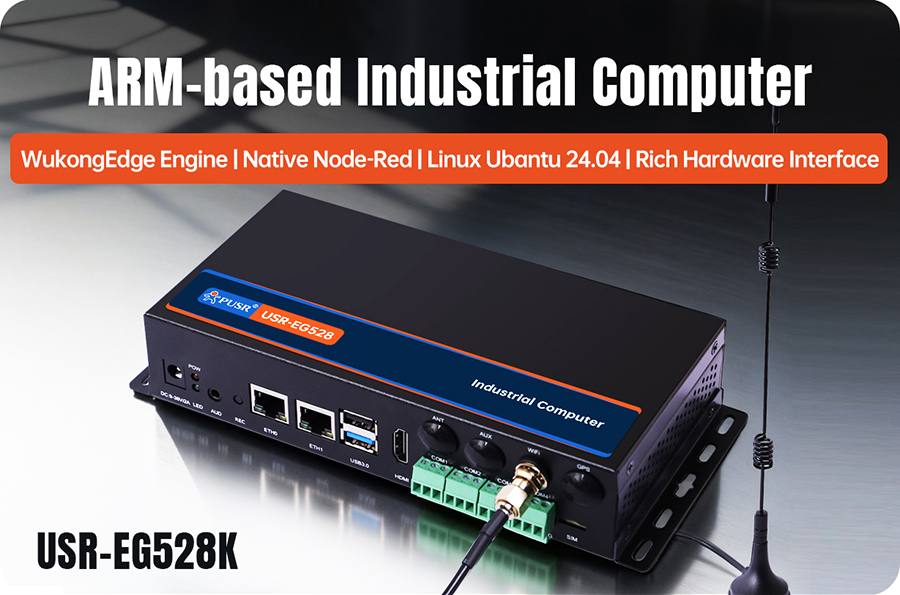
If you're selecting arm industrial PCs for final assembly line AGVs, or you're being tortured by the "a little slow" problem, take a look at the USR-EG528 series. Its heterogeneous computing architecture, modular I/O, fanless passive cooling, and embedded long-lifecycle support are essentially built for these final assembly line pain points. It may not be the only choice, but it deserves a spot on your comparison list.
But more importantly—when selecting an arm industrial PC, don't just read the spec sheet.
Go run it on the line. Watch the response times for three days. Those numbers won't lie to you.
The most expensive thing on a final assembly line isn't the AGV, isn't the robot—it's the person crouching on the floor at 2 a.m. reading logs.
Giving them an arm industrial PC they don't have to babysit is what this industry should be doing.


















