AGV Embedded Single Board Computer That Saves 30% Power: Low-Power Architecture & Dynamic Power Management in Practice
"Every extra kilometer your AGV runs, it burns an extra cent of electricity."
This is probably the calculation you least want to do during selection — but the one you should do most.
Suppose your factory runs 200 AGVs, each with an embedded single board computer averaging 25W, running 20 hours a day.
Over a year, the electricity bill for the embedded single board computers alone exceeds 91,250 kWh.
And that's just electricity. If you're using a lithium battery solution, every extra watt of power consumption means you need 3–5Ah more battery capacity. An extra 3,000mAh per unit × 200 units = 600Ah — that's real money, hidden in your BOM, never looked at closely.
What stings even more: most of the time, 8–10W of that 25W is wasted for nothing.
Wasted where?
Wasted on the embedded single board computer you chose, which simply doesn't understand "when to push hard and when to rest."
This article won't bore you with head-spinning chip architecture specs. We're only talking about one thing: how to save that 30% of power on your AGV embedded single board computer without sacrificing any performance.
After reading this, you'll have an extra ruler in your hand the next time you select.
Before prescribing a cure, we need to understand: in an industrial AGV scenario, where does all the electricity go?
What does your AGV do most of the time? Wait. Wait for dispatch commands, wait to charge, wait for materials. CPU load might be only 5–10%.
But many embedded single board computers use traditional x86 architecture. Even when idle, the CPU runs at rated TDP. A 15W processor actually using only 1.5W — the remaining 13.5W all turns into heat.
It's like your car idling at a red light with the engine revving the whole time.
AGV embedded single board computers have tons of comms interfaces: CAN, RS485, Ethernet, USB… You might only use three or four, but the rest sit in "wake-on-standby" mode, each quietly leaking power.
A USB controller in standby draws ~0.5W. An Ethernet PHY ~0.8W. Add them up — another 2–3W.
You think turning off the machine saves power? Those "fake-off" ports are stealing your electricity from behind.
Traditional embedded single board computers use fans. The fan itself eats power (0.5–1.5W), and when it spins it sucks in dust, reducing cooling efficiency, raising CPU temperature, triggering throttling — then you have to crank up voltage to maintain performance. Vicious cycle.
The fan isn't cooling you down. It's burning your money.
AGVs typically run on 24V or 48V batteries. The embedded single board computer needs to step down to 12V, 5V, 3.3V, 1.05V… Every conversion loses energy. If the power management module is only 85% efficient, 15% of your electricity turns into heat in the transformer.
Your battery isn't drained by the AGV running. It's eaten by the power module.
Real low-power design isn't about making the embedded single board computer "do less work." It's about making it go full throttle when it needs to, and go completely to sleep when it doesn't.
Three core technologies behind this:
Remember Intel's heterogeneous architecture since 12th gen? Performance-cores (P-Cores) handle heavy work. Efficient-cores (E-Cores) handle light work.
Applied to AGVs:
Navigation compute, path planning → P-Cores step in, full blast for just a few seconds.
Sensor polling, status reporting → E-Cores take over, power draw only 1/5 of P-Cores.
Idle waiting → All cores sleep, only a microcontroller stays on "watch duty."
This isn't a new concept, but many embedded single board computer suppliers still use pure big-core designs today because "easy to develop, good compatibility."
The cost? Your AGV spends 90% of its time wasting power like "using a cannon to kill a mosquito."
A good embedded single board computer doesn't just switch power on/off bluntly. It dynamically allocates power by module, by peripheral, by millisecond.
Example:
| Scenario | Traditional | DPM |
|---|---|---|
| AGV idle standby | All modules on, 8W | RTC + network wake only, 0.8W |
| Dispatch command received | CPU full boot, 1.5s | E-core wake in 0.3s, 3W |
| Navigation computing | P-cores full, 15W | P-cores only, 2s then switch to E-cores |
| Charging | Normal operation, 25W | Deep sleep, charge mgmt only, 1W |
Same 20 hours/day, DPM saves 30–40% vs. traditional. This isn't lab data — it's measured on production AGVs.
Fans not only waste power — they're the highest-failure component. OnLogic and AAEON have both proven: with precision thermal design, 15W-level TDP can be handled without a fan.
Fanless means:
Zero fan power draw (save 0.5–1.5W)
Zero dust intake path (double the lifespan)
Zero noise (friendlier shop environment)
Zero vibration source (friendlier to precision sensors)
Saving power and being reliable were never contradictions.
The "Five-Second Judgment" During Selection — One Table Filters Out 80% of Bad Options
I've condensed the above into a selection checklist. Next time you get an embedded single board computer spec sheet, scan it in 5 seconds to tell if it's "truly power-saving" or "fake power-saving":
| Check Item | Pass Line | Fail Line |
|---|---|---|
| CPU Architecture | Heterogeneous (big+small core) or dedicated low-power SoC | Pure big-core x86, TDP ≥15W |
| Standby Power | ≤1.5W (incl. network wake) | ≥5W |
| Cooling | Fanless passive | Fanned |
| Power Conversion Efficiency | ≥90% (DC-DC) | ≤85% |
| I/O Power Mgmt | Per-demand wake / independent switch | Always on |
| Operating Temp | -20°C ~ 70°C (wide) | 0°C ~ 50°C (commercial) |
| Lifecycle | ≥5 years, clear chip roadmap | <3 years, no long-term supply promise |
If an embedded single board computer can't even hit the first three, don't care how fancy the rest is. It will make you regret it on your electricity bill all year.
After all that theory, is there actually a board designed from the ground up this way?
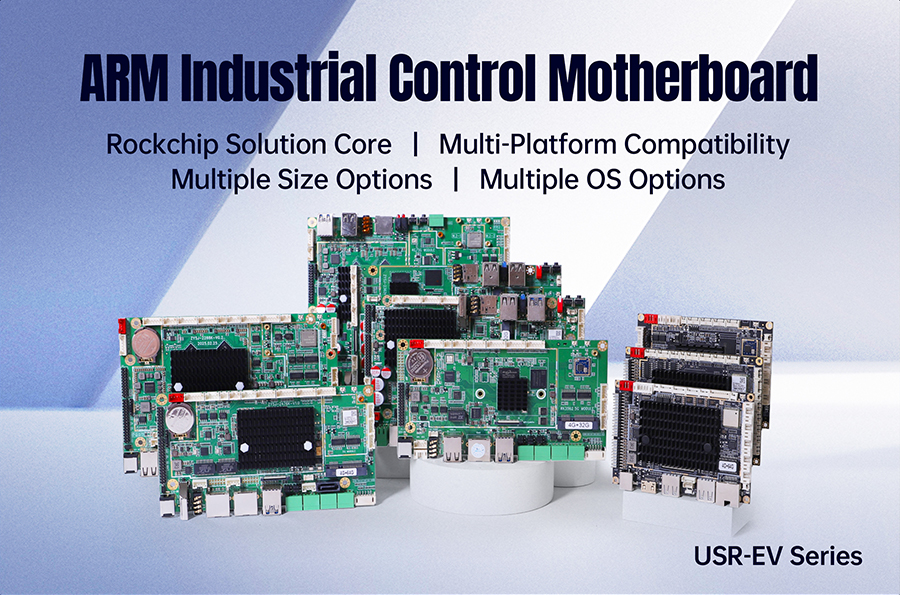
Yes. The USR-EV series embedded single board computer was born for AGV scenarios where "every watt must be counted."
It's not "cutting power" from a generic design. From chip selection onward, the entire architecture revolves around "low power."
Heterogeneous Low-Power Platform
| Item | Traditional 25W SBC | USR-EV Series (8W avg) |
|---|---|---|
| Daily power per unit | 25W × 20h = 500Wh | 8W × 20h = 160Wh |
| Yearly power for 200 units | 365,000Wh ≈ 36,500 kWh | 116,800Wh ≈ 11,700 kWh |
| Yearly electricity (0.8 yuan/kWh) | 29,200 yuan | 9,360 yuan |
| Annual savings | — | 19,840 yuan |
| Battery savings per unit | Baseline | ~2,000mAh less |
| Battery savings for 200 units | — | 400Ah ≈ 8,000 yuan |
| Total annual savings | — | ~28,000 yuan |
28,000 yuan is the "invisible profit" you get just by picking the right embedded single board computer.
And that's not even counting: fan repair costs, downtime losses from overheating, line stoppages from insufficient battery…
Saving power is never just saving on electricity. It's saving your downtime, your maintenance costs, your project reputation.
Anyone doing AGV projects knows how cutthroat this industry has become.
Your navigation accuracy is 0.1° better than the competitor, your response is 0.2s faster, your price is 5% lower — it's all millimeters of market share.
But almost nobody gets serious about "power consumption."
Because power consumption is invisible, intangible. It won't be on your PPT or in your acceptance report.
But it will show up on your electricity bill, in your battery BOM, in your maintenance tickets, and on your profit statement.
The USR-EV series isn't an embedded single board computer with "nice-looking specs." It's one that makes sure you don't lose on every kilowatt-hour, every milliamp, every cent.
Pick right, and your AGV doesn't just run accurately — it runs far, runs long, and runs cheap.
If you're selecting an AGV embedded single board computer and have power requirements but don't know where to start comparing — send us your application scenario and power supply plan. Let's settle this account together.