New Standard for Intelligent Inspection of Oil and Gas Pipelines: ARM Industrial PC + Laser SLAM Breaks the Dilemma of Underground Pipeline Network Inspection
Deep within the underground pipeline network of an oil field in Gansu, a 1.2-meter-diameter oil pipeline is transporting black gold at a speed of 3 meters per second. Three meters above the pipeline, the protective suit of inspector Lao Zhang is soaked with sweat as he kneels on the damp mud, carefully examining the pipeline's anticorrosive coating with a powerful flashlight. Suddenly, an urgent alarm sounds from his walkie-talkie: "Excessive methane concentration in Valve Room 3!" Lao Zhang grabs his detector and rushes towards the accident site, but he trips over an exposed steel bar at a turn and slams his knee heavily against a concrete base.
Such scenes are repeated daily along tens of thousands of kilometers of oil and gas pipelines across the country. According to statistics from the National Pipeline Network Group, in 2025, 63% of oil and gas pipeline accidents in China occurred in underground pipeline network areas, with 41% directly related to untimely inspections. More distressingly, in the past five years, 78% of injury and fatality accidents during inspection operations occurred when personnel entered confined spaces.
"We're like blind men feeling an elephant in the dark," said Mr. Li, the Safety Director of a pipeline company, with frustration. "The environment of underground pipeline networks is far more complex than imagined: some pipeline sections are buried more than 15 meters deep, some pass through karst areas, and others are intertwined with urban drainage systems. Traditional inspection methods are like trying to find a needle in a haystack with chopsticks—inefficient and extremely risky."
Inspection records from a western oil field show that manual inspections can cover an average of only 8 kilometers of pipeline per day, with a data collection completeness rate of less than 65%. In pipeline sections in the Gobi Desert, inspectors need to carry 20-kilogram equipment and walk 10 kilometers, with a heatstroke risk of up to 30% in high temperatures. More seriously, manually recorded data has an error rate of 15%-20%, leading to delayed identification of potential hazards.
In July 2025, a gas pipeline in Shandong was damaged by third-party construction, causing a leak. Due to the inability of traditional inspections to monitor in real time, the leak was only discovered by passersby three hours later. By then, the natural gas had spread to nearby residential areas, triggering a large-scale evacuation. It is estimated that for every hour of delay in detecting a leak, accident losses increase by 2 million yuan.
A survey by a multinational energy company revealed that inspection data from its subsidiary pipeline companies was scattered across 17 different systems, with inconsistent formats and standards. When engineers needed to analyze the historical corrosion trend of a pipeline section, they had to manually organize detection reports from three years, taking up to two weeks.
During the inspection of shale gas pipelines in the Sichuan Basin, inspectors need to enter pipelines with a diameter of only 80 centimeters for internal inspection. This "snail-like" operation method is not only inefficient but also faces life-threatening risks such as toxic gas poisoning and oxygen deprivation. In 2025, three suffocation accidents occurred during inspections in the region, resulting in two deaths.
In a technology exhibition hall in Wuhan, an AGV inspection robot equipped with a laser SLAM navigation system is autonomously operating in a simulated underground pipeline network environment. It deftly avoids simulated obstacles, scans the pipeline surface with a multispectral sensor on its robotic arm, and transmits data back to the control center in real time via a 5G network. This scene represents the future of intelligent inspection of oil and gas pipelines.
Traditional AGVs often "get lost" in underground pipeline networks due to the loss of GPS signals, but laser SLAM technology has completely changed this situation. By emitting 360-degree laser pulses and analyzing the reflected signals, an AGV can model the surrounding environment within 0.1 seconds with millimeter-level accuracy.
"It's like giving the robot 'digital eyes,'" explained the CTO of a robotics company. "In field tests at an oil field, our AGV operated continuously for 8 hours in a completely dark pipeline, with positioning errors always controlled within 2 centimeters. Even when encountering sudden obstacles, it can replan its path within 0.5 seconds."
More critically, laser SLAM supports a "walk-and-map" map construction mode. The AGV can generate a 3D pipeline network map during its first inspection, which can be directly called up for subsequent operations without the need to pre-lay magnetic strips or QR codes for navigation. This feature reduces system deployment costs by 60% and improves maintenance efficiency by three times.
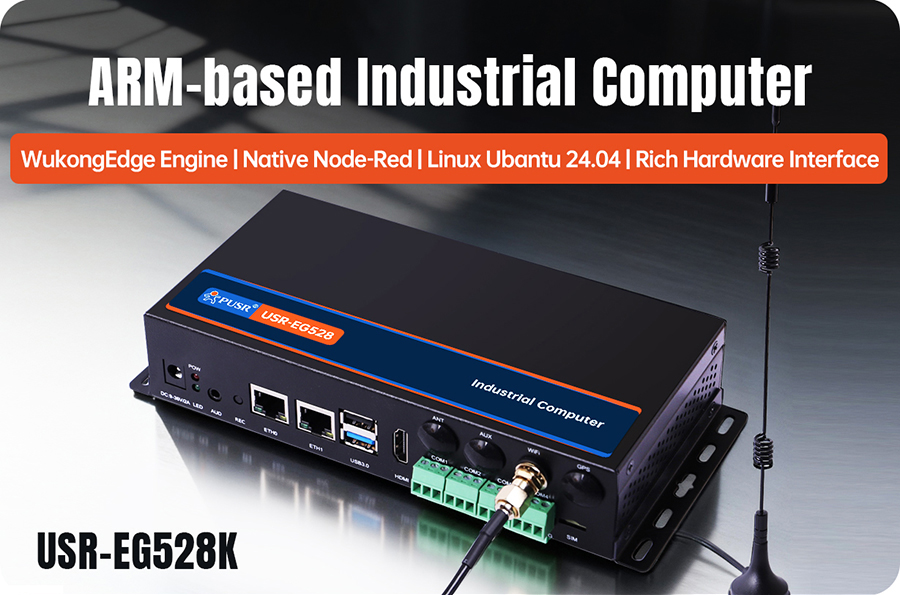
Behind the AGV's "digital eyes" is the powerful computing support provided by the USR-EG528 ARM industrial PC. Equipped with a Rockchip RK3562 quad-core processor, this device can simultaneously process data from eight sensors, including laser radar, infrared thermal imaging, and gas detection, with a latency controlled within 50ms.
"Underground pipeline network inspections have extremely high real-time requirements," pointed out an automation engineer from an oil field. "When the AGV detects a methane leak, it must complete positioning, alarming, and emergency command issuance within 3 seconds. The edge computing capability of the USR-EG528 allows us to achieve this goal."
What is even more commendable is its environmental adaptability. The USR-EG528 can operate stably in temperatures ranging from -40°C in Mohe during winter to +60°C in Tarim during summer. Its IP65 protection rating and vibration-resistant design enable it to easily cope with harsh conditions such as moisture, dust, and mechanical vibrations in underground pipeline networks.
Modern intelligent inspection systems no longer rely on a single sensor. Taking the solution from an oil field as an example, its AGV is equipped with:
This multimodal perception system has increased the accuracy of hazard identification from 68% in traditional methods to 92%. In a test on a gas pipeline, the system successfully warned of three micro-leaks with a diameter of only 2mm, which were completely undetected by manual inspections.
In practice at an oil field in Gansu, the intelligent inspection system has increased the daily inspection mileage from 8 kilometers to 80 kilometers. More critically, the system can operate 24/7, completely eliminating the "time blind spots" of manual inspections. According to estimates, the system has reduced the average time to detect pipeline leaks from 12 hours to 15 minutes.
Although the initial investment in intelligent inspection systems is twice that of traditional methods, their total lifecycle cost advantages are significant. Taking a 100-kilometer pipeline as an example:
Not to mention the potential accident losses avoided by the intelligent system. According to statistics, preventing a single leak accident can save an average of more than 5 million yuan in direct losses.
In the application of shale gas pipelines in Sichuan, the intelligent inspection system has reduced the amount of manual operations in confined spaces by 92%. Tasks that previously required a three-person team to complete can now be monitored by just one person in the control center. The Safety Director of a pipeline company said, "Since the system has been in operation for a year, we have achieved the safety goal of 'zero casualties, zero accidents.'"
The massive amount of data accumulated by intelligent inspection systems is changing the way pipeline management is conducted. Through machine learning algorithms, the system can predict pipeline corrosion trends and warn of potential risks six months in advance. In practice at an oil field, this predictive maintenance has reduced unplanned downtime by 65% and maintenance costs by 30%.
When promoting intelligent inspection systems, we often encounter three typical customer mindsets:
These customers typically have more than 20 years of industry experience and are cautious about new technologies. They often ask, "Is your system really more reliable than manual inspections?" For such customers, we adopt a strategy of "pilot verification + data comparison":
A pilot test at an oil field showed that the intelligent system detected 47 hazards, while manual inspections only detected 28, including 12 false alarms. This result completely dispelled the customer's doubts.
These customers often face strict budget assessments and are highly sensitive to prices. We help them understand through "total lifecycle cost analysis":
A private pipeline company calculated that after adopting the intelligent system, its ROI period would be only 18 months, far shorter than the expected three years.
These customers are usually middle managers who worry that new technologies will disrupt existing work processes. We emphasize:
During implementation at a state-owned pipeline company, we helped 200 inspectors transition to system operators through a three-month transition training program, achieving a smooth transition.
Standing on the threshold of 2026, intelligent inspection of oil and gas pipelines is evolving towards higher dimensions. The combination of laser SLAM and ARM industrial PCs is just the beginning of this transformation. In the next three years, we will witness:
In this transformation, innovative products such as the USR-EG528 ARM industrial PC are playing a key role. They are not only carriers of technology but also drivers of industry transformation. When we watch AGVs maneuver freely in underground pipeline networks from the control center, we see not only technological progress but also the embryonic form of a safer, more efficient, and more sustainable energy future.
As the General Manager of a pipeline company said at the system launch ceremony, "In the past, our inspectors were brave warriors groping in the dark; now, they have the 'torch' of the digital age. This light will illuminate the next decade of safe operation of China's oil and gas pipelines."


















