The Gateway to Digital Twin Production Lines: How All-in-One Computer Touch Screens Achieve Synchronous Mapping Between Physical Robots and Virtual Models
Have you ever wondered: what is that robot on your production line doing right this moment?
What's its joint rotation speed? What's its current load rate? Will it collide with the workpiece next to it in the next second?
If you can't answer — your production line is still stuck at the "can see but can't understand" stage.
The essence of a digital twin isn't drawing a pretty 3D model. It's making the "shadow" in the virtual world breathe in sync with the physical robot.
And the gateway that makes them breathe in sync? That's the all-in-one computer touch screen on your production line.
It's 2024. The phrase "digital twin" has become almost a standard buzzword for manufacturing companies.
It's in PPTs, in showrooms, in bidding proposals. But go take a real look on the shop floor — the 3D model on the screen is rotating, the robot on the line is rotating too. But they're two completely different things.
The model says "I'm welding at 1,200 rpm." In reality, that robot may have already dropped to 800 rpm — because the welding torch overheated and it's protecting itself.
The model is fake. The data is stale. The sync doesn't exist.
This is the biggest pain point of digital twin implementation today: it's not that you can't build the model — it's that you can't feed data into it.
You spent hundreds of thousands on a digital twin platform. The modeling team spent three months on the 3D model. In the end, you find out — 3-second data latency, 15% packet loss, critical parameters simply can't be collected.
The gateway to digital twins isn't software. It's hardware.
To be precise — it's the all-in-one computer touch screen on the production line responsible for collecting, transmitting, and computing data.
It's the door between the physical world and the virtual world.
If the door won't open, the digital twin is just a screensaver.
Most people's understanding of digital twins stops at "3D visualization." But a truly valuable digital twin synchronizes these three layers:
| Sync Layer | Sync Content | Data Source | Latency Requirement |
|---|---|---|---|
| State Sync | Robot's current pose, position, speed | Encoders, servo drives | <100ms |
| Parameter Sync | Current, temperature, torque, vibration | Sensors, PLC | <50ms |
| Event Sync | Alarms, tool changes, collisions, stops | I/O signals, bus messages | <10ms |
All three layers must be fast. Not one can be slow.
If state sync is slow: the model shows the robot at Position A, but in reality it's already at Position B — the operator makes a decision based on the model, and a collision happens.
If parameter sync is slow: the model shows everything normal, but in reality the motor is already overloaded — by the time you notice, the bearing has burned out.
If event sync is slow: the model still shows "running," but in reality it's emergency-stopped — your digital twin platform is still uploading "running normally" data to the cloud.
Digital twins aren't "roughly synchronized." They're "millisecond-synchronized." A 100ms difference is two different worlds.
And that 100ms gap isn't something software can solve. It's determined by the capability of the all-in-one computer touch screen on your production line.
If you're selecting hardware for a digital twin project, you've probably gone through this indecision:
"Industrial PC or all-in-one computer touch screens?"
"Is fanless really necessary?"
"Are the interfaces enough? Do I need expansion cards?"
"How long will this solution last? Will the vendor discontinue it in two years?"
These aren't technical questions. They're risk questions.
Because once a digital twin project goes live, that all-in-one computer touch screen runs 24/7. If it stops, data breaks. If data breaks, the model "distorts." If the model distorts, the entire digital twin becomes an expensive ornament.
So the core logic of selection isn't "which has the highest specs." It's —
"Which machine is least likely to cause problems on my production line."
Let me break this logic into four soul-searching questions:
AAEON repeatedly emphasizes one figure in their industrial PC solutions: operating temperature range of -40°C to 85°C.
OnLogic puts it even more directly: "Industrial PCs are engineered from the ground up with the features necessary to survive in the type of industrial automation environments that might destroy off-the-shelf computers."
Is there dust on your production line? Oil mist? Vibration? Will the workshop temperature spike above 45°C in summer?
If yes, you don't need a machine that "can work." You need a fanless, wide-temp, vibration-resistant all-in-one computer touch screen.
Fans are the number one killer in industrial environments. OnLogic says it clearly: "The built-in fan is the most common failure point of a computer. While the fan draws in air, it also draws in dust and grime, which accumulates and causes cooling problems, eventually leading to system throttling or hardware failure."
The data gateway for digital twins cannot have a fan that can be clogged by dust.
The data sources for digital twins are more complex than OEE.
What you need to connect:
Robot controller (EtherCAT / Profinet / CC-Link)
PLC (Modbus TCP / OPC UA)
Servo drives (pulse / analog)
Sensors (vibration, temperature, torque — 4–20mA / RS485)
Vision cameras (GigE / USB3.0)
Host system (MES / SCADA — Ethernet)
AAEON puts it well: "Industrial PCs offer a plethora of input/output ports, enabling seamless integration with diverse industrial equipment."
But in reality, many all-in-one computer touch screens only give you 2 serial ports, 2 USB, 1 Ethernet. You need to connect 8 devices? Add expansion cards, add hubs, add converters — every extra intermediary is an extra failure point, plus 10ms latency.
Digital twins demand "direct connection," not "adapter connection."
Digital twins aren't just "refreshing the screen once per second."
The backend is doing this:
Collection (100+ data points/sec) → Cleaning → Protocol conversion → State calculation → Model driving → Screen rendering → Cloud upload
Every step in this pipeline must complete in milliseconds.
AAEON mentions a trend: "performance hybrid architecture" lets the CPU assign light tasks to efficiency cores and heavy tasks to performance cores — the result is high performance while using less power.
OnLogic is more direct: "Industrial PCs feature industrial grade components that are engineered for high reliability, with the goal of providing maximum uptime. Industrial grade components are designed to run 24/7."
Your all-in-one computer touch screen must run 24/7 under full load — no throttling, no lag, no reboots.
Because once the digital twin "goes offline," the virtual model disconnects from the physical world. One minute of disconnection means your digital twin is "dead" for one minute.
Digital twin projects aren't one-off deals. Once the model is built, you'll use it for three years, five years, or longer.
OnLogic says: "Industrial PCs allow businesses to standardize on a computer without any major hardware changes for up to five years."
AAEON even emphasizes a 30-year product track record.
You're not selecting a machine. You're selecting the data gateway for the next five years. If the vendor discontinues it in two years, your digital twin platform becomes an orphan system.
So during selection, you must ask: What's the chip roadmap? What's the lead time? Is there a long-term supply commitment?
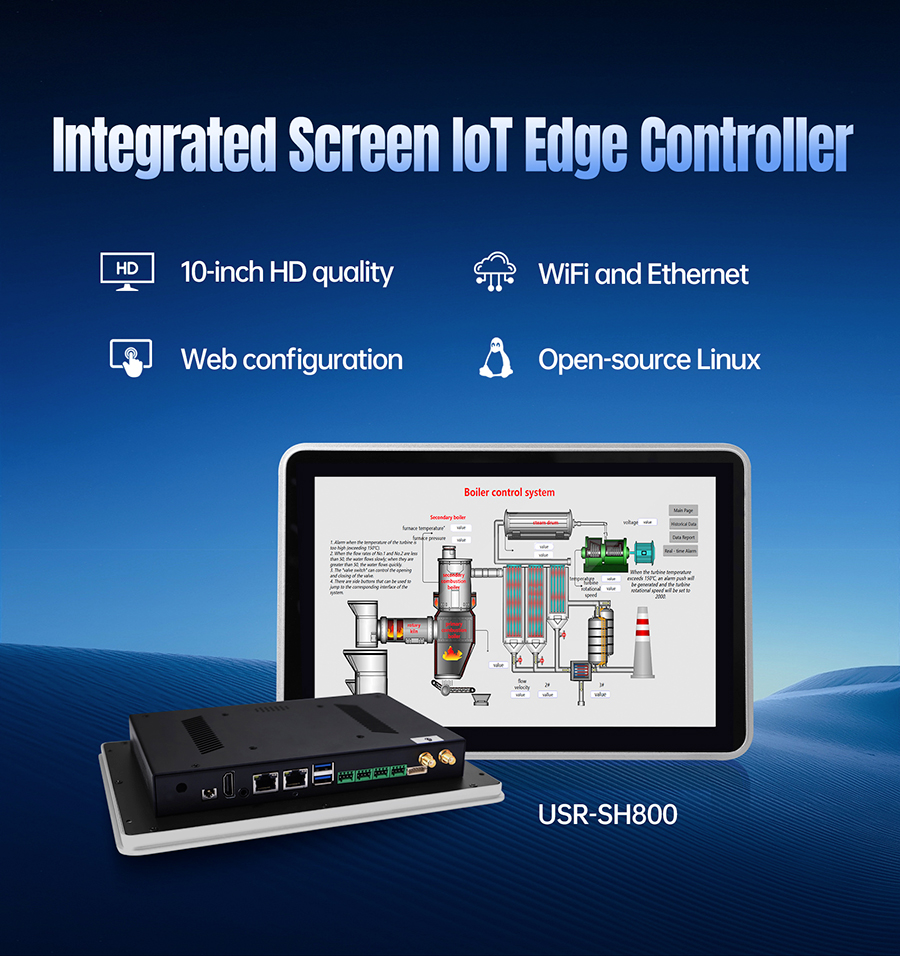
After all that selection logic, it comes down to one question: Is there a machine that answers all four soul-searching questions?
USR-SH800.
I don't want to use the word "recommend." Let me put it differently: this is one of the all-in-one computer touch screens we've seen that covers the most selection pain points in digital twin scenarios.
Fanless + Wide-Temp Design: The Data Gateway Won't Be Clogged by Dust
The USR-SH800 uses fanless passive cooling design — the same philosophy as OnLogic and AAEON's industrial PCs — giving dust zero chance to get in.
In a production line environment, this means:
Zero dust intake, zero noise, zero vibration.
No throttling, no reboots during long-term operation.
Uninterrupted data collection, digital twin never goes offline.
Your virtual model won't "distort" because an IPC overheated.
Rich Interfaces: 8 Devices Direct-Connected, No Intermediaries Needed
The USR-SH800 provides rich I/O interfaces covering mainstream communication needs in digital twin scenarios:
| Interface Type | Qty/Spec | Corresponding Device |
|---|---|---|
| RS232/RS485 | Multi-channel | PLC, servo drives, sensors |
| Ethernet | Multi-port | Robot controller, MES, SCADA |
| USB 3.0 | Multi-port | Industrial cameras, DAQ cards |
| GPIO / CAN | Supported | Custom device access |
| HDMI/VGA | Supported | Local dashboard, multi-screen output |
No expansion cards, no hubs, no adapters. One fewer intermediary on the line means 10ms less latency for the digital twin data.
This follows the same logic as OnLogic's "helping customers eliminate adapters and dongles" — industrial reliability starts with fewer connection points.
Stable Performance: Millisecond Collection, All Three Sync Layers Covered
The USR-SH800 is equipped with an Intel mainstream processor platform, supporting multi-core parallel computing.
The digital twin data flow:
Robot/PLC → Data collection (<10ms) → Parameter calculation (<20ms) → Model driving (<30ms) → Screen rendering (<40ms)
Total controlled within 100ms. State sync, parameter sync, event sync — all three layers meet the target.
Your virtual robot can finally "breathe in sync" with the physical robot.
Multiple Sizes + High-Sensitivity Touch: Fits Any Deployment Scenario
The HMI terminal for digital twins isn't just one form factor.
Some scenarios need a 7-inch screen next to the robot for local monitoring. Others need a 21.5-inch screen on the line dashboard for a global overview.
The USR-SH800 offers 7"/10"/15"/21.5" size options — from compact to large dashboard, full coverage.
The touchscreen uses high-sensitivity capacitive touch, supporting wet-hand and gloved-hand operation — line operators can click, zoom, and check parameters on the virtual model without removing gloves.
A good digital twin gateway doesn't make people adapt to the machine. It makes the machine adapt to people.
Great Value: The Money You Save Buys You Two More Devices
All-in-one computer touch screens with the same config on the market typically cost 30–50% more.
The USR-SH800 spends money where you actually need it: compute, interfaces, reliability, screen.
You're not paying for features you won't use.
AAEON expressed a similar philosophy in their solutions: with advances in chip architecture, low-power CPUs (like Intel Atom x7000E, Intel N-series) can now accomplish tasks that used to require tens of watts — all within a 6W–15W TDP.
Performance up, power down, price down. That's the prerequisite for digital twins to scale.
Many people think digital twins are "nice to have." But do the math — they're "essential."
Suppose your line has 10 robots. Each robot's unexpected downtime loss is:
Downtime: average 30 min/incident
Line loss per minute: 2,000 yuan
Unexpected downtime: 4 times/robot/month
| Metric | No Digital Twin | With Digital Twin (Real-Time Mapping) |
|---|---|---|
| Monthly downtime loss/robot | 24,000 yuan | 8,000 yuan (predictive maintenance reduces unplanned downtime by 60%) |
| 10 robots monthly loss | 240,000 yuan | 80,000 yuan |
| Monthly savings | — | 160,000 yuan |
| Annual savings | — | 1,920,000 yuan |
1.92 million yuan — that's what the digital twin saves you.
And it all hinges on your data gateway — that all-in-one computer touch screen — running 24/7 without going offline, without latency, without packet loss.
The price of one USR-SH800 might be less than two months of your downtime losses.
But what it guards is the data lifeline of your entire production line.
Final Word: The Future of Digital Twins Isn't in the Cloud — It's on the Production Line
Everyone talks about the digital twin's "cloud brain." But few tell you —
Without a stably running all-in-one computer touch screen on the production line, the cloud brain is an empty shell.
Where does data come from? From the production line.
How is data transmitted? Through the all-in-one computer touch screen.
Is data accurate? Depends on the all-in-one computer touch screen's collection precision.
Does data stay connected? Depends on the all-in-one computer touch screen's reliability.
The future of digital twins isn't in the cloud far from the line. It's in the machine close to the line.
The USR-SH800 isn't a miracle machine. But when it comes to being the "digital twin data gateway," it gets everything right:
Fanless, wide-temp, vibration-resistant — data never breaks.
Rich interfaces, direct-connect devices — lowest latency.
Stable performance, millisecond collection — three-layer sync.
Multiple sizes, high-sensitivity touch — fits all scenarios.
Long-term supply, great value — five years of worry-free operation.
If you're planning a digital twin project but aren't sure what hardware to put on the line — send us your line details. We'll help you figure out the interfaces, compute, and size all at once.
Your robot is moving every second. Your virtual model should know every second.
What's missing isn't the algorithm. It's the machine that catches the data.


















