April 28, 2026
All-in-one touch screen's fall detection & emergency call act as a "safety net" for elders
Smart Elderly Care Health Monitoring: The all-in-one computer touch screen's fall detection and emergency call functions serve as a "safety net" for the elderly.
1. The Overlooked "Last Meter": Family and Social Pain Behind Elderly Falls
At 3 a.m., Grandma Wang, living alone in a Beijing community, slipped in the bathroom and struggled to unlock her phone with wet hands. Grandpa Li in Shanghai fainted while walking in the living room and couldn't reach the emergency call button on the coffee table. Aunt Zhang in Guangzhou lost balance while getting items in the kitchen and couldn't cry for help due to a throat injury. These real cases reflect the common dilemma faced by China's 260 million elderly: falls have become the leading cause of accidental injuries among those over 65, with one in three falling at least once a year, and the golden rescue time after a fall is only 3-5 minutes. In traditional elderly care models, families and institutions attempt to solve problems by installing fixed call buttons and providing wearable devices, but the actual effects are often unsatisfactory: Complex operations: The elderly often can't accurately press buttons due to vision decline and finger tremors. Privacy concerns: Wearable devices need to be worn 24/7, triggering resistance to being "monitored." Delayed responses: Fixed call devices have limited coverage, and insufficient night-shift staff cause rescue delays. Data silos: Health monitoring devices and emergency call systems are fragmented, unable to provide comprehensive warnings. These pain points leave children torn between guilt over "not being able to accompany them at all times" and doubts about "whether technology is truly reliable."
2. Technological Breakthrough: How the all-in-one computer touch screen Reconstructs the Triangular Balance of "Safety-Dignity-Freedom"
In the Yingshi Smart Elderly Care Community in Dongyang, Zhejiang, an 82-year-old Grandma Chen had an all-in-one computer touch screen installed at home. One late night, she fainted due to low blood sugar while getting up to use the toilet. The system detected abnormal human posture through non-contact millimeter-wave radar and immediately triggered a three-pronged response: Local alarm: The screen lit up with a red warning light, and a voice announced, "Fall detected. Emergency contacts have been notified." Cloud push: The children's mobile app received an alert simultaneously, displaying the elderly person's location and real-time vital signs. Community linkage: The property management duty room's large screen displayed the distress information, and a caregiver with an AED device arrived within 3 minutes. This seamless "virtual-real" rescue reveals the core value of the all-in-one computer touch screen: through the integrated functions of "fall detection + emergency call + health monitoring," it ensures safety while maximizing the elderly's dignity and freedom of movement.
2.1 Fall Detection: A Paradigm Revolution from "Passive Response" to "Active Prevention"
Traditional fall detection relies on wearable devices or cameras, with two major flaws: the former requires the elderly to wear them actively, and the latter involves privacy disputes. The all-in-one computer touch screen adopts millimeter-wave radar + AI behavior recognition algorithms for "non-intrusive protection":
Non-contact monitoring: By emitting millimeter-wave signals, it penetrates clothing and bedding to accurately capture human micro-movements and posture changes.
Privacy-friendly design: No cameras are needed, avoiding the psychological pressure of being "watched," and meeting the elderly's need for "dignified elderly care."
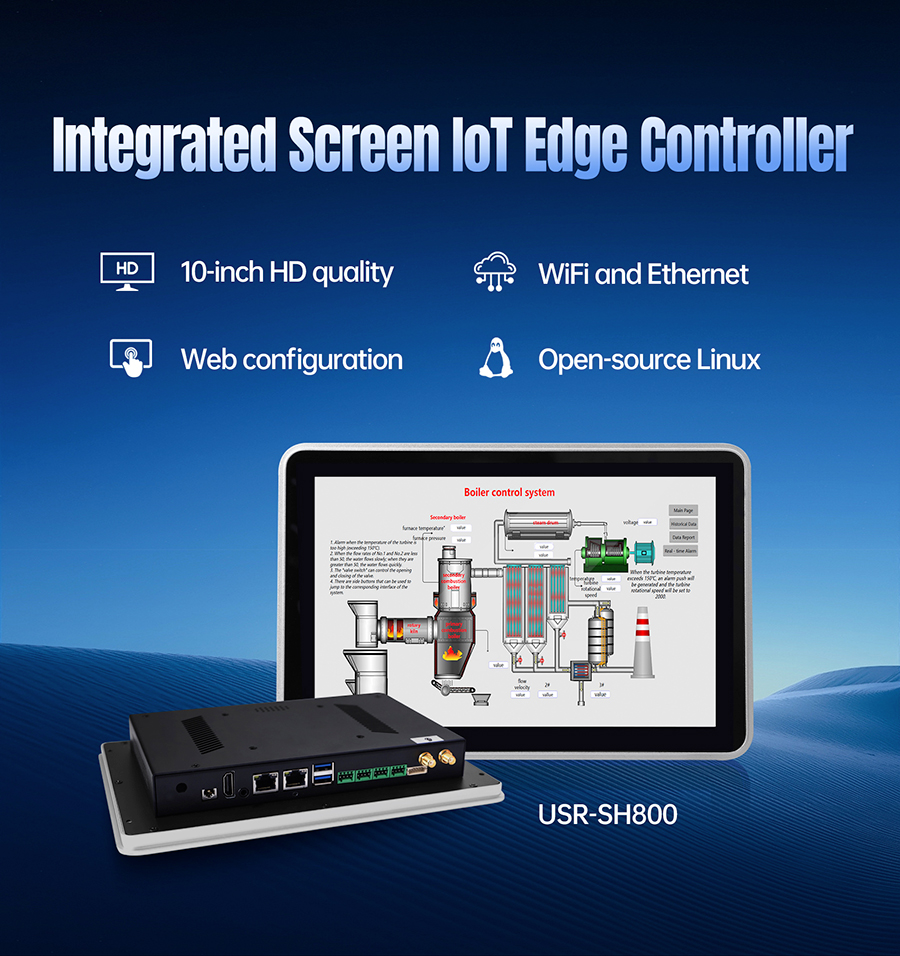
Strong anti-interference ability: It maintains an accuracy rate of over 98% in complex environments (e.g., pet activities, curtain movements). Take the USR-SH800 as an example. Its built-in NPU neural network processor can analyze radar data in real-time, distinguishing "falls" from daily actions like "sitting" and "bending," reducing false alarms by 60% compared to traditional solutions. In a pilot in Changsha's Furong Community, the system successfully warned of 12 falls, with 8 cases avoiding serious consequences like fractures due to timely treatment.
2.2 Emergency Call: An Ecological Upgrade from "Single Notification" to "Full-Link Rescue"
Traditional emergency call buttons can only achieve "one-click notification," while the all-in-one computer touch screen builds a four-level response network of "terminal-family-community-medical":
Terminal layer: The screen integrates a physical SOS button and voice call function, supporting dialect recognition to ensure the elderly can trigger help even while lying in bed.
Family layer: It pushes alerts to children's apps, displaying the elderly's location, vital signs, and historical health data to assist remote decision-making.
Community layer: It connects with property management and elderly care service center systems, automatically assigning the nearest caregiver to visit and calling public area cameras to verify the situation.
Medical layer: It connects with hospital HIS systems, directly transferring to the 120 emergency center in critical cases and synchronously transmitting electronic medical records. In Suzhou Xindao's smart elderly care solution, the USR-SH800, as the core control terminal, can link with smart door locks and lighting systems: when a fall alert is triggered, the system automatically opens the door and turns on corridor lights, creating a "green channel" for rescuers.
2.3 Health Monitoring: Precise Intervention from "Single-Point Data" to "Continuous Profiling"
Another value of the all-in-one computer touch screen lies in building a full-cycle monitoring system of "daytime behavior + nighttime physiology":
Daytime behavior monitoring: Through radar and infrared sensors, it records the elderly's activity trajectories, toilet frequency, and sedentary time, warning of early symptoms of cognitive disorders (e.g., wandering, getting lost).
Nighttime physiological monitoring: It integrates smart mattress data to analyze sleep quality, respiratory rate, and heart rate variability, detecting potential risks like sleep apnea.
Chronic disease management: It connects with blood pressure monitors, glucometers, and other devices, automatically generating medication reminders and synchronizing data to family doctor workstations. After the HW-V600 health detection all-in-one machine from Henan Lejia Electronics was linked with the USR-SH800, it achieved a "physical examination-analysis-intervention" closed loop: after the elderly complete over 50 tests like 12-lead ECGs and bone density in the community, the data is automatically uploaded to the all-in-one screen. AI algorithms generate personalized health reports and recommend suitable rehabilitation training videos.
3. Technological Warmth: How to Make "Cold" Devices "Warm" Companions
The ultimate goal of the all-in-one computer touch screen is to make technology "recede into the background" and become an "emotional bond" between the elderly, families, and communities. This requires achieving technological humanization from three dimensions:
3.1 Elderly-Friendly Design: Eliminating the "Digital Divide"
Simplified interactions: It adopts large fonts, high-contrast UIs, supports voice control and gesture operations, and reduces touch screen mis-touches.
Scene presets: It has built-in one-click scenes like "getting up mode," "medication reminders," and "visitor reception" to reduce learning costs.
Fault self-checks: The system regularly detects network and sensor status and prompts the elderly to contact maintenance personnel via voice when abnormalities occur. The USR-SH800's 10.1-inch capacitive screen and Linux system support multi-touch and custom interfaces, allowing the elderly to use it as naturally as traditional home appliances. Its edge computing capability ensures local alarms and data storage even when offline.
3.2 Privacy Protection: Balancing "Safety" and "Dignity"
Data encryption: It uses national cryptographic algorithms to encrypt transmitted and stored data to prevent leaks.
Permission grading: The elderly can on their own set data sharing ranges (e.g., only for children or designated doctors).
Anonymization: Faces in community surveillance footage are automatically blurred to avoid the elderly feeling "watched."
3.3 Emotional Value: Beyond "Function Piling" for a Sense of Companionship
Family interactions: The screen supports video calls and photo sharing, allowing children to remotely play operas and upload family photos for the elderly.
Social incentives: It has built-in gamified functions like health check-ins and step competitions to encourage the elderly to participate in community activities.
Memory compensation: Through AI voice assistants, it helps the elderly with cognitive disorders recall family memories and recognize relatives' faces. In a pilot by Hangzhou Yingshi Network, 85% of the elderly said the all-in-one screen made them feel their children were still by their side, while the children felt less anxious about "being able to know their parents' conditions at any time."
Contact us to find out more about what you want !
5G and digital twins, the all-in-one computer touch screen will upgrade to "predictive health management":
Fall risk prediction: By analyzing gait and balance data, it can warn of fall risks 3-5 days in advance.
Early disease screening: By combining vital signs and behavior patterns, it can detect early signs of diabetes and cardiovascular diseases.
Carbon neutrality practices: It optimizes device energy consumption to drive elderly care communities toward "zero-carbon" goals. When technology truly "understands" the elderly's needs, the all-in-one computer touch screen will no longer be just a "safety tool" but a "smart bridge" connecting the past and future, individuals and society—allowing every elderly person to age gracefully with dignity and freedom.
Industrial Gateways Ranked First in China by Online Sales for Seven Consecutive Years* Source: Frost & Sullivan; Based on the "2026 China Online Channel Industrial Gateways Market Independent Market Research Report" (2019-2025)
We use cookies to ensure that we give you the best
experience on our website. If you continue to use this site we will assume that you are happy with it.