Application of Industrial Panel PC in Logistics and Warehousing: The Intelligent Revolution in Location Guidance and Inventory Counting
In the logistics and warehousing industry, efficiency and accuracy are the lifeblood for survival and development. However, traditional warehousing management models have long been plagued by issues such as chaotic location guidance, inefficient inventory counting, and data lag. Pickers shuttling between shelves waste over 30% of their working hours due to difficulties in locating products; monthly full-scale inventory counts require mobilizing dozens of people and take 3-5 days, yet still have an error rate as high as 5%; discrepancies between inventory data and actual stock lead to stockouts or overstocking, resulting in annual losses exceeding 10 million yuan. These pain points are being thoroughly rewritten by industrial panel PC technology. This article will provide an in-depth analysis of how industrial panel PCs are reconstructing warehousing operation logic through the dual engines of "dynamic location guidance + intelligent inventory counting" and reveal how they have become a key infrastructure for enterprise digital transformation.
Traditional warehousing relies on paper labels or fixed electronic screens for location guidance. However, when faced with dynamically changing inventory (such as seasonal product transfers or temporary stacking of promotional items), the lag in label updates often leaves pickers in a "blind men touching an elephant" situation. Data from a large e-commerce warehouse shows that pickers walk an average of over 15 kilometers per day, with 30% of that being ineffective paths, directly driving up labor costs and order fulfillment times.
Manual inventory counting requires halting operations and scanning barcodes shelf by shelf, which is inefficient and prone to human interference. A fast-moving consumer goods company once experienced a discrepancy of 20,000 items between system-displayed inventory and actual stock due to counting errors, forcing emergency stock transfers to meet promotional demands and resulting in direct losses exceeding 1 million yuan. More critically, the static counting model fails to reflect inventory dynamics in real-time, making it difficult for companies to accurately predict demand and falling into a vicious cycle of "stockouts-overstocking."
Warehousing systems (WMS), equipment control systems (WCS), surveillance systems (CCTV), etc., often operate independently, with data unable to intercommunicate. For example, AGV trolley path planning relies on WMS instructions, but if sensors do not provide real-time feedback on shelf occupancy status, the trolleys may cause a complete shutdown due to "collisions." This information disconnection keeps warehousing operations in a "passive response" mode, making it difficult to achieve proactive optimization.
By integrating sensors, edge computing, AI algorithms, and visual interaction technologies, industrial panel PCs seamlessly connect the physical space of warehousing with the digital world, becoming a core tool for addressing the aforementioned pain points. Their core value is reflected in three dimensions:
Industrial panel PCs can connect to the WMS system in real-time to dynamically display location information. For example, when a picker scans an order QR code, the all-in-one screen immediately plans the optimal path and guides them to the target location through arrows, lights, or voice prompts. If the location changes due to transfers, the system automatically updates the guidance to ensure "zero errors." After deployment in an auto parts warehouse, picking efficiency increased by 40%, and order fulfillment time shortened by 25%.
The UWB positioning, RFID readers, or visual recognition technologies integrated into the all-in-one screen can collect inventory data in real-time. For example, tracking shelf product locations through UWB tags and analyzing product movement trajectories with AI algorithms automatically identify counting discrepancies; or using visual recognition technology to scan shelf images and compare them with system inventory, with an error rate below 0.1%. After adopting a visual counting solution, a pharmaceutical warehouse shortened its counting cycle from 3 days to 4 hours and achieved "zero downtime" operations.
As an edge computing node, the all-in-one screen can integrate multi-source data from WCS, equipment monitoring, environmental sensors, etc., and achieve global optimization through AI algorithms. For example, when sensors detect that temperature and humidity in a certain area exceed standards, the all-in-one screen automatically sends alerts to administrators and links with the air conditioning system to adjust parameters; when AGV trolley paths are congested, the all-in-one screen replans routes in real-time and pushes them to all equipment to avoid "traffic paralysis." This closed loop of "perception-analysis-decision-execution" shifts warehousing operations from "experience-driven" to "data-driven."
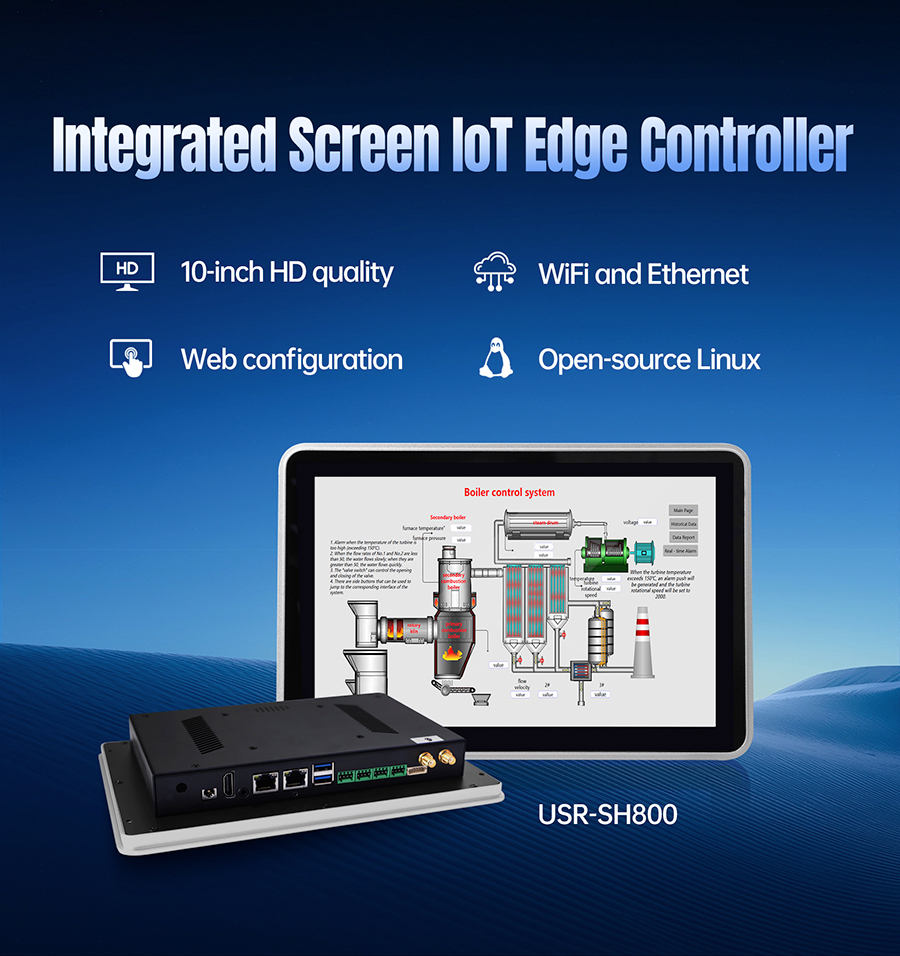
Among numerous industrial panel PCs, the USR-SH800 stands out as an ideal choice for warehousing scenarios due to its dual advantages of "hardcore configuration + flexible application." Its core capabilities include:
The USR-SH800 is equipped with a 10.1-inch capacitive touchscreen with a resolution of 800×1280, capable of displaying over 30 types of data in layers, including location maps, product information, and path planning. For example, in a smart park project, the all-in-one screen simultaneously connected to 200 air conditioning units, 50 elevator control systems, and 300 environmental sensors. Using a drag-and-drop configuration tool, engineers built a visual dashboard displaying everything from pump status to water quality data in just 2 hours, with configuration elements linked in real-time to equipment status. When pipeline pressure in a certain area is abnormal, the corresponding pipeline icon immediately turns red and flashes with an alert, achieving "what you see is what you get" dynamic guidance.
The USR-SH800 incorporates the WukongEdge edge application platform, which integrates over 100 industrial protocol libraries, enabling seamless connection to PLCs, sensors, cameras, and other devices for local data cleaning, anomaly detection, and linkage control. For example, in a manufacturing enterprise project, the all-in-one screen constructed an equipment health model by analyzing historical data on equipment vibration, temperature, and current, successfully predicting air compressor bearing wear (14 days in advance) and injection molding machine hydraulic system leaks (8 days in advance), reducing unplanned equipment downtime by 70% and maintenance costs by 40%. More critically, its 1.0 TOPS AI computing power supports the deployment of models from mainstream frameworks such as Caffe and TensorFlow, enabling intelligent counting in complex scenarios such as license plate recognition, violation detection, and traffic statistics.
The USR-SH800's Linux Ubuntu 20.04 system supports desktop operations and allows the installation of development tools such as Docker and Node-RED for building personalized business logic. For example, in a provincial power grid project, the all-in-one screen constructed a "source-grid-load-storage" collaborative control platform by connecting smart meters, distributed photovoltaic systems, and energy storage systems, increasing renewable energy consumption by 18%, narrowing peak-valley differences by 25%, and reducing line losses by 12%. This integrated capability of "collection, control, display, and cloud" makes it not only suitable for warehousing scenarios but also expandable to urban governance fields such as smart transportation, smart energy, and smart government.
The deployment of industrial panel PCs should follow the principle of "scenario-based design + phased implementation." Taking a fast-moving consumer goods enterprise's warehousing upgrade project as an example:
Deploy the USR-SH800 in high-value areas (such as promotional product shelves) to implement pilot projects for dynamic location guidance and visual counting. After 3 months of operation and validation, picking efficiency increased by 35%, and counting error rates dropped to 0.2%, providing data support for full-scale promotion.
Gradually expand to the entire warehouse, integrating data from AGV scheduling, environmental monitoring, security systems, etc., to achieve "single-screen management" through the all-in-one screen. For example, when sensors detect that temperature and humidity in a certain area exceed standards, the all-in-one screen automatically sends alerts to administrators and links with the air conditioning system to adjust parameters, while also notifying pickers to suspend operations in that area to avoid product damage.
Leverage the edge computing capabilities of the all-in-one screen to construct an inventory prediction model that combines historical sales data with real-time inventory dynamics to automatically generate replenishment recommendations. For example, if the system predicts that a product will be out of stock in 3 days, it automatically triggers a purchase order and adjusts the location to be near the packing area, shortening order fulfillment time.


















