Application of Industrial Panel PC in Smart Buildings: How to Integrate Air Conditioning/Lighting/Security Systems? Unlock a New Paradigm for All-Scenario Intelligent Management
Under the dual drivers of carbon neutrality and digitalization, smart buildings are transitioning from concept to reality. According to statistics, the global smart building market is expected to surpass $1.2 trillion by 2027, with equipment integration and system collaboration emerging as core demands. However, in traditional building management, subsystems such as air conditioning, lighting, and security operate independently, leading to energy waste, inefficient management, and frequent security vulnerabilities. As the "nerve center" of smart buildings, the industrial panel PC is reshaping building operation models through unified protocols, data fusion, and intelligent decision-making. This article analyzes how industrial panel PCs address building management pain points from three dimensions—system integration logic, technical implementation paths, and typical scenario applications—and explores the innovative value of USR-SH800 in practice.
In traditional buildings, systems like air conditioning, lighting, and security operate independently, lacking coordinated control. For example:
Conflicts between air conditioning and lighting: In unoccupied conference rooms, air conditioning remains at low temperatures while lighting fails to turn off automatically.
Lack of security-energy linkage: When the security system triggers an alarm at night, lighting does not activate synchronously, compromising surveillance effectiveness.
Equipment idling: Underground parking lot lighting remains on 24/7, consuming significant electricity even when unused.
Data Support: A survey of a commercial complex revealed that energy waste due to fragmented systems accounted for 35%, with annual losses exceeding RMB 2 million.
Traditional building management relies on multiple independent platforms:
Air conditioning control requires logging into the BACnet system.
Lighting management requires operating the DALI protocol interface.
Security monitoring requires switching to a video management platform.
Operations and maintenance (O&M) personnel must master multiple system operation logics, with troubleshooting taking up to 2 hours per incident. Additionally, scattered data makes it difficult to form holistic insights.
Independent operation of subsystems results in weak security protections:
Lighting systems use default passwords, making them vulnerable to hacking.
Air conditioning controllers communicate without encryption, risking data tampering.
Security systems lack linkage with other systems, failing to respond promptly to threats.
Case Study: A office building experienced a temperature surge to 40°C due to a compromised air conditioning system, causing equipment damage and customer complaints.
The core value of industrial panel PC lies in "protocol conversion" and "data interoperability," with a technical architecture comprising three layers:
Edge Layer: Through protocol conversion gateways (e.g., Modbus to BACnet, KNX to MQTT), it supports mainstream protocols for air conditioning (BACnet), lighting (DALI/KNX), security (ONVIF/GB/T 28181), and more.
Platform Layer: Based on IoT operating systems (e.g., AWS IoT/Azure IoT), it enables device registration, data cleansing, and rule engine configuration.
Application Layer: Provides a unified management interface supporting device status monitoring, scenario mode settings, and energy consumption analysis.
USR-SH800 Practice: The device integrates a multi-protocol parsing chip, supporting simultaneous connection to 50+ device types with protocol conversion delays below 50ms, ensuring real-time control without lag.
Through sensor networks and edge computing, industrial panel PC can collect real-time data on:
Environmental parameters: Temperature, humidity, CO₂ concentration, and light intensity.
Equipment status: Air conditioning operation, lighting brightness, and access control records.
Energy metrics: Sub-metered electricity consumption, water flow, and gas usage.
After cleansing, data is uploaded to the cloud to generate a digital twin model of the building, informing optimization decisions. For example:
Dynamic temperature adjustment: Automatically modifies air conditioning supply temperature based on occupancy and activity levels.
Intelligent lighting: Adjusts brightness based on natural light intensity and regional usage.
Security linkage: When smoke sensors trigger, automatically shuts down air conditioning fresh air systems and activates emergency lighting.
Industrial panel PC achieve three upgrades through AI algorithms:
Predictive maintenance: Forecast failures in critical components like air conditioning compressors and lighting drivers 30 days in advance using operational data.
Energy optimization: Reduces energy consumption by 15%-30% through machine learning-driven control strategies.
Scenario modes: Supports one-click switching between "meeting mode," "off-duty mode," and "emergency mode" to minimize manual operations.
Case Study: A hospital using an industrial panel PC achieved annual energy savings of 420,000 kWh and reduced carbon emissions by 320 tons through intelligent lighting and air conditioning coordination.
Environmental Adaptability: USR-SH800 automatically adjusts air conditioning and lighting via temperature/humidity sensors and PIR sensors:In unoccupied conference rooms, air conditioning enters standby mode, and lighting turns off.
Upon occupancy, lights gradually brighten to 300 lux, and air conditioning sets to 26°C.
Seamless Management: O&M personnel remotely monitor device status via a mobile app, with fault alerts pushed in <1 minute.
Energy Transparency: Generates department-specific energy reports to support carbon footprint accounting and ESG disclosures.
Data Comparison: A tech company reported a 25% increase in employee satisfaction and an 18% reduction in air conditioning energy consumption after implementation.
Traffic Optimization: Guides customer flow through lighting linkage with people counting sensors:Strengthens main aisle lighting during peak hours while dimming inactive zones.
Retains only security-required lighting during nighttime closures.
Security Linkage: Upon fire alarm activation, USR-SH800 automatically:Turns off all non-emergency lighting.
Activates smoke exhaust fans.
Unlocks all access control channels.
Remote O&M: Mall property teams can batch-update device parameters via cloud platforms, reducing on-site inspections.
Case Study: A shopping center shortened emergency response times from 5 minutes to 30 seconds and reduced annual maintenance costs by 40% after implementation.
Intelligent Parking Lot Lighting: USR-SH800 combines radar sensors with LED dimming technology:Reduces brightness to 10% when unoccupied.
Brightens the area 20 meters ahead to 100% upon vehicle entry, with gradual dimming in subsequent zones.
Elevator Energy Control: Integrates elevator operational data via industrial panel PC to:Automatically deactivate some elevators during off-peak hours.
Dynamically allocate elevators based on floor call volume.
Public Health Management: Monitors restroom odor levels and automatically activates exhaust fans or air fresheners.
Data Support: A subway station reduced parking lot lighting energy consumption by 75% and elevator standby time by 60% after implementation.
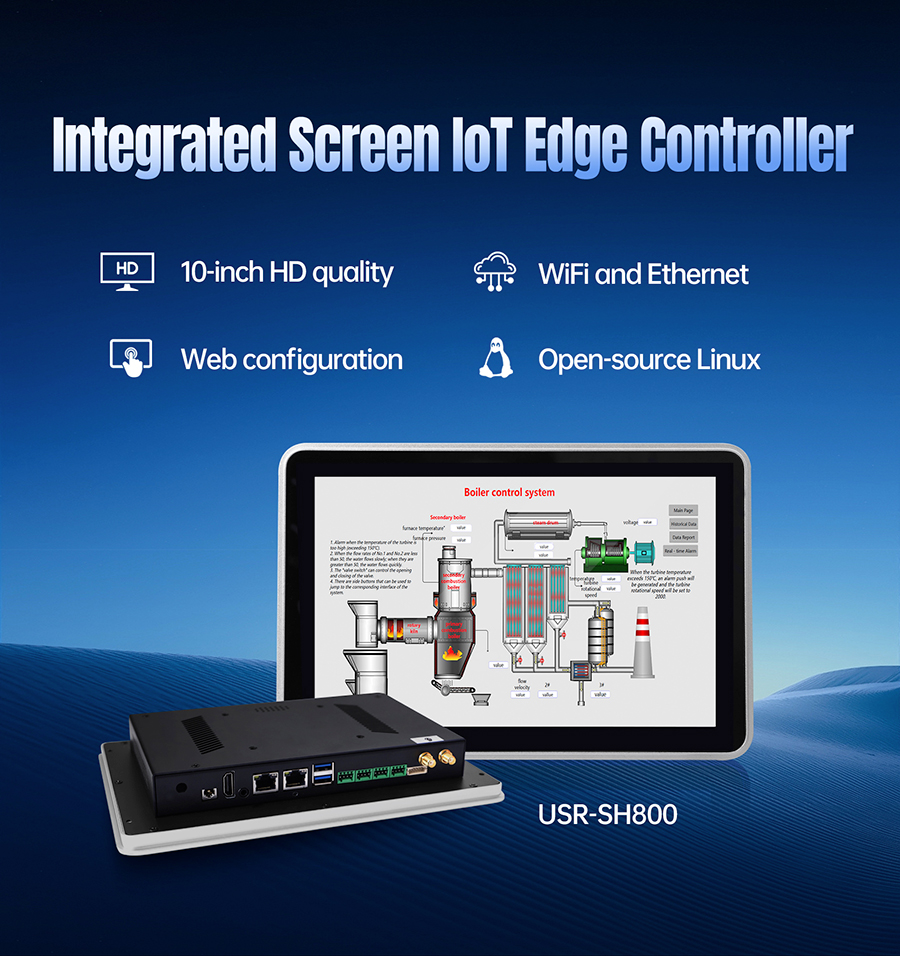
As a highly integrated industrial panel PC, USR-SH800 offers the following advantages in technical architecture and functional design:
Full Protocol Compatibility: Supports 20+ industrial protocols, including BACnet, Modbus, KNX, DALI, and ONVIF, without requiring additional gateways.
Edge Computing Capability: Equipped with a quad-core processor and 1GB RAM, it runs lightweight AI models locally for real-time decision-making.
Multi-Screen Interaction: Provides synchronized 10.1-inch capacitive touchscreens, mobile apps, and web interfaces to meet diverse scenario needs.
Security Protections: Certified to China's Classified Protection 2.0 Level 3, it supports encrypted data transmission and device authentication to resist cyberattacks.
Open Ecosystem: Offers RESTful API interfaces for seamless integration with ERP, CRM, and other systems, expanding application scenarios.
Typical Application: In a smart campus project, USR-SH800 integrated 12 device types, including air conditioning, lighting, security, elevators, and charging stations, enabling "single-screen management of the entire building." Equipment failure rates dropped by 50%, and O&M efficiency tripled.
Industrial panel PC are not just tools for device integration but transformers of building operation models. Through system integration, enterprises can achieve:
Cost Optimization: Reduce hardware investment and O&M labor, lowering total cost of ownership (TCO).
Efficiency Gains: Improve fault response speeds by 80% by shifting from "manual inspections" to "proactive alerts."
Experience Upgrades: Deliver personalized, seamless spatial services to enhance user retention.
Sustainability: Support carbon neutrality goals through energy optimization and carbon management.
Actionable Recommendations: If your building faces challenges such as:
Independent operation of air conditioning, lighting, and security systems with inefficient management.
Severe energy waste lacking data-driven optimization solutions.
Weak security protections vulnerable to cyberattacks.
High O&M costs due to the absence of a unified management platform.
Contact us to obtain a building automation solution featuring the USR-SH800 industrial panel PC and complimentary on-site survey services, turning integration technology into an accelerator for your digital transformation.


















