December 31, 2025
Application of Industrial Panel PC in Smart Healthcare
Application of Industrial Panel PC in Smart Healthcare: How to Ensure Data Security through HIPAA Certification?
Data Security Concerns amid the Smart Healthcare Wave
In the wave of digital transformation, smart healthcare is reshaping the industry landscape with a compound annual growth rate of 15%. From remote monitoring to AI-assisted diagnosis, and from intelligent infusion management to full-process electronic medical records, IoT technology has penetrated every aspect of medical services. However, when medical devices are interconnected through the IoT, the risk of leakage of patients' health information (PHI) also grows exponentially. According to the HIMSS 2025 report, 72% of global medical data breaches stem from security vulnerabilities in IoT devices, with an average loss of up to $4.2 million per incident.
Against this backdrop, the Health Insurance Portability and Accountability Act (HIPAA) in the United States has become the gold standard for global medical data security. It requires medical institutions to implement three core principles of "minimum access, full encryption, and dynamic auditing" for electronic PHI (ePHI) and ensure compliance through technical certifications. This article will provide an in-depth analysis of how industrial panel PC can build a data security defense line through HIPAA certification and offer professional advice on hardware selection for medical institutions.
1. Core Requirements of HIPAA Certification and Their Technical Mapping
1.1 Compliance Challenges of the Three Security Pillars
The HIPAA security rule constructs a protection system around three dimensions: administrative safeguards, physical safeguards, and technical safeguards, imposing the following strict requirements on IoT devices:
Data Encryption: All ePHI must be encrypted using AES-256 or an equivalent-strength algorithm during transmission and storage.
Access Control: Role-based access control (RBAC) should implement the "principle of least privilege." For example, nurses can only view the medical records of patients under their care.
Audit Trails: All access behaviors should record timestamps, user IDs, and operation types and be retained for at least six years.
Device Certification: IoT terminals must pass FIPS 140-2 certification to ensure the reliability of hardware-level security modules (such as TPMs).
1.2 Typical Risk Scenarios for Medical IoT Devices
Scenario 1: Unauthorized Access to Smart Infusion Terminals
A top-tier hospital once experienced a patient drug overdose incident due to a hacker tampering with the infusion rate parameters because the infusion pump had not enabled TLS encryption. HIPAA requires that such devices must enforce two-way authentication and generate independent session keys for each communication.
Scenario 2: Data Leakage from Interactive Large Screens at Nurse Stations
Traditional touchscreens often lead to ePHI theft due to default passwords and open USB interfaces. HIPAA-compliant solutions require disabling all physical interfaces and implementing two-factor authentication through biometrics + dynamic tokens.
Scenario 3: Loss Risk of Mobile Nursing PDAs
If a device does not have remote wipe functionality enabled, the loss of the device may lead to the leakage of data on hundreds of patients. HIPAA requires that devices be equipped with geofencing, automatically locking and reporting security incidents when outside the hospital premises.
2. Implementation Path for HIPAA Compliance of Industrial Panel PC
2.1 Hardware-Level Security Design: Full-Chain Protection from Chips to Interfaces
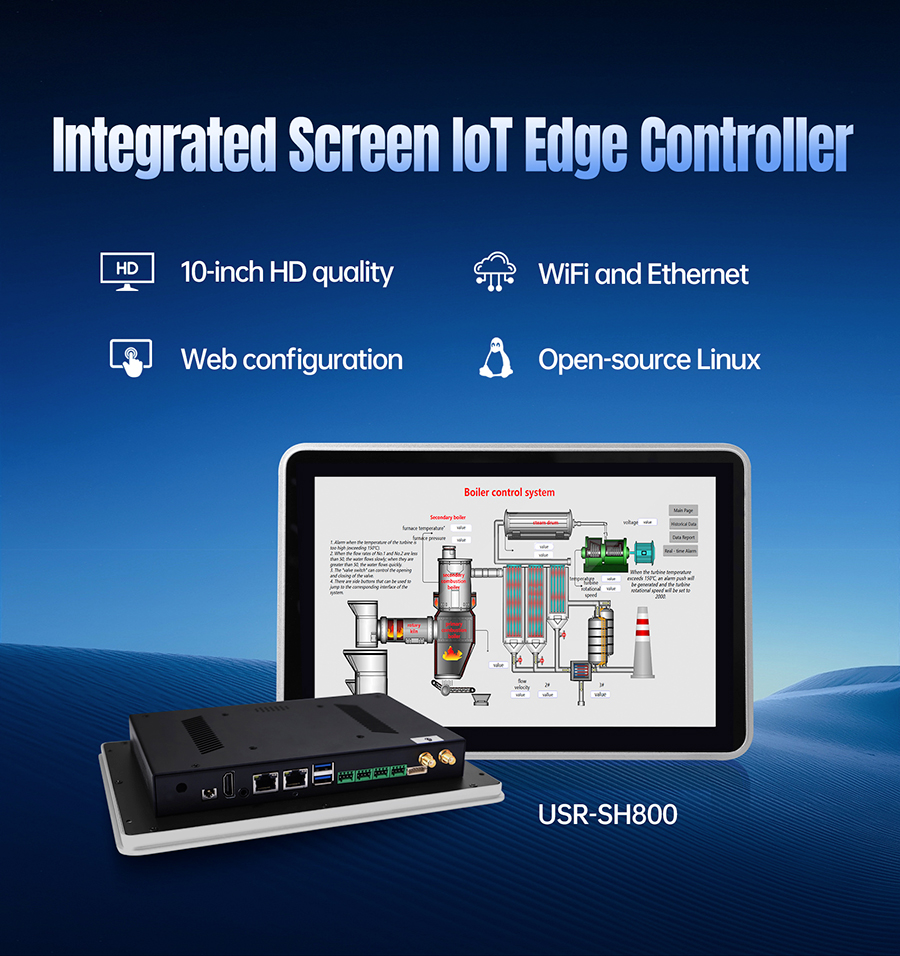
Taking the USR-SH800 industrial panel PC as an example, its security architecture includes the following key components:
Secure Encryption Chip: Integrates dual-algorithm engines of the national cryptographic SM4 and AES-256, supporting hardware-level key generation and storage to avoid the risk of key leakage at the software layer.
Trusted Execution Environment (TEE): Isolates sensitive operations through ARM TrustZone technology to ensure that the ePHI processing process is physically isolated from other parts of the system.
Physical Interface Control: All USB/HDMI interfaces are disabled by default, and data transmission is only allowed through secure gateways, with each connection requiring dynamic authorization.
Anti-Tamper Design: An accelerometer is built into the back of the screen, and data self-destruct mechanisms are triggered immediately upon illegal disassembly.
2.2 Software-Level Security Mechanisms: Dynamic Protection and Intelligent Auditing
Multi-Factor Authentication System: Supports triple authentication of fingerprint + dynamic password + NFC card. The device is automatically locked and reports to the security center if authentication fails more than three times.
Data Transmission Encryption: Adopts the TLS 1.3 protocol and the ECDHE key exchange algorithm to ensure forward secrecy during communication. Even if the key is leaked, historical data cannot be decrypted.
Behavior Auditing Engine: Builds user behavior baselines based on machine learning, and immediately triggers alarms for abnormal operations (such as accessing sensitive medical records during non-working hours).
Automatic Compliance Check: Built-in HIPAA compliance check tools scan system configurations daily, automatically generate rectification reports, and push them to security administrators.
2.3 Compliance Practices in Typical Application Scenarios
Scenario 1: Smart Ward Interactive Platform
Data Display Compliance: Patient information is presented in a card-based format, displaying only necessary fields such as nursing level and allergy history, while hiding sensitive information such as ID numbers.
Operation Tracking: All operations such as medical order execution and vital sign recording record the operator, time, and values before and after modification to support forensic evidence.
Emergency Response: The device is equipped with an emergency button. After being pressed, the screen is locked within 3 seconds, the security system is notified, and the operation logs of the last 10 seconds are uploaded simultaneously.
Scenario 2: IoT Terminals in Operating Rooms
Sterile Environment Adaptation: Adopts an IP65-rated dustproof and waterproof design and supports gloved touch operations to avoid device damage due to the disinfection process.
Data Isolation: Surgical images and patient medical records are transmitted through separate channels. Image data is encrypted using the DICOM standard, and medical record data is encrypted through the HL7 protocol.
Device Interconnection Security: When communicating with anesthesia machines, monitors, and other devices, the digital certificates of the devices must be verified to prevent counterfeit devices from accessing the surgical network.
3. Selection Guide for Medical-Grade Industrial Panel PC
3.1 Core Evaluation Dimensions
Dimension
Key Indicators
Security Certification
Whether it has passed HIPAA, HITECH, ISO 27001 certifications, and whether the encryption chip complies with FIPS 140-2 Level 3
Data Encryption
Supported algorithm types (AES-256/SM4/RSA-3072), whether it has hardware acceleration capabilities
Log field completeness (whether it includes client IP and operation results), storage period (whether it is ≥ 6 years)
Environmental Adaptability
Operating temperature range (-20°C to 60°C), protection level (IP65/IP67), anti-electromagnetic interference capability
3.2 Advantages Analysis of the USR-SH800 Product
As an industrial panel PC specifically designed for medical scenarios, the USR-SH800 excels in the following aspects:
Full-Scenario Security Coverage: From wards to operating rooms, from outpatient clinics to ambulances, it supports wide-temperature operation from -20°C to 60°C and has anti-electromagnetic interference up to the IEC 61000-4-6 Level 4 standard.
Intelligent Compliance Management: Built-in HIPAA compliance check engine can automatically generate rectification reports, reducing compliance costs for medical institutions by more than 30%.
Ultimate User Experience: 10-point capacitive touch supports gloved operations with a response time of ≤ 5 ms, ensuring efficient interaction in emergency scenarios.
Ecosystem Openness: Provides an SDK to support seamless integration with HIS, EMR, and other systems and has completed compatibility certifications with mainstream vendors such as Donghua Mediway and Winning Health.
4. Implementation Recommendations: Full-Process Optimization from Selection to Deployment
4.1 Phase 1: Requirement Analysis and Risk Assessment
Identify High-Risk Scenarios: Prioritize the reinforcement of terminals handling PHI, such as nurse stations, operating rooms, and ICUs.
Establish Security Baselines: Define device configuration standards according to HIPAA requirements, such as disabling USB interfaces and setting a mandatory screen lock time of ≤ 5 minutes.
4.2 Phase 2: Device Deployment and Integration Testing
Regional Pilot Testing: Select 1-2 wards for pilot testing to verify the compatibility of the devices with existing systems.
Penetration Testing: Commission third-party security agencies to simulate attacks, focusing on testing vulnerabilities such as authentication bypass and data leakage.
4.3 Phase 3: Operation and Maintenance and Continuous Improvement
Establish a Security Operations Center (SOC): Monitor device status in real-time and automatically respond to abnormal behaviors.
Regular Compliance Reviews: Conduct a HIPAA gap analysis every quarter and update security policies and device configurations.
5. Starting a New Chapter in Smart Healthcare with Security as the Foundation
With the number of medical IoT devices exceeding 5 billion today, data security is no longer a technical option but a survival necessity. By choosing industrial panel PC that have passed HIPAA certification, medical institutions can not only avoid legal risks but also win patient trust and gain an edge in digital transformation.
Contact us to obtain detailed technical specifications and customized solutions for the USR-SH800, making security the core competitiveness of your smart healthcare strategy!
Industrial Gateways Ranked First in China by Online Sales for Seven Consecutive Years* Source: Frost & Sullivan; Based on the "2026 China Online Channel Industrial Gateways Market Independent Market Research Report" (2019-2025)
We use cookies to ensure that we give you the best
experience on our website. If you continue to use this site we will assume that you are happy with it.