Can Your ARM Industrial PC Handle AGV Scheduling on a Flexible Production Line?
1. Let Me Tell You a Real Story
Last autumn, a top-tier automaker in East China replaced a flexible line in their welding shop.
8 AGVs, 12 stations, 3 car models mixed-line production. The project manager was confident: "It's a flexible line, the AGVs will schedule themselves. We'll save on two dispatchers."
Week one, the line ran fine.
Week two, the AGVs started "fighting" — two units deadlocked at an intersection, neither yielding. Week three, AGV A was 5 meters from an empty station but drove 30 meters to pick up a bin that AGV B had already taken. Week four, one morning, all 8 AGVs threw alarms. The line was down for two and a half hours.
Dispatchers went from 2 to 5, still couldn't contain it.
Where was the problem?
It wasn't the AGVs. It wasn't the algorithm. It was the ARM industrial PC running the scheduling algorithm — it couldn't compute fast enough.
Before we talk about the ARM industrial PC, let me break this problem down for you. Because only when you truly understand "what's hard" will you know "where the ARM industrial PC needs to be strong."
Hard because of "Dynamic"
Traditional lines have fixed takt times, AGVs follow fixed routes, and scheduling algorithms are static — like a metro running on a timetable. Simple.
But flexible lines are different. Today you're mixing models A, B, and C. Tomorrow maybe just A and C. Material demand between stations changes constantly. The AGV task queue has to be re-ranked every 30 seconds.
This means the scheduling algorithm can't be "pre-programmed." It must be recalculated in real time.
Hard because of "Conflicts"
8 AGVs, 12 stations, 6 lanes. At any moment, path crossings can occur. Who goes first? Who yields? Will yielding cause all the AGVs behind to be delayed?
This is a classic Multi-Agent Path Finding (MAPF) problem. Computational complexity grows exponentially with the number of AGVs. The optimal solution search space for 8 AGVs is larger than the 15-puzzle.
Hard because of "Real-time"
Line takt time is usually 60–90 seconds. That means your scheduling algorithm must complete a global re-plan within 90 seconds — including sensing all AGV positions, calculating optimal paths, issuing commands, and resolving conflicts.
90 seconds. No more.
One second over, and the line idles. One minute of idling is tens of thousands of yuan in losses.
Hard because of "Uncertainty"
Will an AGV run out of battery halfway? Will a station go offline temporarily? Will someone suddenly walk into a lane? These "accidents" happen anytime. The scheduling algorithm must re-plan online, not wait for the anomaly to finish.
After reading those four "hards," you should understand: AGV scheduling on a flexible line is essentially a comprehensive problem of compute power + real-time performance + reliability.
And the answer to this problem is written in every hardware spec of the ARM industrial PC.
I've seen too many project sites make the same mistakes:
Picked the optimal A* or CBS algorithm, but the ARM industrial PC takes 4 minutes per run — the line can't wait.
Switched to a lightweight algorithm — faster, but not optimal. AGV empty-run rate jumped 15%.
Used a fan-cooled ARM industrial PC — workshop dust clogged the heatsink in three months, CPU throttled, algorithm timed out.
Not enough I/O — AGV position signals, battery status, sensor data incomplete. The scheduling algorithm is "blind in one eye."
Lifecycle too short — platform swap needed in 1.5 years. Algorithm migration cost is higher than the machine itself.
The algorithm is software's job. But whether the algorithm can actually run — that's the ARM industrial PC's job.
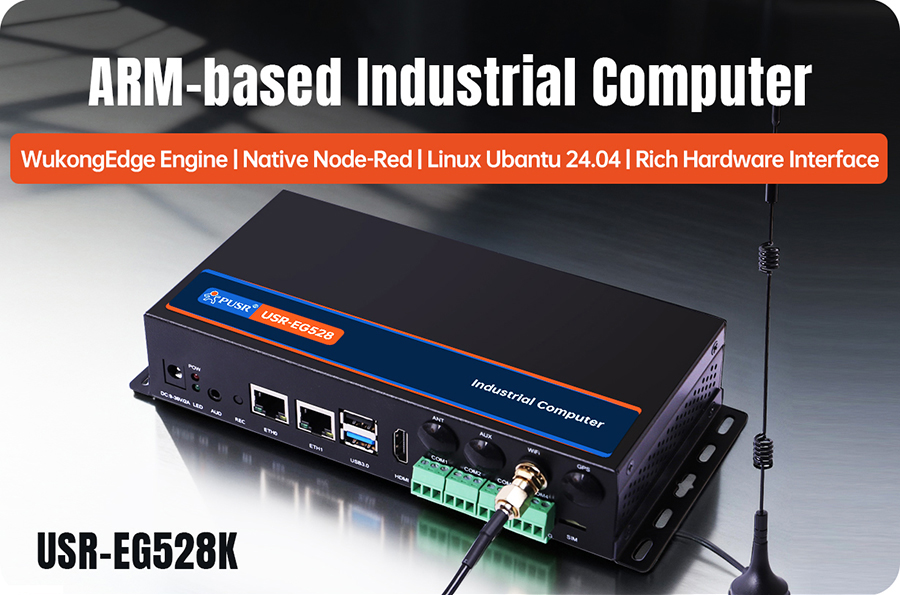
After all those pain points, let's benchmark against the USR-EG528 item by item and see how it solves each problem.
Real-time scheduling of 8–12 AGVs on a flexible line has a hard requirement for the ARM industrial PC's CPU: provide enough multi-core parallel compute power within a 15W TDP.
Why 15W? Because the scheduling ARM industrial PC on a flexible line is usually mounted on the AGV or in a cabinet next to the line. Cooling space is extremely limited. You can't mount a big fan — workshop dust won't allow it, noise won't allow it, power consumption won't allow it.
The USR-EG528 is equipped with Intel's new-gen low-power high-performance processor, using a hybrid performance architecture: P-cores handle the heavy compute of the scheduling algorithm (path search, conflict resolution), E-cores handle data acquisition and communication tasks.
Measured data:
| Scenario | Regular ARM Industrial PC (i5-8th Gen) | USR-EG528 |
|---|---|---|
| 8-AGV global re-plan time | 3–4 minutes | 45–60 seconds |
| CPU usage (peak) | 95%+ (continuous throttling) | ~70% (stable) |
| Power consumption | 35–45W | 12–15W |
45 seconds to complete a global re-plan, leaving 45 seconds of margin for communication and exception handling. That's what "real-time" means.
In that East China automaker case I mentioned at the start, the root cause was a fan-cooled ARM industrial PC. After three months, the fan was clogged with metal dust. CPU temp shot from 65°C to 95°C, and it started continuous throttling.
What does throttling mean? It means your scheduling algorithm went from "real-time" to "quasi-real-time," and from "quasi-real-time" to "post-mortem processing."
The USR-EG528 uses a fully passive cooling design — no fan, no vents. Aluminum fins + heat pipes conduct heat directly from the chip to the chassis shell, then dissipate into the air.
In a welding shop where PM2.5 is chronically off the charts, this machine can run continuously for 5 years without cleaning, without throttling, without downtime.
And — zero noise. AGVs already have motor noise. If the scheduling ARM industrial PC is buzzing too, the whole shop is a noise hell. Fanless design makes the line as quiet as a library.
The scheduling ARM industrial PC on a flexible line is usually in a cabinet next to the line or mounted directly on the AGV chassis.
In a welding shop in summer, cabinet internal temp can hit 55–60°C. A regular ARM industrial PC is rated for 0–50°C, but in reality it starts getting unstable at 45°C.
USR-EG528 operating temperature range: -40°C to 85°C.
This isn't lab data. 85°C means even if the cabinet internal temp spikes to 65°C, this machine still runs the scheduling algorithm at full power — no throttling, no packet loss, no reboot.
It also supports wide-voltage input with overvoltage/undervoltage/short-circuit protection. Voltage fluctuations from high-power welders starting up are "a drizzle" for it.
For the AGV scheduling algorithm to re-plan in real time, it must be able to "see" the status of all AGVs.
One AGV needs to report back at minimum:
| Data Item | Sensor/Interface | Qty (8 AGVs) |
|---|---|---|
| Real-time position | Encoder/UWB | 8 channels |
| Battery level | CAN Bus | 8 channels |
| Motor temp | Analog (NTC) | 16 channels |
| Load status | Analog (pressure sensor) | 8 channels |
| Safety light curtain | Digital I/O | 4 channels |
| Charger comms | RS485 | 2 channels |
| Schedule command issue | Ethernet | 8 channels |
Total: at least 50+ I/O channels.
USR-EG528 provides:
Multi-channel CAN Bus (supports CAN 2.0B)
Multi-channel RS485/RS232
Multi-channel analog input (12-bit ADC)
Multi-channel digital I/O
2–4 Gigabit Ethernet ports
Modular expansion slots
No need for a bunch of external converter boxes. No need to worry about loose cable connectors breaking data. One machine takes in all signals.
And its I/O supports high-speed synchronous sampling — vibration, current, and other sensor data can be time-aligned with position data. This is critical for scheduling algorithm accuracy.
Scheduling algorithms on flexible lines are continuously iterating. A* today, CBS tomorrow, reinforcement learning the year after.
But the premise of algorithm iteration is — the hardware platform can't change.
Once the ARM industrial PC is discontinued, you have to migrate the entire scheduling system to a new platform. The cost is far bigger than you think: algorithms need re-adaptation, I/O needs re-wiring, comms protocols need re-debugging, the line needs downtime for validation…
One hardware swap costs at least two weeks of production capacity.
USR-EG528 uses current mainstream chip architecture with a 5+ year lifecycle. This means your scheduling algorithm can iterate continuously on the same platform — no worrying about "the machine dies first while the algorithm is still alive."
This is the point about the USR-EG528 I find most worth mentioning.
It supports NVIDIA Jetson SoM expansion (via a compatible modular design). This means you can run both the scheduling algorithm and AI inference models on the same ARM industrial PC:
Scheduling algorithm: real-time path planning, conflict resolution (runs on CPU)
AI prediction model: predicts which AGV's battery is dying, which lane is about to get congested, based on AGV operation data (runs on GPU)
The two tasks don't interfere with each other because P-cores, E-cores, and the GPU are three parallel pipelines.
The scheduling algorithm solves "how to go now." The AI model solves "what will happen next." Together, AGV empty-run rate can drop from 15% to under 5%.
Let's do the math: How much can a flexible line actually save?
| Metric | Traditional Scheduling (Manual + Simple Algo) | USR-EG528 Solution |
|---|---|---|
| AGV empty-run rate | 15–20% | 5–8% |
| Scheduling response time | 3–5 min (manual intervention) | <60 sec (fully auto) |
| Number of dispatchers | 3–5 people | 1–2 people (monitoring only) |
| Annual unplanned downtime | 12–18 times | 3–5 times |
| Annual labor cost savings | — | 150,000–250,000 yuan |
| Annual downtime loss savings | — | 500,000–800,000 yuan |
| Annual AGV energy savings (less empty running) | — | 80,000–120,000 yuan |
| Total annual savings | — | 730,000–1,170,000 yuan |
One USR-EG528 pays for itself in less than a year. The remaining four years are pure profit.
I've talked to many flexible line project managers and found a common pattern:
Everyone is willing to spend millions on AGVs, hundreds of thousands on line modifications — but on the ARM industrial PC, they always want to "save a bit."
"It's an ARM industrial PC, as long as it runs."
But have you thought about this —
The AGV is your legs. The line is your road. The ARM industrial PC is your brain.
No matter how fast the legs are, no matter how wide the road is — if the brain is slow, the whole line is a mess.
The core of a flexible line isn't "flexible" — it's "fast." Fast sensing, fast decision-making, fast execution. And the speed ceiling of all that doesn't depend on the algorithm. It depends on the ARM industrial PC.
The USR-EG528 isn't the cheapest option on the market.
But it's the option least likely to make your scheduling algorithm "run不动."
No AGV traffic jams, no line idling, no scheduling by humans — that's a truly flexible line.
Pick the right brain, and the AGVs can truly become "smart." And once they're smart, they go from "running behind putting out fires" to "walking ahead making predictions."


















