Design Secrets for AGV Embedded Single Board Computer with 30% Power Savings: Low-Power Architecture and Dynamic Power Management in Practice
In the wave of smart manufacturing and intelligent logistics, Automated Guided Vehicles (AGVs) and Autonomous Mobile Robots (AMRs) have become key tools for improving efficiency and reducing costs. However, as application scenarios become increasingly complex, the battery life and energy efficiency of AGVs have gradually become bottlenecks restricting their widespread adoption. How to achieve low-power operation of embedded single board computers while ensuring high performance has become an urgent challenge for engineers. This article will deeply analyze the design secrets for AGV embedded single board computers that save 30% power, and through practical strategies of low-power architecture and dynamic power management, solve deep pain points for customers and empathize with every pursuit of energy efficiency.
In busy logistics centers or automated production lines, AGVs act as tireless porters, shuttling between workstations and performing heavy material handling tasks. However, behind high-intensity work lies enormous energy consumption and frequent charging demands. For customers, this not only means high operating costs but may also affect overall production efficiency due to downtime caused by charging. Therefore, improving the energy efficiency of AGVs and extending their battery life has become one of the most urgent needs for customers.
Traditional AGV embedded single board computers often adopt general-purpose designs without fully considering low-power requirements, resulting in persistently high energy consumption during long-term operation. Especially in scenarios requiring 24-hour uninterrupted operation, range anxiety has become an invisible shackle restricting AGV applications. Customers have to frequently schedule charging times and even increase the number of backup AGVs to cope with potential downtime risks.
Improving energy efficiency means reducing energy consumption and lowering operating costs. However, while pursuing energy efficiency, customers also face the dual considerations of performance and cost. How to maximize energy efficiency while ensuring stable AGV operation and efficient task processing has become an important factor for customers when choosing embedded single board computers.
To achieve the power-saving goals for AGV embedded single board computers, low-power architecture design is the key. By optimizing hardware selection, circuit design, and system architecture, energy consumption can be reduced from the source, providing strong support for long-term AGV operation.
In the design of embedded single board computers, the selection of core components such as processors, memory, and communication modules is crucial. Choosing low-power, high-performance chips can effectively reduce energy consumption while ensuring processing capability. For example, adopting ARM architecture-based low-power processors can achieve lower power consumption at the same performance level compared to traditional x86 architectures. Meanwhile, selecting processors with Dynamic Voltage and Frequency Scaling (DVFS) capabilities allows dynamic adjustment of operating frequency and voltage based on task load, further reducing energy consumption.
Circuit design is another critical aspect of low-power architecture. By streamlining circuit structures and reducing unnecessary signal transmission and conversion, energy loss in circuits can be minimized. At the same time, adopting efficient power management circuits, such as the reasonable combination of Low Dropout Regulators (LDOs) and switching power supplies (DC-DC), can maximize power conversion efficiency while meeting the power supply requirements of different components.
System architecture design also affects the energy efficiency of embedded single board computers. Adopting a layered architecture to isolate modules with different functions can reduce mutual interference between modules and improve system stability and energy efficiency. Meanwhile, through reasonable task scheduling algorithms, high-load tasks can be distributed across different time slots for execution, preventing the processor from remaining in a high-power state for extended periods, thereby optimizing energy efficiency.
In addition to low-power architecture design, Dynamic Power Management (DPM) is another important means to achieve the power-saving goals for AGV embedded single board computers. By monitoring system load and power status in real time and dynamically adjusting the power supply strategy for each component, power can be supplied on demand, avoiding energy waste.
The first step in dynamic power management is load monitoring. Through built-in sensors and monitoring circuits, the load conditions of core components such as processors, memory, and communication modules are perceived in real time. Based on the load level, the supply voltage and current are dynamically adjusted to ensure components operate at the lowest power consumption while meeting performance requirements.
Based on load monitoring results, the dynamic power management system can intelligently switch the operating modes of the embedded single board computer. For example, in idle or low-load states, the processor can be downclocked or put into sleep mode, and unnecessary communication modules and peripherals can be turned off to reduce overall power consumption. In high-load states, the processor frequency is rapidly increased and all necessary modules are activated to ensure efficient system operation.
During AGV operation, actions such as braking and deceleration generate a large amount of regenerative energy. By integrating an energy recovery system, such as supercapacitors or battery packs, this energy can be recovered and stored, and used to power the embedded single board computer or other components when needed. This not only achieves energy reuse but also further extends the battery life of AGVs.
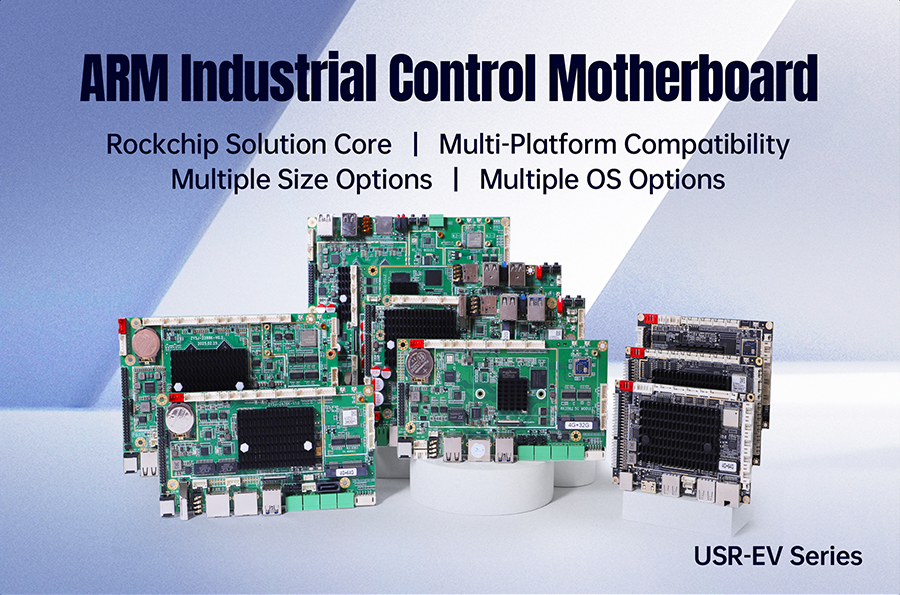
Among numerous AGV embedded single board computers, the USR-EV series stands out with its excellent low-power design and dynamic power management capabilities. Below, we will deeply analyze its power-saving approach through actual application cases of the USR-EV series.
The USR-EV series adopts ARM Cortex-A series low-power processors, combined with advanced manufacturing processes and DVFS technology, achieving a perfect balance between performance and power consumption. At the same time, unnecessary energy losses are reduced through optimized circuit design, improving power conversion efficiency. In terms of memory, low-power DDR memory and NAND Flash storage are selected to further reduce static power consumption.
The USR-EV series has a built-in advanced dynamic power management system capable of monitoring system load and power status in real time and intelligently switching operating modes. In idle or low-load states, the system automatically enters low-power mode, turning off unnecessary modules and peripherals; while in high-load states, the processor frequency is rapidly increased to ensure efficient system operation. In addition, the USR-EV series supports energy recovery functionality, achieving braking energy recovery and reuse through integrated supercapacitors.
In actual applications, the USR-EV series embedded single board computer has demonstrated remarkable power-saving effects. Compared to traditional embedded single board computers, the USR-EV series reduces energy consumption by over 30% under the same task load. This not only extends the battery life of AGVs, reduces charging frequency and downtime, but also saves customers significant operating costs. Meanwhile, the stable operation and efficient processing capability of the USR-EV series have also won unanimous praise from customers.
In the wave of smart manufacturing and intelligent logistics, the energy efficiency of AGVs has become a bottleneck restricting their widespread application. Through practical strategies of low-power architecture design and dynamic power management, we can not only achieve the power-saving goals for AGV embedded single board computers but also solve deep pain points for customers, improving overall production efficiency and operational benefits. The USR-EV series embedded single board computer, as a leader in this field, has won market recognition with its excellent low-power design and dynamic power management capabilities. In the future, we will continue to dedicate ourselves to the R&D and innovation of energy efficiency technologies, empathizing with every pursuit of energy efficiency, and contributing more to the development of smart manufacturing and intelligent logistics.


















