In accompanying enterprises through their digital transformation journey, we have observed a pattern: many enterprises have already completed device networking, data collection, and visualization dashboards. Yet as data continues to accumulate, new challenges emerge — are these data truly serving business operations? Are they genuinely helping enterprises solve practical problems?
In the past, many enterprises building IoT systems focused on:
●How many devices to connect
●How much data to collect
●How much information to display
These capabilities address the questions of "how to connect devices" and "how to present data." But when the system truly serves business operations, enterprises need to further answer:
●When a device malfunctions, how is it detected promptly?
●When business risks arise, how are they anticipated in advance?
●After an issue occurs, who is responsible for handling it? How is the resolution tracked?
Therefore, a genuinely valuable IoT application does more than connect devices and display data — it helps enterprises:
Complete business tasks and solve practical problems.
The next phase of IoT is not about connecting more devices to the cloud. More importantly, it is about:
Connecting devices, data, and business processes together.
A complete business scenario needs to align with enterprise objectives, bringing together:
Devices · Data · Rules · Workflows · Personnel
For example:
●Devices must not only be "visible," but also able to assess operational status.
●Alerts must not only be "issued," but also notify the right person.
●Issues must not only be "discovered," but also tracked continuously until resolved.
This is how PUSR Cloud truly serves business.
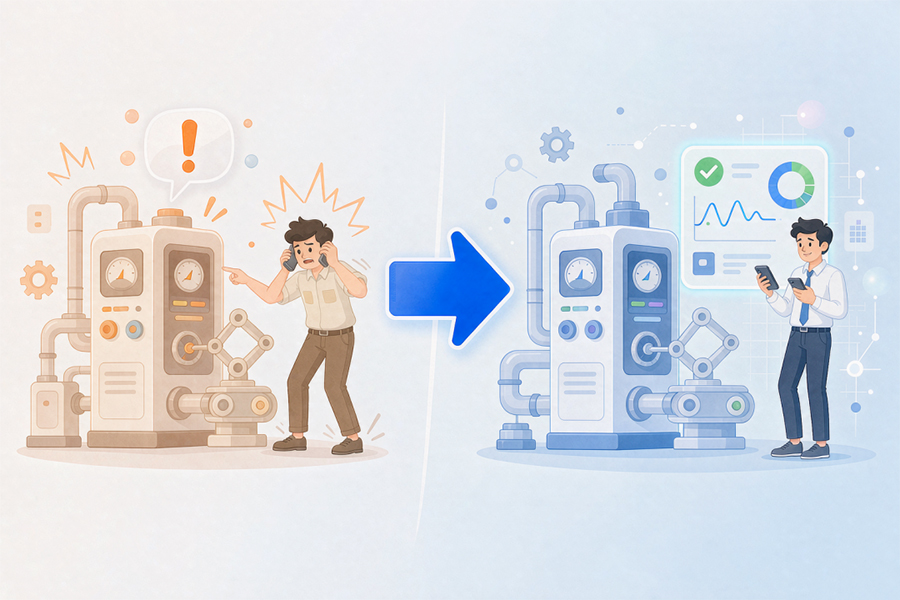
▲ From reactive patrol to platform-driven proactive management
Taking equipment management in a manufacturing enterprise as an example, the core task the enterprise truly wants to accomplish is:
Reduce equipment failure risk and improve operational efficiency.
▍ In the past:
●Equipment inspectors performed daily rounds, relying on experience to judge conditions.
●Equipment anomalies were often discovered only after failures occurred.
●Fault handling lacked records, making it difficult to track.
▍ When equipment management moves to the cloud:
●Equipment data is aggregated in real time.
●Device status becomes uniformly visible.
●Abnormal parameters are automatically identified.
●Risks trigger early alerts.
●Issue resolution processes are continuously tracked.
The equipment management approach shifts from:
Manual inspection, reactive response → Real-time sensing, early warning, closed-loop handling.
A genuinely valuable IoT application is not a single dashboard displaying data. It is a business task around which devices, data, and business rules work together.
For example:
Equipment anomaly → Platform assesses risk → Alert triggered → Responsible person notified → Enters handling workflow → Ultimately completes the loop.
The value of a scenario lies in making digital capabilities truly integrated into business processes.
In PUSR Cloud, a "scenario" is not a page — it is a set of digital capabilities built around a business task. A scenario can:
●Associate multiple devices
●Aggregate data from different devices
●Perform combination calculations based on business needs
●Configure business judgment rules
●Recreate on-site operational status through scenario composition
This allows enterprises to rapidly build their own digital scenarios based on their specific business requirements.
Different industries face different tasks:
● Manufacturing: Equipment anomalies detected earlier, fault handling closed faster.
● Water Management: Distributed pump stations under unified supervision, reducing manual monitoring pressure.
● Environmental Protection: Monitoring data stays continuously online, abnormalities detected promptly.
● Agriculture: Environmental changes sensed in real time, early alerts for anomalies.
Industries differ, business objectives differ. But the end result is always the same:
Make the frontline more transparent, management more efficient, and decision-making more intelligent.
The true value of an IoT project is not about launching a system — it is about making business tasks actually run.
You may want to reconsider three questions:
① What is the core task your business most wants to accomplish?
② Do your current devices and data truly support this task?
③ When an anomaly occurs, is there already a complete workflow of detection, assessment, and resolution?
If your current IoT project still remains at "device networking + data display," then the next phase should start from business tasks, rebuilding your enterprise's own digital scenarios.
PUSR Cloud: From connecting devices to building business scenarios;
Let every device create value, let every business scenario achieve digital transformation.